
人类胰腺癌单细胞图谱揭示了CXCL10+成纤维细胞与基底亚型肿瘤细胞之间的关联。
Human Pancreatic Cancer Single-Cell Atlas Reveals Association of CXCL10+ Fibroblasts and Basal Subtype Tumor Cells.
作者信息
Loveless Ian M, Kemp Samantha B, Hartway Kailee M, Mitchell Jacob T, Wu Yuesong, Zwernik Samuel D, Salas-Escabillas Daniel James, Brender Sydney, George Madison, Makinwa Yetunde, Stockdale Thais, Gartrelle Kendyll, Reddy Rohit G, Long Daniel W, Wombwell Allison, Clark Julie M, Levin Albert M, Kwon David, Huang Ling, Francescone Ralph, Vendramini-Costa Débora B, Stanger Ben Z, Alessio Adam, Waters Andrew M, Cui Yuehua, Fertig Elana J, Kagohara Luciane T, Theisen Brian, Crawford Howard C, Steele Nina G
机构信息
Department of Public Health Sciences, Center for Bioinformatics, Henry Ford Health, Detroit, Michigan.
Medical Imaging and Data Integration Lab, Department of Computational Mathematics, Science, and Engineering, Michigan State University, East Lansing, Michigan.
出版信息
Clin Cancer Res. 2025 Feb 17;31(4):756-772. doi: 10.1158/1078-0432.CCR-24-2183.
PURPOSE
Pancreatic ductal adenocarcinoma (PDAC) patients with tumors enriched for the basal-like molecular subtype exhibit enhanced resistance to standard-of-care treatments and have significantly worse overall survival compared with patients with classic subtype-enriched tumors. It is important to develop genomic resources, enabling identification of novel putative targets in a statistically rigorous manner.
EXPERIMENTAL DESIGN
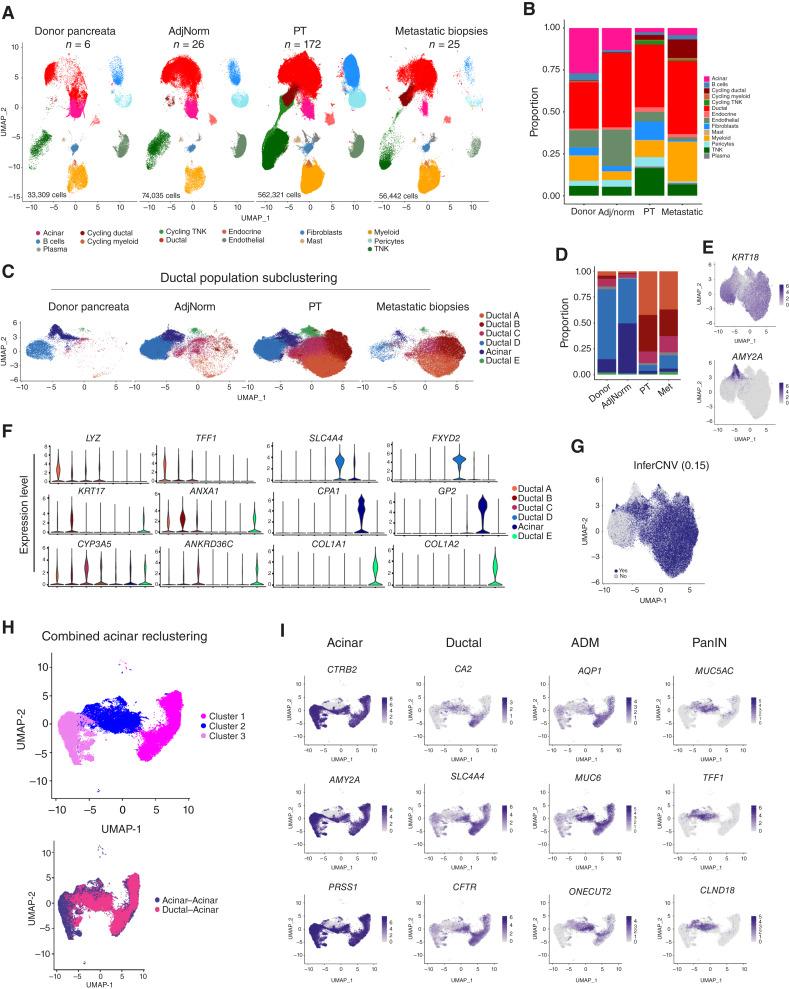
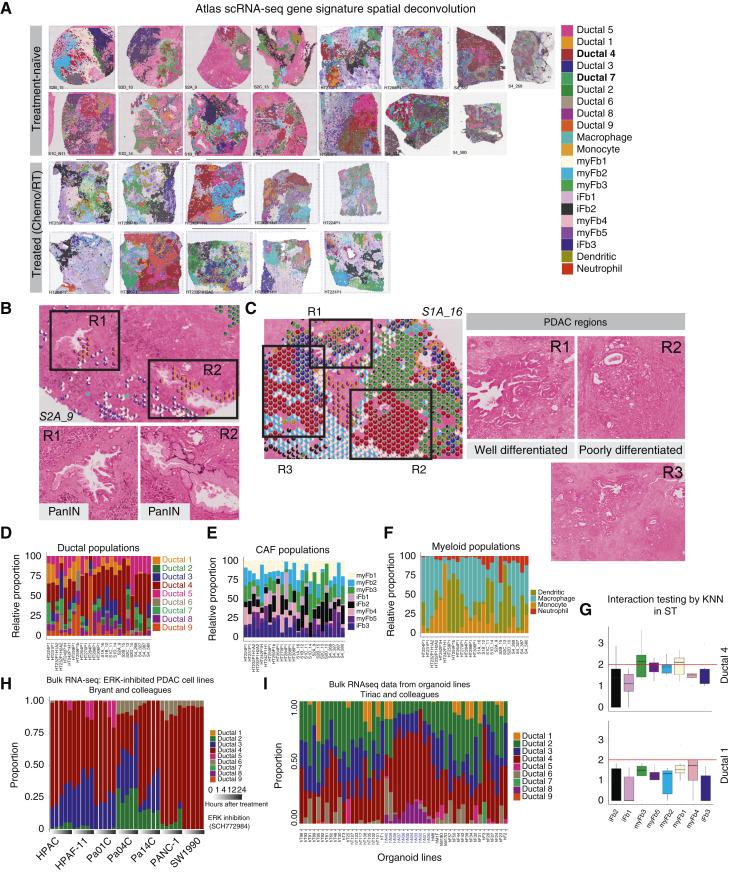
We compiled a single-cell RNA sequencing (scRNA-seq) atlas of the human pancreas with 229 patient samples aggregated from publicly available raw data. We mapped cell type-specific scRNA-seq gene signatures in bulk RNA-seq (n = 744) and spatial transcriptomics (ST; n = 22) and performed validation using multiplex immunostaining.
RESULTS
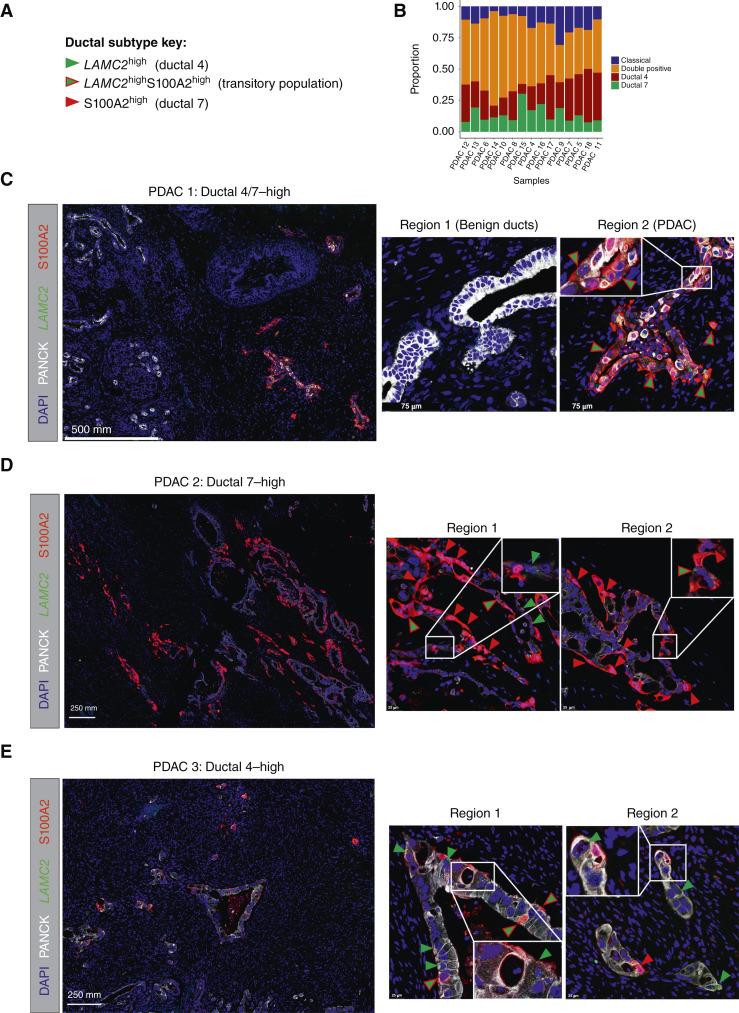
Analysis of tumor cells from our scRNA-seq atlas revealed nine distinct populations, two of which aligned with the basal subtype, correlating with worse overall survival in bulk RNA-seq. Deconvolution identified one of the basal populations to be the predominant tumor subtype in nondissociated ST tissues and in vitro tumor cell and patient-derived organoid lines. We discovered a novel enrichment and spatial association of CXCL10+ cancer-associated fibroblasts with basal tumor cells. We identified that besides immune cells, ductal cells also express CXCR3, the receptor for CXCL10, suggesting a relationship between these cell types in the PDAC tumor microenvironment.
CONCLUSIONS
We show that our scRNA-seq atlas (700,000 cells), integrated with ST data, has increased statistical power and is a powerful resource, allowing for expansion of current subtyping paradigms in PDAC. We uncovered a novel signaling niche marked by CXCL10+ cancer-associated fibroblasts and basal tumor cells that could be explored for future targeted therapies.
目的
与富含经典分子亚型肿瘤的患者相比,胰腺导管腺癌(PDAC)中富含基底样分子亚型肿瘤的患者对标准治疗的耐药性增强,总生存期显著更差。开发基因组资源以能够以统计学严谨的方式鉴定新的假定靶点非常重要。
实验设计
我们从公开可用的原始数据中汇总了229例患者样本,编制了人类胰腺的单细胞RNA测序(scRNA-seq)图谱。我们在批量RNA测序(n = 744)和空间转录组学(ST;n = 22)中绘制了细胞类型特异性scRNA-seq基因特征,并使用多重免疫染色进行验证。
结果
对我们scRNA-seq图谱中的肿瘤细胞分析揭示了九个不同的群体,其中两个与基底亚型一致,与批量RNA测序中较差的总生存期相关。反卷积确定其中一个基底群体是未解离的ST组织以及体外肿瘤细胞和患者来源类器官系中的主要肿瘤亚型。我们发现CXCL10 + 癌症相关成纤维细胞与基底肿瘤细胞有新的富集和空间关联。我们确定除免疫细胞外,导管细胞也表达CXCL10的受体CXCR3,这表明在PDAC肿瘤微环境中这些细胞类型之间存在关系。
结论
我们表明,我们的scRNA-seq图谱(700,000个细胞)与ST数据相结合,具有更高的统计效力,是一种强大的资源,可用于扩展目前PDAC的亚型分类模式。我们发现了一个以CXCL10 + 癌症相关成纤维细胞和基底肿瘤细胞为特征的新信号微环境,可用于未来的靶向治疗探索。


 Zotero 插件