
药物诱导的钠通道阻滞及心脏传导变化概述:对药物安全性的影响
An overview of drug-induced sodium channel blockade and changes in cardiac conduction: Implications for drug safety.
作者信息
Chaudhary Khuram W, Clancy Colleen E, Yang Pei-Chi, Pierson Jennifer B, Goldin Alan L, Koerner John E, Wisialowski Todd A, Valentin Jean-Pierre, Imredy John P, Lagrutta Armando, Authier Simon, Kleiman Robert, Sager Philip T, Hoffmann Peter, Pugsley Michael K
机构信息
Bristol Myers Squibb, New Brunswick, New Jersey, USA.
Department of Physiology and Membrane Biology, University of California Davis, Davis, California, USA.
出版信息
Clin Transl Sci. 2024 Dec;17(12):e70098. doi: 10.1111/cts.70098.
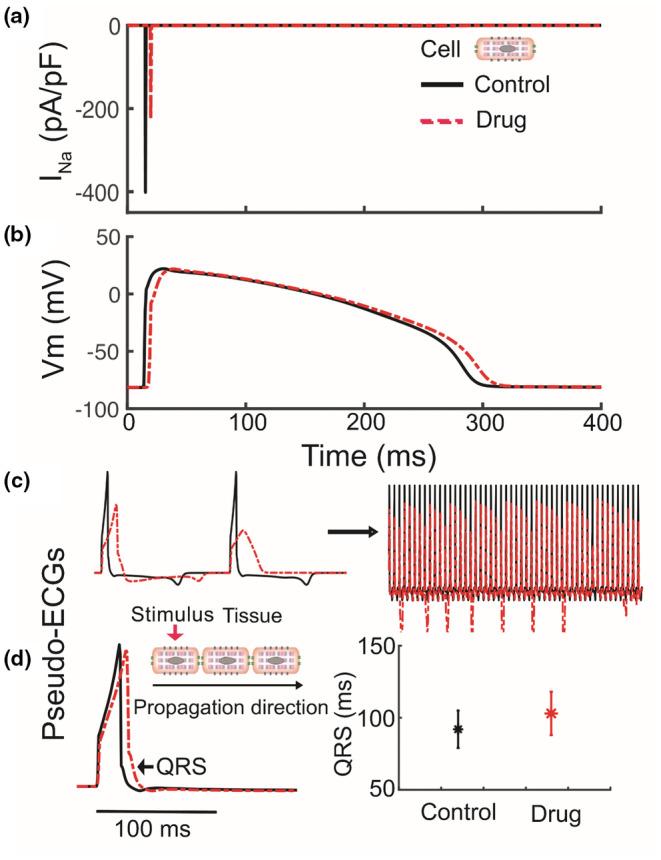
The human voltage-gated sodium channel Na1.5 (hNa1.5/SCN5A) plays a critical role in the initiation and propagation of action potentials in cardiac myocytes, and its modulation by various drugs has significant implications for cardiac safety. Drug-dependent block of Na1.5 current (I) can lead to significant alterations in cardiac electrophysiology, potentially resulting in conduction slowing and an increased risk of proarrhythmic events. This review aims to provide a comprehensive overview of the mechanisms by which various pharmacological agents interact with Na1.5, focusing on the molecular determinants of drug binding and the resultant electrophysiological effects. We discuss the structural features of Na1.5 that influence drug affinity and specificity. Special attention is given to the concept of state-dependent block, where drug binding is influenced by the conformational state of the channel, and its relevance to therapeutic efficacy and safety. The review also examines the clinical implications of I block, highlighting case studies of drugs that have been associated with adverse cardiac events, and how the Vaughan-Williams Classification system has been employed to qualify "unsafe" sodium channel block. Furthermore, we explore the methodologies currently used to assess I block in nonclinical and clinical settings, with the hope of providing a weight of evidence approach including in silico modeling, in vitro electrophysiological assays and in vivo cardiac safety studies for mitigating proarrhythmic risk early in drug discovery. This review underscores the importance of understanding Na1.5 pharmacology in the context of drug development and cardiac risk assessment.
人类电压门控钠通道Na1.5(hNa1.5/SCN5A)在心肌细胞动作电位的起始和传播中起着关键作用,其受各种药物的调节对心脏安全性具有重要意义。药物依赖性阻断Na1.5电流(I)可导致心脏电生理发生显著改变,可能导致传导减慢和心律失常事件风险增加。本综述旨在全面概述各种药理剂与Na1.5相互作用的机制,重点关注药物结合的分子决定因素以及由此产生的电生理效应。我们讨论了影响药物亲和力和特异性的Na1.5的结构特征。特别关注状态依赖性阻断的概念,即药物结合受通道构象状态的影响,以及其与治疗效果和安全性的相关性。该综述还研究了I阻断的临床意义,强调了与不良心脏事件相关的药物的案例研究,以及如何使用Vaughan-Williams分类系统来界定“不安全”的钠通道阻断。此外,我们探索了目前用于在非临床和临床环境中评估I阻断的方法,希望提供一种证据权重方法,包括计算机模拟、体外电生理测定和体内心脏安全性研究,以便在药物发现早期减轻心律失常风险。本综述强调了在药物开发和心脏风险评估背景下理解Na1.5药理学的重要性。
 Zotero 插件