
环状RNA CDR1as/ciRS-7——实体瘤中的一种新型生物标志物。
Circular RNA CDR1as/ciRS-7- a novel biomarker in solid tumors.
作者信息
Zhang Yun, Xiong Chanyu, Jiang Zhilin, Wang Xiao, Ji Juanjuan, Pan Yan, Yu Tianshu, Wang Zihao, Zhu Lin, Yue Yumei, Li Qiong, Wang Haizhen, Zhu Shikai, Zhou Yu
机构信息
Sichuan Provincial Key Laboratory for Human Disease Gene Study, Genome Sequencing Center, Department of Laboratory Medicine, Sichuan Provincial People's Hospital, School of Medicine, University of Electronic Science and Technology of China, Chengdu, China.
Organ Transplant Center, Sichuan Provincial Key Laboratory for Clinical Immunology Translational Medicine, School of Medicine, Sichuan Provincial People's Hospital, University of Electronic Science and Technology of China, Chengdu, China.
出版信息
Front Oncol. 2024 Nov 29;14:1468363. doi: 10.3389/fonc.2024.1468363. eCollection 2024.
INTRODUCTION
Circular RNA CDR1as/ciRS-7 has been reported to function as an oncogenic regulator in various cancers. However, the prognostic value of CDR1as/ciRS-7 expression in solid tumors remains unclear. Herein, we conducted an updated meta-analysis to investigate the association between CDR1as/ciRS-7 expression and clinical outcomes in solid tumors.
METHODS
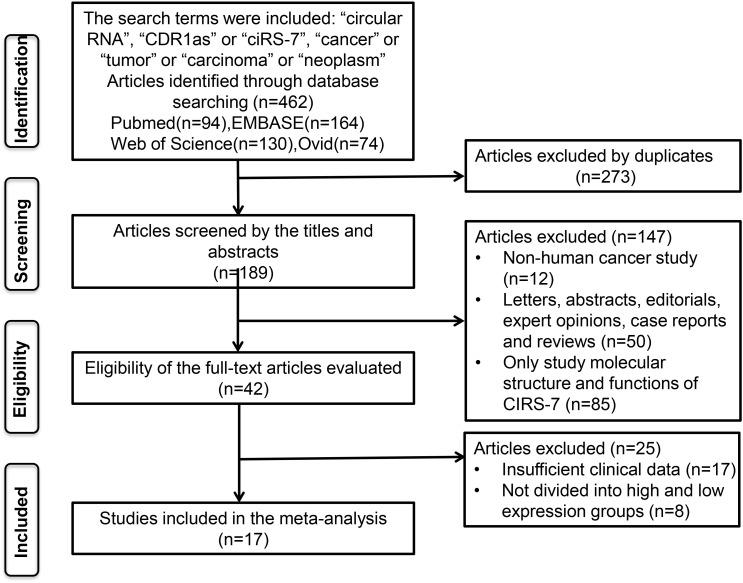
A systematic search was performed through the PubMed, EMBASE, Web of Science, and Ovid databases for eligible studies on clinical values of CDR1as/ciRS-7 in solid tumors. The pooled hazard ratios (HRs) or odd ratios (ORs) with 95% confidence intervals (CIs) were used to evaluate the correlation between CDR1as/ciRS-7 and clinical outcomes.
RESULTS
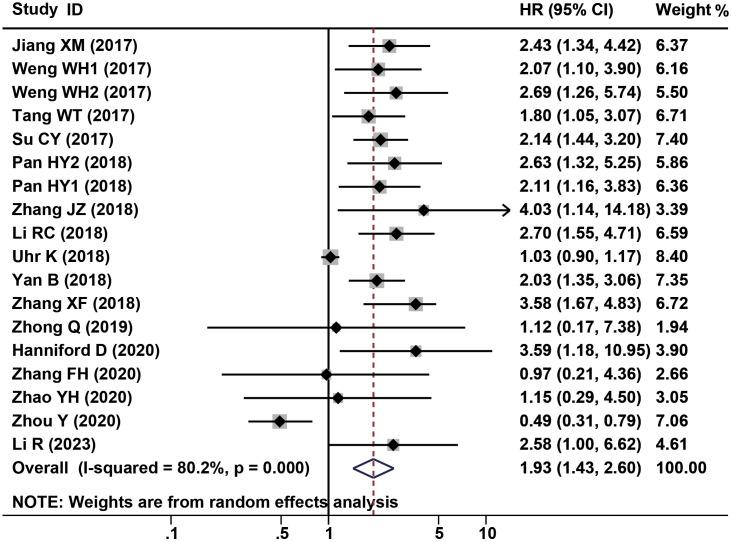
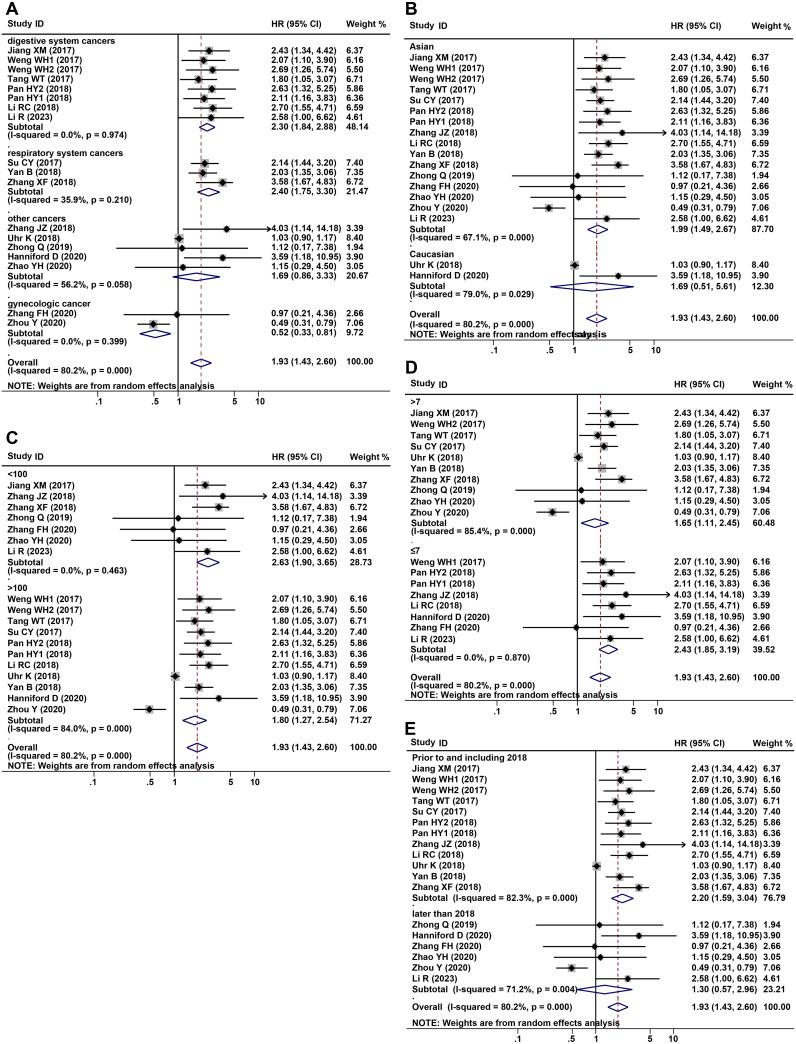
A total of 2424 patients from 17 studies between 2017 and 2023 were included. The results suggested that elevated CDR1as/ciRS-7 expression predicted a poor overall survival (OS) for 12 types of solid tumors (HR=1.93, 95% CI: 1.43-2.60, P<0.001) with no heterogeneity (I2 = 80.2%, P<0.001). Stratified analysis indicated that there was a negative relationship between CDR1as/ciRS-7 expression and OS in digestive system cancers (HR=2.30, 95% CI: 1.84-2.88, P<0.001), and respiratory cancers (HR=2.40, 95% CI: 1.75-3.30, P<0.001). Furthermore, we also revealed that CDR1as/ciRS-7 was positively related to tumor size (OR=2.11, 95%CI: 1.64-2.71, P<0.001), TNM stage (OR=2.05, 95%CI: 1.65-2.54, P<0.001), lymph node metastasis (LNM) (OR=1.74, 95%CI: 1.38-2.21, P<0.001), and distant metastasis (OR=2.79, 95%CI: 1.71-4.55, P<0.001). Although the probable evidence of publication bias was found in the studies with OS, tumor size, TNM stage, and LNM, the trim and fill analysis confirmed the reliability of these results was not affected.
CONCLUSION
Elevated CDR1as/ciRS-7 expression was associated with larger tumor size, advanced TNM stage, worse LNM, distant metastasis, and shorter OS, suggesting that CDR1as/ciRS-7 may act as an independent prognostic biomarker in solid tumors.
引言
据报道,环状RNA CDR1as/ciRS-7在多种癌症中作为致癌调节因子发挥作用。然而,CDR1as/ciRS-7表达在实体瘤中的预后价值仍不清楚。在此,我们进行了一项更新的荟萃分析,以研究CDR1as/ciRS-7表达与实体瘤临床结局之间的关联。
方法
通过PubMed、EMBASE、Web of Science和Ovid数据库进行系统检索,以获取关于CDR1as/ciRS-7在实体瘤中临床价值的合格研究。采用合并风险比(HRs)或比值比(ORs)及95%置信区间(CIs)来评估CDR1as/ciRS-7与临床结局之间的相关性。
结果
纳入了2017年至2023年间17项研究中的2424例患者。结果表明,CDR1as/ciRS-7表达升高预示着12种实体瘤的总生存期(OS)较差(HR=1.93,95%CI:1.43-2.60,P<0.001),且无异质性(I2 = 80.2%,P<0.001)。分层分析表明,CDR1as/ciRS-7表达与消化系统癌症(HR=2.30,95%CI:1.84-2.88,P<0.001)和呼吸系统癌症(HR=2.40,95%CI:1.75-3.30,P<0.001)的OS呈负相关。此外,我们还发现CDR1as/ciRS-7与肿瘤大小(OR=2.11,95%CI:1.64-2.71,P<0.001)、TNM分期(OR=2.05,95%CI:1.65-2.54,P<0.001)、淋巴结转移(LNM)(OR=1.74,95%CI:1.38-2.21,P<0.001)和远处转移(OR=2.79,95%CI:1.71-4.55,P<0.001)呈正相关。尽管在OS、肿瘤大小、TNM分期和LNM的研究中发现了可能的发表偏倚证据,但剪补分析证实这些结果的可靠性未受影响。
结论
CDR1as/ciRS-7表达升高与更大的肿瘤大小、晚期TNM分期、更差的LNM、远处转移及更短的OS相关,提示CDR1as/ciRS-7可能作为实体瘤中的独立预后生物标志物。


 Zotero 插件