
转录因子与激素受体:癌症治疗的性别特异性靶点(综述)
Transcription factors and hormone receptors: Sex‑specific targets for cancer therapy (Review).
作者信息
Kim Juyeon, Bang Hyobin, Seong Cheyun, Kim Eun-Sook, Kim Sun Young
机构信息
Department of Chemistry, College of Science and Technology, Duksung Women's University, Seoul 01369, Republic of Korea.
College of Pharmacy, Duksung Women's University, Seoul 01369, Republic of Korea.
出版信息
Oncol Lett. 2024 Dec 6;29(2):93. doi: 10.3892/ol.2024.14839. eCollection 2025 Feb.
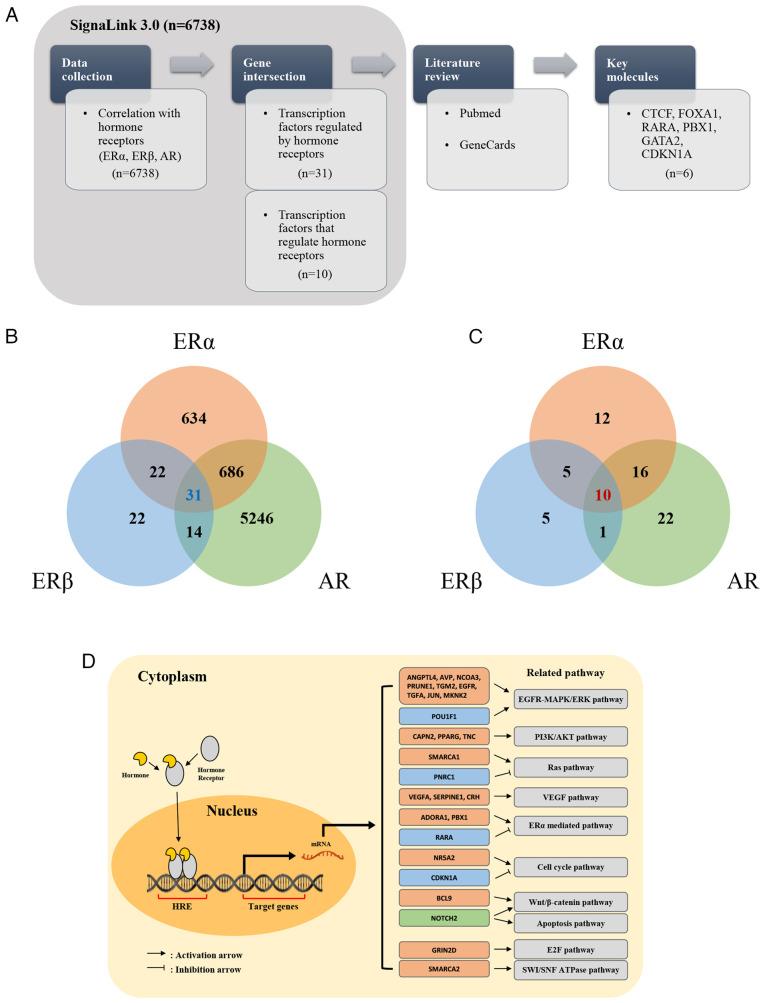
Despite advancements in diagnostic and therapeutic technologies, cancer continues to pose a challenge to disease-free longevity in humans. Numerous factors contribute to the onset and progression of cancer, among which sex differences, as an intrinsic biological condition, warrant further attention. The present review summarizes the roles of hormone receptors estrogen receptor α (ERα), estrogen receptor β (ERβ) and androgen receptor (AR) in seven types of cancer: Breast, prostate, ovarian, lung, gastric, colon and liver cancer. Key cancer-related transcription factors known to be activated through interactions with these hormone receptors have also been discussed. To assess the impact of sex hormone receptors on different cancer types, hormone-related transcription factors were analyzed using the SignaLink 3.0 database. Further analysis focused on six key transcription factors: CCCTC-binding factor, forkhead box A1, retinoic acid receptor α, PBX homeobox 1, GATA binding protein 2 and CDK inhibitor 1A. The present review demonstrates that these transcription factors significantly influence hormone receptor activity across various types of cancer, and elucidates the complex interactions between these transcription factors and hormone receptors, offering new insights into their roles in cancer progression. The findings suggest that targeting these common transcription factors could improve the efficacy of hormone therapy and provide a unified approach to treating various types of cancer. Understanding the dual and context-dependent roles of these transcription factors deepens the current understanding of the molecular mechanisms underlying hormone-driven tumor progression and could lead to more effective targeted therapeutic strategies.
尽管诊断和治疗技术取得了进步,但癌症仍然对人类的无病长寿构成挑战。许多因素导致癌症的发生和发展,其中性别差异作为一种内在的生物学条件,值得进一步关注。本综述总结了激素受体雌激素受体α(ERα)、雌激素受体β(ERβ)和雄激素受体(AR)在七种癌症中的作用:乳腺癌、前列腺癌、卵巢癌、肺癌、胃癌、结肠癌和肝癌。还讨论了已知通过与这些激素受体相互作用而被激活的关键癌症相关转录因子。为了评估性激素受体对不同癌症类型的影响,使用SignaLink 3.0数据库分析了激素相关转录因子。进一步的分析集中在六个关键转录因子:CCCTC结合因子、叉头框A1、视黄酸受体α、PBX同源盒1、GATA结合蛋白2和CDK抑制剂1A。本综述表明,这些转录因子在各种类型的癌症中显著影响激素受体活性,并阐明了这些转录因子与激素受体之间的复杂相互作用,为它们在癌症进展中的作用提供了新的见解。研究结果表明,针对这些常见的转录因子可以提高激素治疗的疗效,并为治疗各种类型的癌症提供统一的方法。了解这些转录因子的双重和依赖背景的作用,加深了目前对激素驱动肿瘤进展的分子机制的理解,并可能导致更有效的靶向治疗策略。

 Zotero 插件