
牙周炎中免疫亲和富集的唾液小细胞外囊泡
Immunoaffinity-enriched salivary small extracellular vesicles in periodontitis.
作者信息
Liu Chun, Seneviratne Chaminda Jayampath, Palma Carlos, Rice Greg, Salomon Carlos, Khanabdali Ramin, Ivanovski Sašo, Han Pingping
机构信息
Epigenetics nanodiagnostic and therapeutic group, Center for Oral-facial Regeneration, Rehabilitation and Reconstruction (COR3), School of Dentistry, The University of Queensland, Brisbane, QLD 4006, Australia.
INOVIQ Limited, Notting Hill, VIC 3168, Australia.
出版信息
Extracell Vesicles Circ Nucl Acids. 2023 Dec 30;4(4):698-712. doi: 10.20517/evcna.2023.48. eCollection 2023.
AIM
aliva extracellular vesicles (EVs) serve as a significant reservoir of biomarkers that may be of clinical use in disease diagnosis. Saliva, however, contains EVs of both host- and bacterial- origin. Identifying suitable EVs for disease diagnosis involves enriching host EVs and limiting non-host contamination with effective isolation methods. The objectives of this research were: (1) to evaluate the salivary EVs enrichment in 12 periodontally healthy patients by two different methods: size exclusion chromatography (SEC) and bead-based immunoaffinity capture (EXO-NET); (2) to analyze the variance expression of inflammatory cytokines in EXO-NET-enriched EVs, comparing individuals with periodontitis ( = 20) to non-periodontitis ( = 12).
METHODS
Whole unstimulated saliva samples were collected from 12 periodontally healthy and 20 periodontitis patients. EVs were isolated from the 12 non-periodontitis patients using SEC (referred to as SEC-EVs) and EXO-NET (referred to as EXO-NET EVs), after which their total protein content, 37 EV surface markers, and bacterial pathogens expression were compared. Subsequently, the inflammatory cytokines expression levels (interleukin-IL-6, IL-1β, IL-8, and IL-10) in EXO-NET EVs were measured for non-periodontitis and periodontitis.
RESULTS
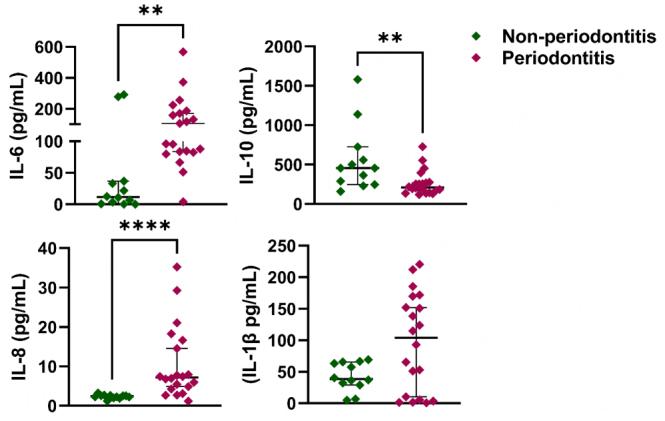
EXO-NET EVs contained more EV-specific protein and substantially higher expression of EV surface markers (CD9, CD81, CD63), but less pathogenic DNA was detected compared to that in SEC-EVs. Additionally, EXO-NET EVs from periodontitis patients contained higher amounts of IL-6 and IL-8, and decreased IL-10, compared to those from non-periodontitis patients.
CONCLUSION
The findings suggest that immunoaffinity capture (EXO-NET) is a dependable method for salivary EVs enrichment, resulting in a higher yield of host EVs with reduced bacterial DNA detection compared to SEC. Furthermore, the research proposes that immunoaffinity capture enriched EVs can function as biomarkers for periodontitis, demonstrated by an increased expression of proinflammatory cytokines from periodontitis patients.
目的
唾液细胞外囊泡(EVs)是生物标志物的重要储存库,可能在疾病诊断中具有临床应用价值。然而,唾液中含有宿主来源和细菌来源的EVs。识别适合疾病诊断的EVs需要通过有效的分离方法富集宿主EVs并限制非宿主污染。本研究的目的是:(1)通过两种不同方法评估12名牙周健康患者唾液中EVs的富集情况:尺寸排阻色谱法(SEC)和基于磁珠的免疫亲和捕获法(EXO-NET);(2)分析EXO-NET富集的EVs中炎症细胞因子的差异表达,比较牙周炎患者(n = 20)和非牙周炎患者(n = 12)。
方法
收集12名牙周健康患者和20名牙周炎患者的未刺激全唾液样本。使用SEC(称为SEC-EVs)和EXO-NET(称为EXO-NET EVs)从12名非牙周炎患者中分离EVs,然后比较它们的总蛋白含量、37种EV表面标志物和细菌病原体表达。随后,测量非牙周炎和牙周炎患者EXO-NET EVs中炎症细胞因子(白细胞介素-IL-6、IL-1β、IL-8和IL-10)的表达水平。
结果
与SEC-EVs相比,EXO-NET EVs含有更多的EV特异性蛋白,EV表面标志物(CD9、CD81、CD63)的表达显著更高,但检测到的致病DNA更少。此外,与非牙周炎患者相比,牙周炎患者的EXO-NET EVs中IL-6和IL-8含量更高,IL-10含量降低。
结论
研究结果表明,免疫亲和捕获法(EXO-NET)是一种可靠的唾液EVs富集方法,与SEC相比,能获得更高产量的宿主EVs,同时减少细菌DNA检测。此外,该研究提出免疫亲和捕获富集的EVs可作为牙周炎生物标志物,牙周炎患者促炎细胞因子表达增加证明了这一点。


 Zotero 插件