
肥胖与多囊卵巢综合征
Obesity and Polycystic Ovary Syndrome.
作者信息
Kim Jin Ju
机构信息
Department of Obstetrics and Gynecology, Seoul National University Hospital Healthcare System Gangnam Center, Seoul, Korea.
Department of Obstetrics and Gynecology, Seoul National University College of Medicine, Seoul, Korea.
出版信息
J Obes Metab Syndr. 2024 Dec 30;33(4):289-301. doi: 10.7570/jomes24035. Epub 2024 Dec 20.
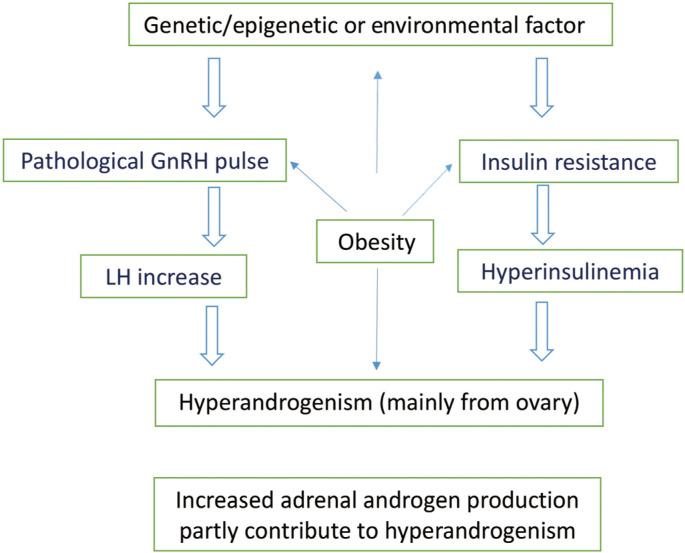
The core pathophysiology of polycystic ovary syndrome involves an overproduction of androgens primarily originating from ovarian thecal cells. Two major external triggers promote androgen overproduction in the ovaries: the increased secretion of luteinizing hormone, a consequence of aberrant hypothalamic gonadotropin-releasing hormone secretion dynamics, and compensatory hyperinsulinemia resulting from insulin resistance. Obesity interacts with polycystic ovary syndrome in multiple ways, but a major role of obesity in its pathophysiology is the exacerbation of insulin resistance. Additionally, obesity contributes to polycystic ovary syndrome by facilitating the conversion of precursor hormones to testosterone within adipose cells. Moreover, obesity can lead to relative hyperandrogenemia, which is marked by lower levels of sex hormone binding globulin and increased availability of free testosterone to target tissues. Also, obesity affects the secretion of gonadotropins, resulting in heightened luteinizing hormone secretion or increased sensitivity of thecal cells to luteinizing hormone. Obesity-related insulin resistance might be amplified by alterations in adipokine and inflammatory cytokine production. Ultimately, obesity and polycystic ovary syndrome might share a common genetic predisposition. The cornerstone of managing polycystic ovary syndrome is to address individual symptoms such as hyperandrogenism (hirsutism, acne, and female type boldness), menstrual irregularities, and infertility stemming from anovulation. However, obesity is integral to the pathophysiology of polycystic ovary syndrome and exacerbates all of its features. Therefore, lifestyle modifications aimed at weight reduction should be the primary strategy in overweight or obese women with polycystic ovary syndrome.
多囊卵巢综合征的核心病理生理学涉及主要源自卵巢卵泡膜细胞的雄激素过度产生。两个主要的外部触发因素促进卵巢雄激素过度产生:促黄体生成素分泌增加,这是下丘脑促性腺激素释放激素分泌动力学异常的结果,以及胰岛素抵抗导致的代偿性高胰岛素血症。肥胖通过多种方式与多囊卵巢综合征相互作用,但其在病理生理学中的主要作用是加剧胰岛素抵抗。此外,肥胖通过促进脂肪细胞内前体激素向睾酮的转化而导致多囊卵巢综合征。此外,肥胖可导致相对性高雄激素血症,其特征是性激素结合球蛋白水平降低,游离睾酮向靶组织的可利用性增加。此外,肥胖会影响促性腺激素的分泌,导致促黄体生成素分泌增加或卵泡膜细胞对促黄体生成素的敏感性增加。肥胖相关的胰岛素抵抗可能因脂肪因子和炎性细胞因子产生的改变而加剧。最终,肥胖和多囊卵巢综合征可能存在共同的遗传易感性。管理多囊卵巢综合征的基石是解决个体症状,如高雄激素血症(多毛、痤疮和女性型脱发)、月经不规律以及无排卵导致的不孕。然而,肥胖是多囊卵巢综合征病理生理学的一个组成部分,并加剧其所有特征。因此,对于超重或肥胖的多囊卵巢综合征女性,旨在减轻体重的生活方式改变应是主要策略。
 Zotero 插件