
软骨靶向肽修饰的氧化铈纳米颗粒减轻骨关节炎中的氧化应激和软骨损伤。
Cartilage-targeting peptide-modified cerium oxide nanoparticles alleviate oxidative stress and cartilage damage in osteoarthritis.
作者信息
Zhuang Huangming, Ren Xunshan, Li Huajie, Zhang Yuelong, Zhou Panghu
机构信息
Department of Orthopedics, Renmin Hospital of Wuhan University, Wuhan, 430060, China.
出版信息
J Nanobiotechnology. 2024 Dec 19;22(1):784. doi: 10.1186/s12951-024-03068-1.
BACKGROUND
Osteoarthritis (OA) is a degenerative joint disease that leads to a substantial decline in the well-being of older individuals. Chondrocyte senescence and the resultant damage to cartilage tissue, induced by elevated levels of reactive oxygen species within the joint cavity, are significant causative factors in OA development. Cerium oxide nanoparticles (CeONPs) present a promising avenue for therapeutic investigation due to their exceptional antioxidant properties. However, the limited effectiveness of drugs in the joint cavity is often attributed to their rapid clearance by synovial fluid.
METHODS
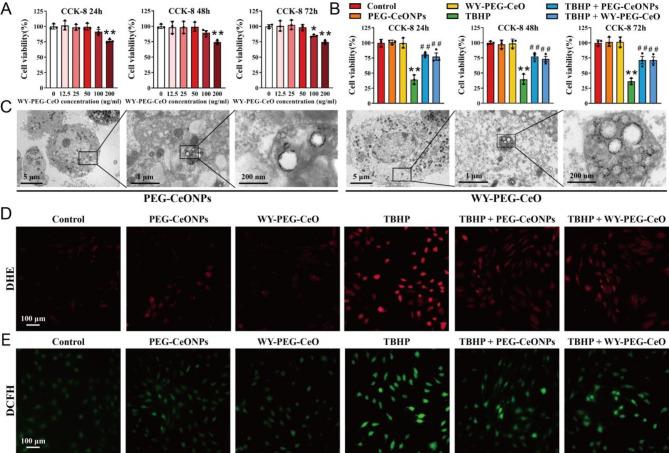
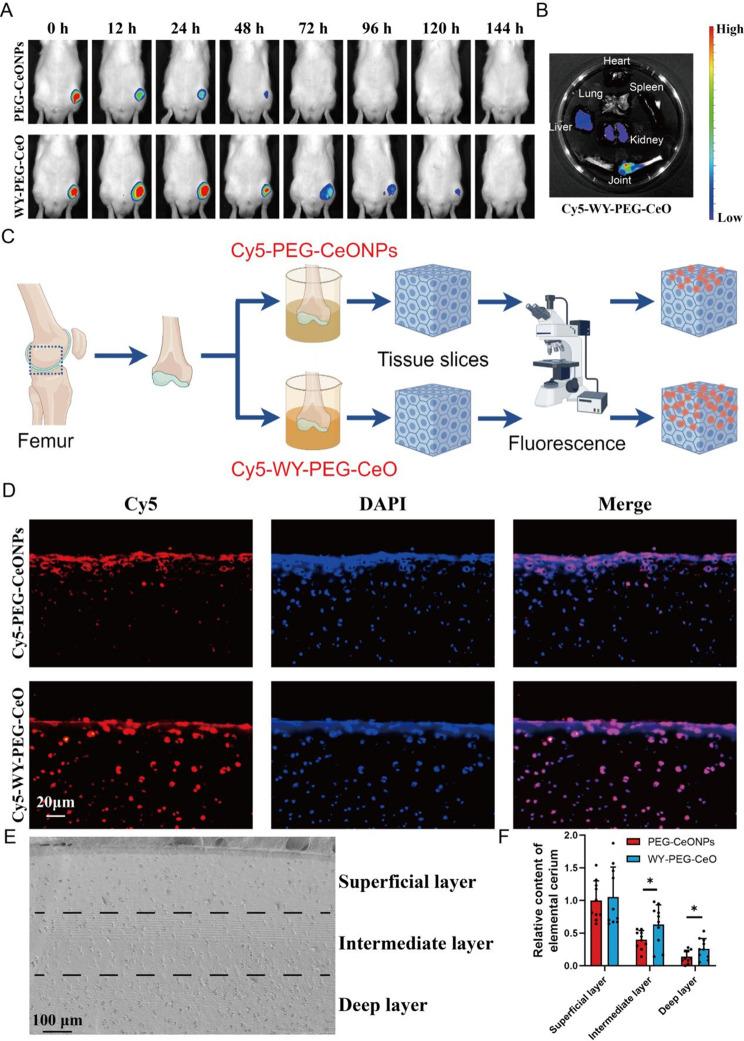
Polyethylene glycol-packed CeONPs (PEG-CeONPs) were synthesized and subsequently modified with the cartilage-targeting peptide WYRGRLGK (WY-PEG-CeO). The antioxidant free radical activity and the mimetic enzyme activity of PEG-CeONPs and WY-PEG-CeO were detected. The impact of WY-PEG-CeO on chondrocytes oxidative stress, cellular senescence, and extracellular matrix degradation was assessed using in vitro assays. The cartilage targeting and protective effects were explored in animal models.
RESULTS
WY-PEG-CeO demonstrated significant efficacy in inhibiting oxidative stress, cellular senescence, and extracellular matrix degradation in OA chondrocytes. The underlying mechanism involves the inhibition of the PI3K/AKT and MAPK signaling pathways. Animal models further revealed that WY-PEG-CeO exhibited a prolonged residence time and enhanced penetration efficiency in cartilage tissue, leading to the attenuation of pathological changes in OA.
CONCLUSIONS
These findings suggest that WY-PEG-CeO exerts therapeutic effects in OA by inhibiting oxidative stress and suppressing the over-activation of PI3K/AKT and MAPK signaling pathways. This investigation served as a fundamental step towards the advancement of CeONPs-based interventions, providing potential strategies for the treatment of OA.
背景
骨关节炎(OA)是一种退行性关节疾病,会导致老年人的健康状况大幅下降。关节腔内活性氧水平升高诱导的软骨细胞衰老以及由此对软骨组织造成的损伤,是OA发展的重要致病因素。由于其卓越的抗氧化性能,氧化铈纳米颗粒(CeONPs)为治疗研究提供了一条有前景的途径。然而,药物在关节腔内的有效性有限通常归因于它们被滑液快速清除。
方法
合成了聚乙二醇包裹的CeONPs(PEG-CeONPs),随后用软骨靶向肽WYRGRLGK(WY-PEG-CeO)进行修饰。检测了PEG-CeONPs和WY-PEG-CeO的抗氧化自由基活性和模拟酶活性。使用体外试验评估了WY-PEG-CeO对软骨细胞氧化应激、细胞衰老和细胞外基质降解的影响。在动物模型中探索了软骨靶向和保护作用。
结果
WY-PEG-CeO在抑制OA软骨细胞的氧化应激、细胞衰老和细胞外基质降解方面显示出显著效果。其潜在机制涉及对PI3K/AKT和MAPK信号通路的抑制。动物模型进一步表明,WY-PEG-CeO在软骨组织中具有延长的停留时间和增强的渗透效率,导致OA病理变化减轻。
结论
这些发现表明,WY-PEG-CeO通过抑制氧化应激和抑制PI3K/AKT及MAPK信号通路的过度激活,在OA中发挥治疗作用。本研究是推进基于CeONPs的干预措施的重要一步,为OA的治疗提供了潜在策略。




 Zotero 插件