
微小RNA组-代谢组全基因组关联研究揭示了微小RNA调控在儿童哮喘嗜酸性粒细胞增多和气流阻塞中的作用。
miRNAome-metabolome wide association study reveals effects of miRNA regulation in eosinophilia and airflow obstruction in childhood asthma.
作者信息
Sharma Rinku, Mendez Kevin, Begum Sofina, Chu Su, Prince Nicole, Hecker Julian, Kelly Rachel S, Chen Qingwen, Wheelock Craig E, Celedón Juan C, Clish Clary, Gertszen Robert, Tantisira Kelan G, Weiss Scott T, Lasky-Su Jessica, McGeachie Michael
机构信息
Channing Division of Network Medicine, Department of Medicine, Brigham and Women's Hospital and Harvard Medical School, Boston, MA, USA.
Channing Division of Network Medicine, Department of Medicine, Brigham and Women's Hospital and Harvard Medical School, Boston, MA, USA; Department of Chemistry, Edith Cowan University, Perth, Australia.
出版信息
EBioMedicine. 2025 Feb;112:105534. doi: 10.1016/j.ebiom.2024.105534. Epub 2024 Dec 30.
BACKGROUND
There are important inter-relationships between miRNAs and metabolites: alterations in miRNA expression can be induced by various metabolic stimuli, and miRNAs play a regulatory role in numerous cellular processes, impacting metabolism. While both specific miRNAs and metabolites have been identified for their role in childhood asthma, there has been no global assessment of the combined effect of miRNAs and the metabolome in childhood asthma.
METHODS
We performed miRNAome-metabolome-wide association studies ('miR-metabo-WAS') in two childhood cohorts of asthma to evaluate the contemporaneous and persistent miRNA-metabolite associations: 1) Genetic Epidemiology of Asthma in Costa Rica Study (GACRS) (N = 1121); 2) the Childhood Asthma Management Program (CAMP) (N = 312 and N = 454). We conducted a meta-analysis of the two cohorts to identify common contemporaneous associations between CAMP and GACRS (false-discovery rate (FDR) = 0.05). We assessed persistent miRNA-metabolome associations using baseline miRNAs and metabolomic profiling in CAMP at the end of the trial. The relation between miRNAs, metabolites and clinical phenotypes, including airway hyper-responsiveness (AHR), peripheral blood eosinophilia, and airflow obstruction, were then assessed via. Mediation analysis with 1000 bootstraps at an FDR significance level of 0.05.
FINDINGS
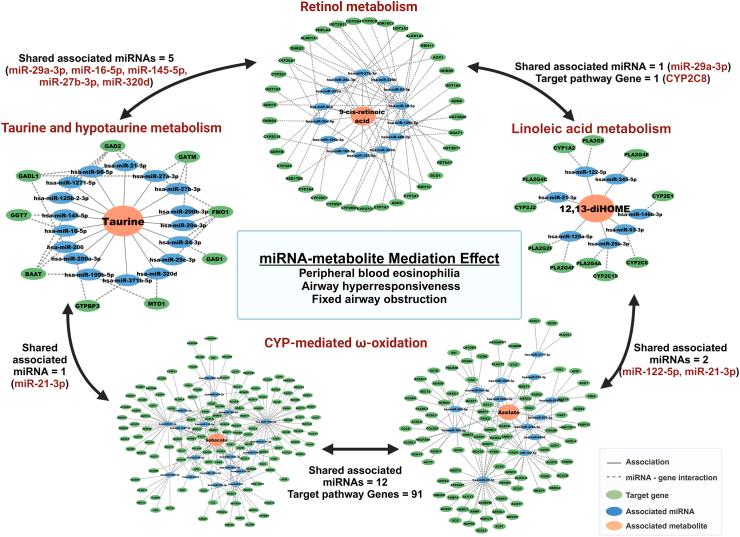
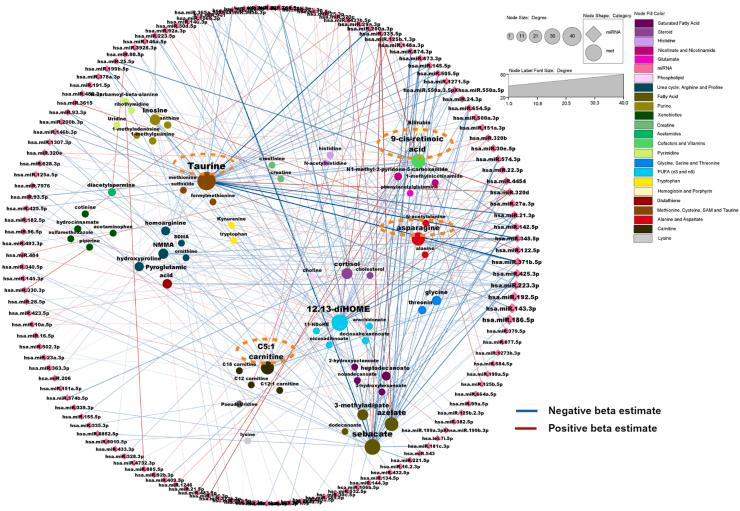
The meta-analysis yielded a total of 369 significant contemporaneous associations, involving 133 miRNAs and 60 metabolites. We identified 13 central hub metabolites (taurine, 12,13-diHOME, sebacate, 9-cis-retinoic acid, azelate, asparagine, C5:1 carnitine, cortisol, 3-methyladipate, inosine, NMMA, glycine, and Pyroglutamic acid) and four hub miRNAs (hsa-miR-186-5p, hsa-miR-143-3p, hsa-miR-192-5p, and hsa-miR-223-3p). Nine of these associations, between eight miRNAs and eight metabolites, were persistent in CAMP from baseline to the end of trial. Finally, five central hub metabolites (9-cis-retinoic acid, taurine, sebacate, azelate, and 12,13-diHOME) were identified as primary mediators in over 100 significant indirect miRNA-metabolite associations, with a collective influence on peripheral blood eosinophilia, AHR, and airflow obstruction.
INTERPRETATION
The robust association between miRNAs and metabolites, along with the substantial indirect impact of miRNAs via 5 hub metabolites on multiple clinical asthma metrics, suggests important integrated effects of miRNAs and metabolites on asthma. These findings imply that the indirect regulation of metabolism and cellular functions by miRNA influences Th2 inflammation, AHR, and airflow obstruction in childhood asthma.
FUNDING
Molecular data for CAMP and GACRS via the Trans-Omics in Precision Medicine (TOPMed) program was supported by the National Heart, Lung, and Blood Institute (NHLBI).
背景
微小RNA(miRNA)与代谢物之间存在重要的相互关系:各种代谢刺激可诱导miRNA表达改变,且miRNA在众多细胞过程中发挥调节作用,影响新陈代谢。虽然已确定特定的miRNA和代谢物在儿童哮喘中发挥的作用,但尚未对miRNA和代谢组在儿童哮喘中的联合效应进行全面评估。
方法
我们在两个儿童哮喘队列中开展了全miRNA组-全代谢组关联研究(“miR-代谢物全基因组关联研究”,即“miR-metabo-WAS”),以评估miRNA与代谢物的同期及持续关联:1) 哥斯达黎加哮喘遗传流行病学研究(GACRS)(N = 1121);2) 儿童哮喘管理项目(CAMP)(N = 312和N = 454)。我们对这两个队列进行了荟萃分析,以确定CAMP和GACRS之间常见的同期关联(错误发现率(FDR)= 0.05)。我们利用CAMP试验结束时的基线miRNA和代谢组学分析评估miRNA-代谢组的持续关联。然后通过在FDR显著性水平为0.05时进行1000次自抽样的中介分析,评估miRNA、代谢物与临床表型之间的关系,包括气道高反应性(AHR)、外周血嗜酸性粒细胞增多和气流阻塞。
结果
荟萃分析共产生369个显著的同期关联,涉及133个miRNA和60种代谢物。我们确定了13种核心枢纽代谢物(牛磺酸、12,13-二羟基十八碳二烯酸、癸二酸、9-顺式视黄酸、壬二酸、天冬酰胺(天冬酰胺)、C5:1肉碱、皮质醇、3-甲基己二酸、次黄嘌呤、N-甲基-D-天冬氨酸、甘氨酸和焦谷氨酸)和4种核心枢纽miRNA(hsa-miR-186-5p、hsa-miR-143-3p、hsa-miR-192-5p和hsa-miR-223-3p)。其中,8个miRNA与8种代谢物之间的9种关联在CAMP中从基线到试验结束时持续存在。最后,5种核心枢纽代谢物(9-顺式视黄酸、牛磺酸、癸二酸、壬二酸和12,13-二羟基十八碳二烯酸)被确定为100多个显著的间接miRNA-代谢物关联中的主要中介物,对外周血嗜酸性粒细胞增多、AHR和气流阻塞具有共同影响。
解读
miRNA与代谢物之间的强关联,以及miRNA通过5种枢纽代谢物对多种临床哮喘指标产生的实质性间接影响,表明miRNA与代谢物对哮喘具有重要的综合作用。这些发现意味着miRNA对代谢和细胞功能的间接调节影响儿童哮喘中的Th2炎症、AHR和气流阻塞。
资助
通过精准医学跨组学(TOPMed)项目获得的CAMP和GACRS的分子数据由美国国立心肺血液研究所(NHLBI)提供支持。


 Zotero 插件