
循环微小RNA与儿童哮喘吸入性糖皮质激素反应:一项维生素D效应修饰随机对照试验干预组的分层分析
Circulating miRNAs and childhood asthma ICS response: a stratified analysis in the intervention arm of an RCT with vitamin D effect modification.
作者信息
Jiang Mingye, Zhang Yunxiao, Liu Tao, Hong Xiaoning, Kho Alvin T, Li Jiang, Gao Yunfei, Sharma Rinku, Celedon Juan Carlos, McGeachie Michael, Weiss Scott, Tantisira Kelan G, Li Jiang
机构信息
Clinical Big Data Research Center, The Seventh Affiliated Hospital of Sun Yat-sen University, Shenzhen, China.
Department of Andrology, The Seventh Affiliated Hospital of Sun Yat-sen University, Shenzhen, Guangdong, China.
出版信息
Thorax. 2025 Jun 4. doi: 10.1136/thorax-2024-222618.
BACKGROUND
miRNAs play a crucial role in the anti-inflammatory effects of inhaled corticosteroids (ICS) in asthma. Vitamin D can modulate the expression of several miRNAs and reduces asthma exacerbations, but its molecular interaction with ICS remains unclear.
OBJECTIVE
We hypothesised that vitamin D influences long-term ICS response through miRNA regulation.
METHODS
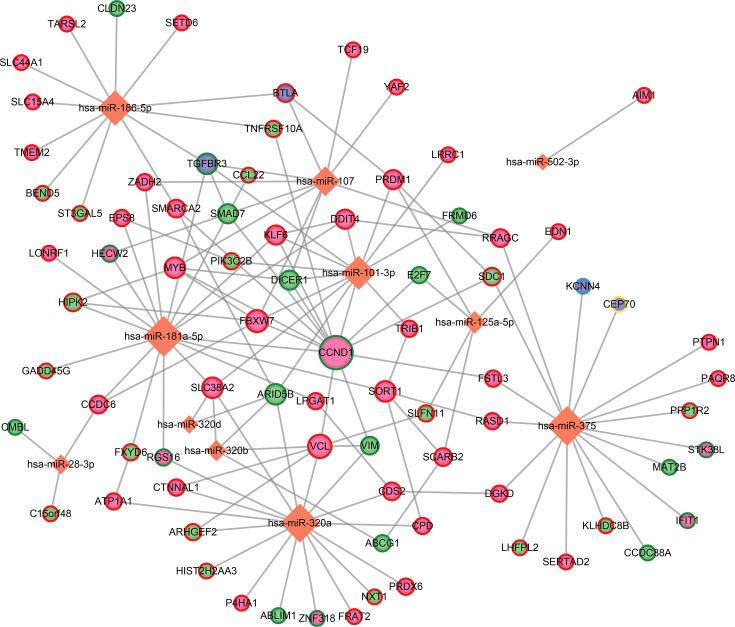
Baseline serum miRNAs were sequenced from 462 subjects in the Childhood Asthma Management Program (CAMP), with 187 randomised to ICS treatment included in this study. Linear regression assessed associations between miRNA expression and prebronchodilator forced expiratory volume in 1 s per cent predicted (FEV%) change over 4 years, stratified by baseline vitamin D levels and tested in interaction models. Microarray analysis of lymphoblastoid B cells (lymphoblastoid cell lines (LCLs)) from 22 CAMP subjects treated with dexamethasone (DEX), vitamin D or sham identified differentially expressed genes (DEGs). An miRNA target gene network was constructed, clustered and annotated by enrichment analysis. Top miRNAs were evaluated for ICS response prediction.
RESULTS
12 miRNAs were significantly associated with ICS-mediated FEV% change in vitamin D insufficient subjects, and 11 miRNAs showed significant interaction with vitamin D (p≤0.05). Three miRNAs were approximately replicated in the Genetics of Asthma in Costa Rica Study. Microarray analysis identified 220 and 240 DEGs in DEX and vitamin D-treated LCLs, respectively. miRNAs hsa-miR-125a-5p, hsa-miR-181a-5p, hsa-miR-101-3p and hsa-miR-107 were enriched in haemopoiesis and leucocyte differentiation pathways (p≤0.05). Two miRNAs, hsa-miR-125a-5p and hsa-miR-181a-5p, predicted ICS response with an area under the receiver operating characteristic curve of 0.86 in the vitamin D insufficient group.
CONCLUSIONS
Vitamin D may modulate ICS response through miRNAs involved in immune cell differentiation, which could serve as biomarkers for ICS response, particularly in vitamin D insufficient individuals.
背景
微小RNA(miRNA)在吸入性糖皮质激素(ICS)对哮喘的抗炎作用中起关键作用。维生素D可调节多种miRNA的表达并减少哮喘发作,但其与ICS的分子相互作用仍不清楚。
目的
我们假设维生素D通过miRNA调节影响ICS的长期反应。
方法
对儿童哮喘管理项目(CAMP)中462名受试者的基线血清miRNA进行测序,本研究纳入了随机接受ICS治疗的187名受试者。线性回归评估了miRNA表达与4年内支气管扩张剂前1秒用力呼气容积占预计值百分比(FEV%)变化之间的关联,按基线维生素D水平分层,并在交互模型中进行检验。对22名接受地塞米松(DEX)、维生素D或假处理的CAMP受试者的淋巴母细胞样B细胞(淋巴母细胞系(LCLs))进行微阵列分析,确定差异表达基因(DEGs)。构建miRNA靶基因网络,通过富集分析进行聚类和注释。评估顶级miRNA对ICS反应的预测能力。
结果
在维生素D不足的受试者中,12种miRNA与ICS介导的FEV%变化显著相关,11种miRNA与维生素D存在显著交互作用(p≤0.05)。3种miRNA在哥斯达黎加哮喘遗传学研究中得到近似重复验证。微阵列分析分别在DEX和维生素D处理的LCLs中鉴定出220个和240个DEGs。miRNA hsa-miR-125a-5p、hsa-miR-181a-5p、hsa-miR-101-3p和hsa-miR-107在造血和白细胞分化途径中富集(p≤0.05)。在维生素D不足组中,两种miRNA,即hsa-miR-125a-5p和hsa-miR-181a-5p,预测ICS反应的受试者工作特征曲线下面积为0.86。
结论
维生素D可能通过参与免疫细胞分化的miRNA调节ICS反应,这些miRNA可作为ICS反应的生物标志物,尤其是在维生素D不足的个体中。


 Zotero 插件