
婚姻与生活状况及生物衰老轨迹:一项长达20年随访的纵向队列研究
Marital and living status and biological ageing trajectories: a longitudinal cohort study with a 20-year follow-up.
作者信息
Yin Weiyao, Li Xia, Chen Ruoqing, Zhan Yiqiang, Jylhävä Juulia, Fang Fang, Hägg Sara
机构信息
Department of Medical Epidemiology and Biostatistics, Karolinska Institutet, Box 210, 171 77, Stockholm, Sweden.
Department of Obstetrics and Gynecology, West China Second University Hospital, Sichuan University, Chengdu, China.
出版信息
Biogerontology. 2025 Jan 8;26(1):34. doi: 10.1007/s10522-024-10171-1.
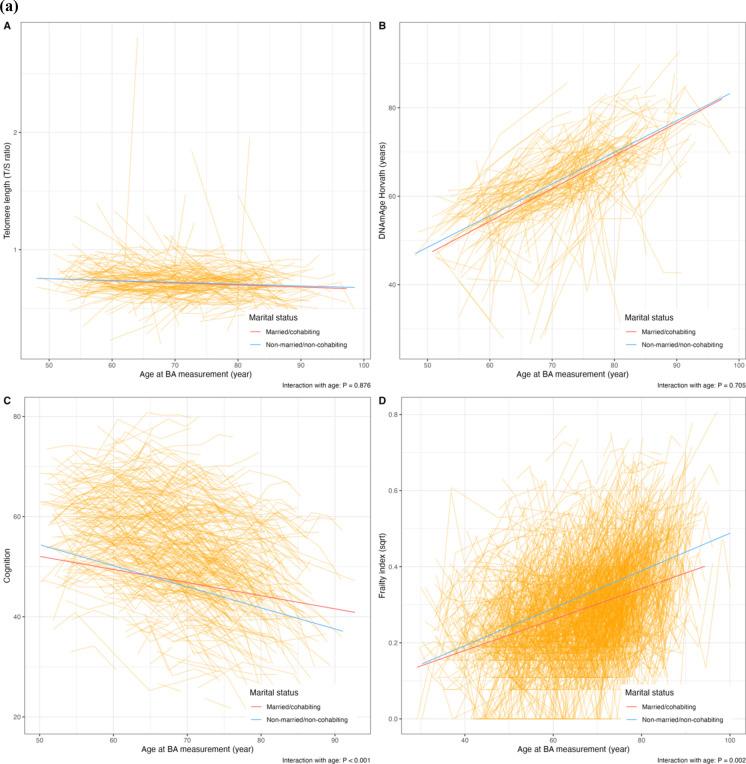
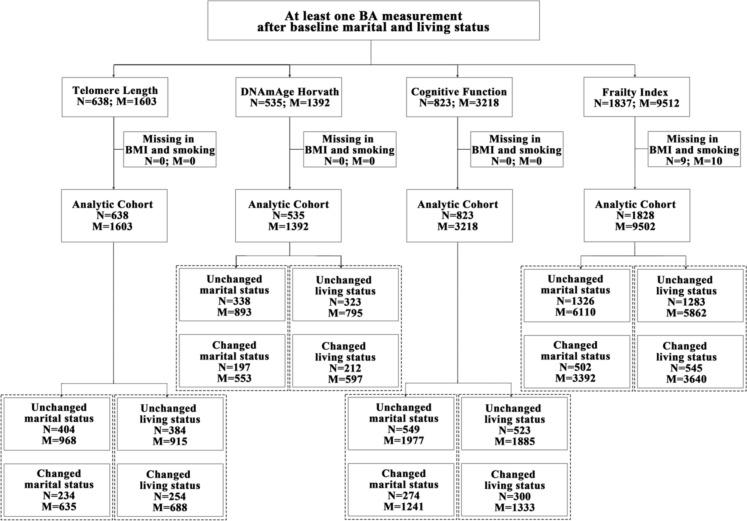
Biomarkers of ageing (BA) can predict health risks beyond chronological age, but little is known about how marital/living status affects longitudinal changes in BA. We examined the association between marital/living status and BA over time using the-Swedish-Adoption/Twin-Study-of-Aging (SATSA) cohort. Four BAs were analyzed: telomere length (TL) (638 individuals; 1603 measurements), DNAmAge (535 individuals; 1392 measurements), cognition (823 individuals; 3218 measurements), and frailty index (FI) (1828 individuals; 9502 measurements). Individuals were born between 1900 and 1948, and data on marital/living status, BAs, and covariates were collected through nine waves of questionnaires and in-person testing from 1986 to 2014. Mixed linear regression with random effects at twin-pair and individual levels were used to assess BA changes for constant marital/living status. Conditional generalized estimating equation assessed within-individual BA changes for varying marital/living status. Results showed that individuals who were consistently unmarried/non-cohabiting (β = 0.291, 95%CI = 0.189-0.393) or living alone (β = 0.203, 95%CI = 0.090-0.316) were more frail, and experienced accelerated frailty (p-for-interaction with age < 0.001 for marital status; p-for-interaction = 0.002 for living status) and cognitive decline (p-for-interaction < 0.001), compared to those married/cohabiting or living with someone Among individuals whose marital/living status changed, frailty was higher when living alone (β = 0.089, 95%CI = 0.017-0.162) and frailty accelerated when they became unmarried/non-cohabiting or were living alone (p-for-interaction < 0.001). Cognitive decline also accelerated when living alone (p-for-interaction = 0.020). No associations were observed for TL and DNAmAge. In conclusion, being unmarried/non-cohabiting or living alone from mid-to-old age is linked to accelerated cognitive decline and frailty. These findings highlight the potential importance of social support networks and living arrangements for healthy ageing.
衰老生物标志物(BA)能够预测超越实际年龄的健康风险,但对于婚姻/生活状况如何影响BA的纵向变化却知之甚少。我们利用瑞典收养/双胞胎衰老研究(SATSA)队列,研究了婚姻/生活状况与BA随时间的关联。分析了四种BA:端粒长度(TL)(638人;1603次测量)、DNA甲基化年龄(DNAmAge)(535人;1392次测量)、认知能力(823人;3218次测量)和衰弱指数(FI)(1828人;9502次测量)。研究对象出生于1900年至1948年之间,通过1986年至2014年的九轮问卷调查和现场测试收集了婚姻/生活状况、BA和协变量的数据。采用在双胞胎对和个体水平具有随机效应的混合线性回归来评估婚姻/生活状况不变时BA的变化。条件广义估计方程评估婚姻/生活状况变化时个体内BA的变化。结果显示,持续未婚/非同居(β = 0.291,95%置信区间 = 0.189 - 0.393)或独居(β = 0.203,95%置信区间 = 0.090 - 0.316)的个体更衰弱,且与已婚/同居或与他人同住的个体相比,经历了加速衰弱(婚姻状况与年龄的交互作用p值 < 0.001;生活状况的交互作用p值 = 0.002)和认知能力下降(交互作用p值 < 0.001)。在婚姻/生活状况发生变化的个体中,独居时衰弱程度更高(β = 0.089,95%置信区间 = 0.017 - 0.162),当他们变为未婚/非同居或独居时衰弱加速(交互作用p值 < 0.001)。独居时认知能力下降也会加速(交互作用p值 = 0.020)。未观察到TL和DNAmAge与婚姻/生活状况之间的关联。总之,从中年到老年未婚/非同居或独居与加速的认知能力下降和衰弱有关。这些发现凸显了社会支持网络和生活安排对健康衰老的潜在重要性。
 Zotero 插件