
为高危型人乳头瘤病毒(HPV)感染且细胞学检查结果正常的患者提供符合指南的护理。
Delivering Guideline-Concordant Care for Patients With High-Risk HPV and Normal Cytologic Findings.
作者信息
Tiro Jasmin A, Lykken Jacquelyn M, Chen Patricia M, Clark Cheryl R, Kobrin Sarah, Chubak Jessica, Feldman Sarah, Werner Claudia, Atlas Steven J, Silver Michelle I, Haas Jennifer S
机构信息
Department of Public Health Sciences, Division of the Biological Sciences, The University of Chicago, Chicago, Illinois.
Peter O'Donnell School of Public Health, University of Texas Southwestern Medical Center, Dallas.
出版信息
JAMA Netw Open. 2025 Jan 2;8(1):e2454969. doi: 10.1001/jamanetworkopen.2024.54969.
IMPORTANCE
As US health care systems shift to human papillomavirus (HPV)-based cervical cancer screening, more patients are receiving positive high-risk non-16/18 genotype HPV results and negative for intraepithelial lesion or malignancy (NILM) cytological findings. Risk-based management guidelines recommend 2 consecutive negative annual results to return to routine screening.
OBJECTIVE
To quantify patterns of surveillance testing and associated outcomes for patients after an HPV-positive results and NILM cytologic findings.
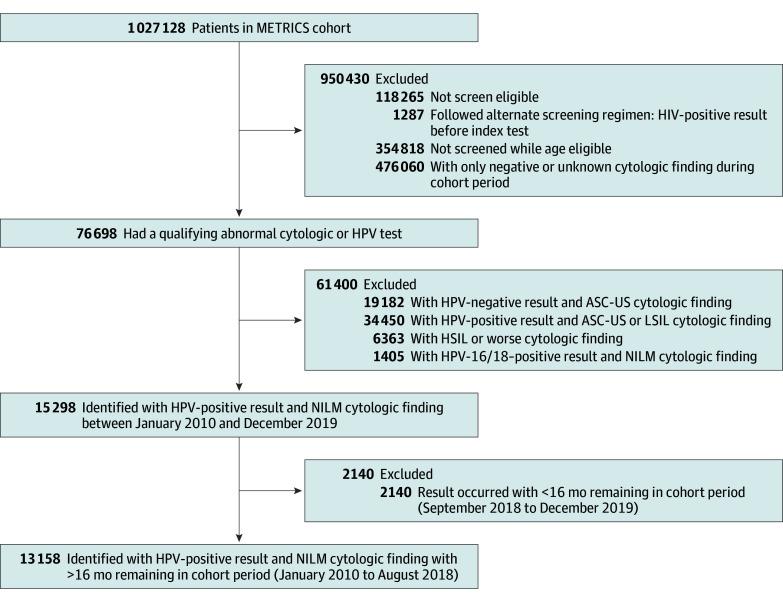
DESIGN, SETTING, AND PARTICIPANTS: This cohort study analyzed patients in the METRICS (Multi-level Optimization of the Cervical Cancer Screening Process in Diverse Settings and Populations) cohort of the PROSPR II (Population-Based Research to Optimize the Screening Process) Cervical Consortium. Population-based data were obtained from 3 diverse health care systems (Mass General Brigham [MGB] in Massachusetts, Kaiser Permanente Washington [KPWA] in Washington, and Parkland Health [PH] in Texas) in the METRICS cohort. Participants were patients aged 21 to 65 years who received an HPV-positive (non-16/18 or pooled genotypes) result and NILM cytologic finding from January 2010 to August 2018 and were followed up through December 2019. Data analyses were performed between April 2021 and November 2024.
MAIN OUTCOMES AND MEASURES
Test receipt and outcomes delivered within 16 months after the index result (round 1 surveillance).
RESULTS
The final sample across the 3 health care systems comprised 13 158 female patients (3228 Hispanic or Latine [24.5%], 1990 non-Hispanic African American or Black [15.1%], 749 non-Hispanic Asian [5.7%], and 6559 non-Hispanic White [49.8%] individuals). Sociodemographic characteristics varied by site, with more non-Hispanic White (2277 [63.7%] and 4061 [61.2%]) and commercially insured patients (3137 [87.8%] and 4365 [65.7%]) at KPWA and MGB, and more Hispanic or Latine (1664 [56.5%]) and uninsured patients (2352 [79.9%]) at PH. During round 1 surveillance, 43.7% of patients were tested, of whom 18.2% (2394) had HPV-negative results and NILM cytologic findings and 25.5% (3351) had abnormal results. Many patients remained in the cohort and were untested through round 1 surveillance (overall: 49.4% [6505]; across sites: 39.0% [1395] to 69.4% [2043]), while fewer exited the cohort (overall: 6.9% [908]; across sites: 0.2% [12] to 24.6% [879]). Groups with lower odds of timely testing were younger adults (aged 25-29 vs 30-39 years: adjusted odds ratio [AOR], 0.65; 95% CL, 0.53-0.81), non-Hispanic African American or Black compared with non-Hispanic White patients (AOR, 0.78; 95% CL, 0.68-0.89), and those with Medicaid compared with commercial insurance (AOR, 0.81; 95% CL, 0.72-0.91), while those with a primary care clinician were more likely to have timely testing (AOR, 1.44; 95% CL, 1.21-1.70). Cancer was diagnosed in 10 patients (0.2%) untested in round 1 surveillance compared with 0 cancers in those with an HPV-negative results and NILM cytologic findings.
CONCLUSIONS AND RELEVANCE
This cohort study found that among patients with HPV-positive results and NILM cytologic findings, less than half received a surveillance cotest during the guideline-recommended time frame. Health care systems should monitor annual surveillance and gather evidence on interventions to optimize the delivery of surveillance testing.
重要性
随着美国医疗保健系统转向基于人乳头瘤病毒(HPV)的宫颈癌筛查,越来越多的患者高危非16/18基因型HPV检测结果呈阳性,而宫颈上皮内瘤变或恶性肿瘤(NILM)细胞学检查结果为阴性。基于风险的管理指南建议连续两年结果为阴性才能恢复常规筛查。
目的
量化HPV检测结果呈阳性且细胞学检查结果为NILM的患者的监测检测模式及相关结果。
设计、背景和参与者:这项队列研究分析了PROSPR II(基于人群的优化筛查流程研究)宫颈联盟的METRICS(不同环境和人群中宫颈癌筛查流程的多层次优化)队列中的患者。基于人群的数据来自METRICS队列中的3个不同医疗保健系统(马萨诸塞州的麻省总医院布莱根分院[MGB]、华盛顿州的凯撒永久医疗集团华盛顿分院[KPWA]和得克萨斯州的帕克兰健康中心[PH])。参与者为2010年1月至2018年8月期间HPV检测结果呈阳性(非16/18或混合基因型)且细胞学检查结果为NILM的21至65岁患者,并随访至2019年12月。数据分析于2021年4月至2024年11月进行。
主要结局和指标
在索引结果后的16个月内(第一轮监测)的检测接受情况和结果。
结果
3个医疗保健系统的最终样本包括13158名女性患者(3228名西班牙裔或拉丁裔[24.5%]、1990名非西班牙裔非裔美国人或黑人[15.1%]、749名非西班牙裔亚洲人[5.7%]和6559名非西班牙裔白人[49.8%])。社会人口学特征因地点而异,KPWA和MGB的非西班牙裔白人(分别为2277名[63.7%]和4061名[61.2%])以及商业保险患者(分别为3137名[87.8%]和4365名[65.7%])更多,而PH的西班牙裔或拉丁裔(1664名[56.5%])和无保险患者(2352名[79.9%])更多。在第一轮监测期间,43.7%的患者接受了检测,其中18.2%(2394名)HPV检测结果为阴性且细胞学检查结果为NILM,25.5%(3351名)结果异常。许多患者仍在队列中,在第一轮监测中未接受检测(总体:49.4%[6505名];各地点:39.0%[1395名]至69.4%[2043名]),而退出队列的患者较少(总体:6.9%[908名];各地点:0.2%[12名]至24.6%[879名])。及时检测几率较低的群体包括年轻成年人(25 - 29岁与30 - 39岁:调整后的优势比[AOR],0.65;95%置信区间[CL],0.53 - 0.81)、非西班牙裔非裔美国人或黑人与非西班牙裔白人患者相比(AOR,0.78;95% CL,0.68 - 0.89),以及有医疗补助的患者与商业保险患者相比(AOR,0.81;95% CL,0.72 - 0.91),而有初级保健医生的患者更有可能及时接受检测(AOR,1.44;95% CL,1.21 - 1.70)。在第一轮监测中未接受检测的10名患者(0.2%)被诊断出患有癌症,而HPV检测结果为阴性且细胞学检查结果为NILM的患者中无癌症病例。
结论与意义
这项队列研究发现,在HPV检测结果呈阳性且细胞学检查结果为NILM的患者中,不到一半的患者在指南推荐的时间框架内接受了监测联合检测。医疗保健系统应监测年度监测情况,并收集有关干预措施的证据,以优化监测检测的实施。

 Zotero 插件