
组织驻留记忆性CD8 T细胞的多样性在时空上被印记。
Tissue-resident memory CD8 T cell diversity is spatiotemporally imprinted.
作者信息
Reina-Campos Miguel, Monell Alexander, Ferry Amir, Luna Vida, Cheung Kitty P, Galletti Giovanni, Scharping Nicole E, Takehara Kennidy K, Quon Sara, Challita Peter P, Boland Brigid, Lin Yun Hsuan, Wong William H, Indralingam Cynthia S, Neadeau Hayley, Alarcón Suzie, Yeo Gene W, Chang John T, Heeg Maximilian, Goldrath Ananda W
机构信息
School of Biological Sciences, Department of Molecular Biology, University of California, San Diego, La Jolla, CA, USA.
La Jolla Institute for Immunology, La Jolla, CA, USA.
出版信息
Nature. 2025 Mar;639(8054):483-492. doi: 10.1038/s41586-024-08466-x. Epub 2025 Jan 22.
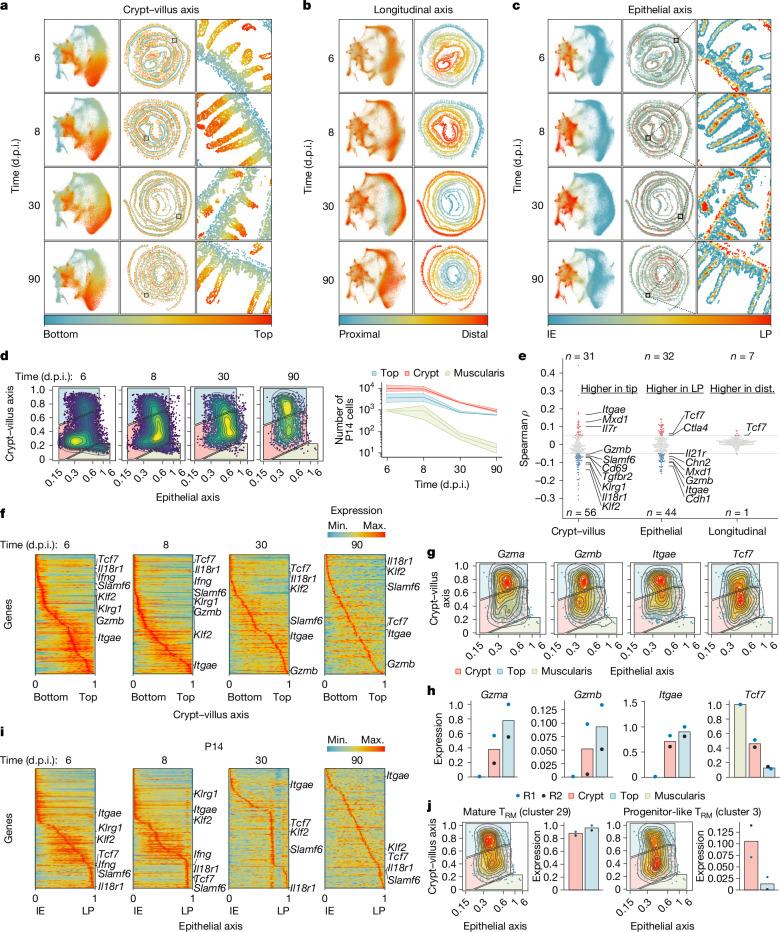
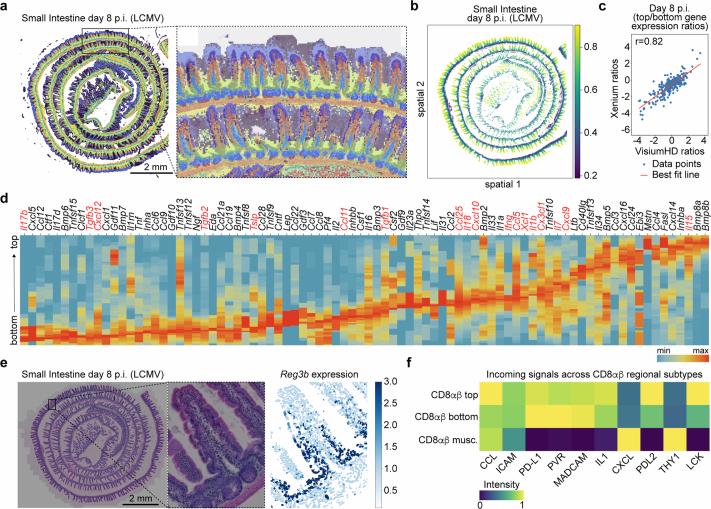
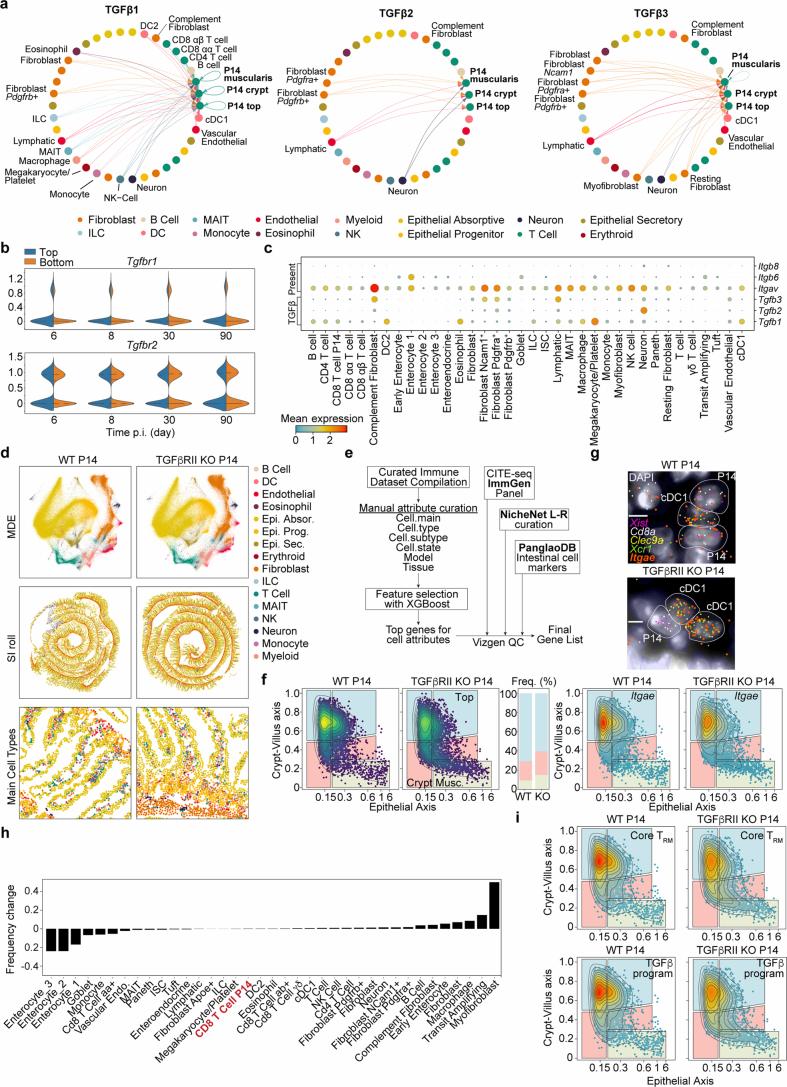
Tissue-resident memory CD8 T (T) cells provide protection from infection at barrier sites. In the small intestine, T cells are found in at least two distinct subpopulations: one with higher expression of effector molecules and another with greater memory potential. However, the origins of this diversity remain unknown. Here we proposed that distinct tissue niches drive the phenotypic heterogeneity of T cells. To test this, we leveraged spatial transcriptomics of human samples, a mouse model of acute systemic viral infection and a newly established strategy for pooled optically encoded gene perturbations to profile the locations, interactions and transcriptomes of pathogen-specific T cell differentiation at single-transcript resolution. We developed computational approaches to capture cellular locations along three anatomical axes of the small intestine and to visualize the spatiotemporal distribution of cell types and gene expression. Our study reveals that the regionalized signalling of the intestinal architecture supports two distinct T cell states: differentiated T cells and progenitor-like T cells, located in the upper villus and lower villus, respectively. This diversity is mediated by distinct ligand-receptor activities, cytokine gradients and specialized cellular contacts. Blocking TGFβ or CXCL9 and CXCL10 sensing by antigen-specific CD8 T cells revealed a model consistent with anatomically delineated, early fate specification. Ultimately, our framework for the study of tissue immune networks reveals that T cell location and functional state are fundamentally intertwined.
组织驻留记忆性CD8 T(T)细胞可在屏障部位提供抗感染保护。在小肠中,T细胞至少存在两个不同的亚群:一个效应分子表达较高,另一个具有更大的记忆潜能。然而,这种多样性的起源尚不清楚。在这里,我们提出不同的组织微环境驱动了T细胞的表型异质性。为了验证这一点,我们利用人类样本的空间转录组学、急性全身性病毒感染的小鼠模型以及一种新建立的用于汇集光学编码基因扰动的策略,以单转录本分辨率描绘病原体特异性T细胞分化的位置、相互作用和转录组。我们开发了计算方法来捕捉沿小肠三个解剖轴的细胞位置,并可视化细胞类型和基因表达的时空分布。我们的研究表明,肠道结构的区域化信号支持两种不同的T细胞状态:分化的T细胞和祖细胞样T细胞,分别位于绒毛上部和绒毛下部。这种多样性是由不同的配体-受体活性、细胞因子梯度和特殊的细胞接触介导的。阻断抗原特异性CD8 T细胞对TGFβ或CXCL9和CXCL10的感知揭示了一个与解剖学上划定的早期命运决定相一致的模型。最终,我们用于研究组织免疫网络的框架表明,T细胞的位置和功能状态在根本上是相互交织的。







 Zotero 插件