
具有与人类阿尔茨海默病风险人群的转化效度的衰老人源化载脂蛋白E(APOE)小鼠的体重轨迹:一项回顾性分析。
Weight trajectories in aging humanized APOE mice with translational validity to human Alzheimer's risk population: A retrospective analysis.
作者信息
Vitali Francesca, Wiegand Jean-Paul, Parker-Halstead Lillian, Tucker Allan, Diaz Brinton Roberta
机构信息
Center for Innovation in Brain Science, University of Arizona Health Sciences, Tucson, Arizona, United States of America.
Department of Neurology, College of Medicine Tucson, University of Arizona, Tucson, Arizona, United States of America.
出版信息
PLoS One. 2025 Jan 24;20(1):e0314097. doi: 10.1371/journal.pone.0314097. eCollection 2025.
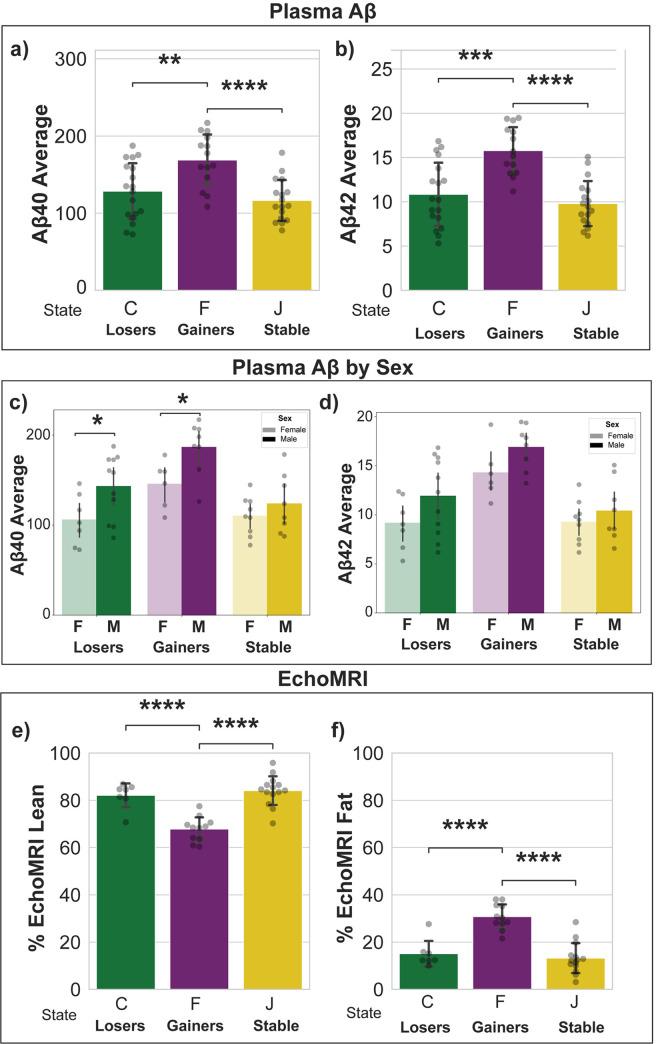
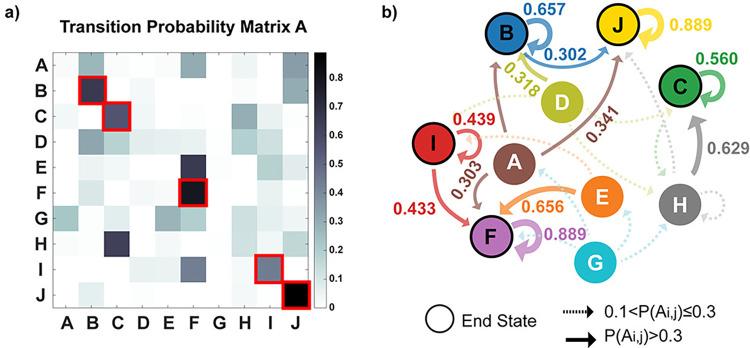
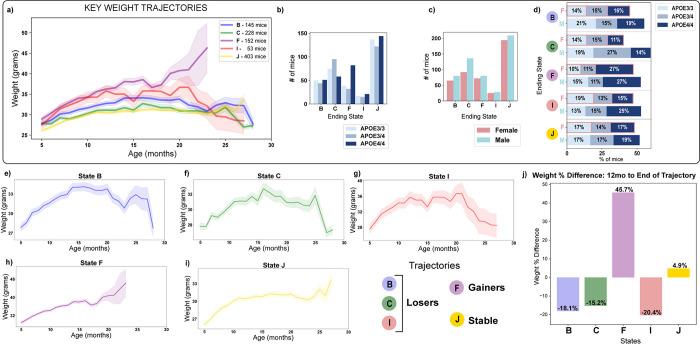
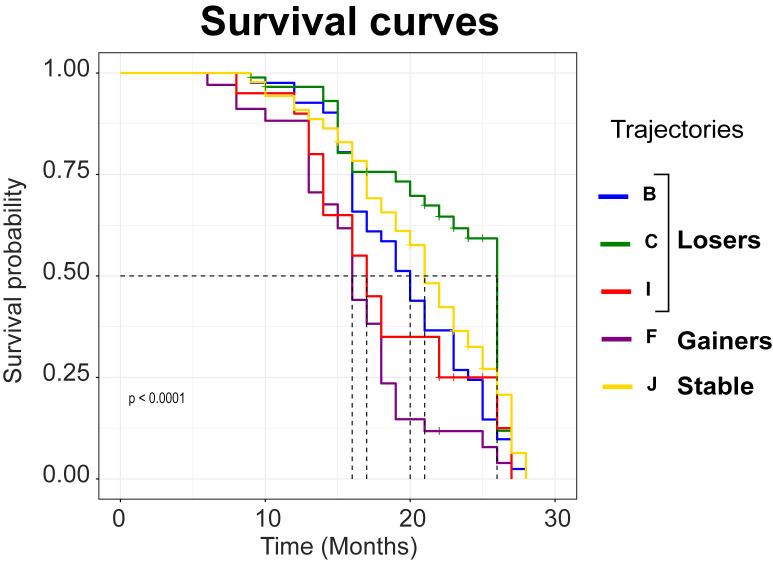
Translational validity of mouse models of Alzheimer's disease (AD) is variable. Because change in weight is a well-documented precursor of AD, we investigated whether diversity of human AD risk weight phenotypes was evident in a longitudinally characterized cohort of 1,196 female and male humanized APOE (hAPOE) mice, monitored up to 28 months of age which is equivalent to 81 human years. Autoregressive Hidden Markov Model (AHMM) incorporating age, sex, and APOE genotype was employed to identify emergent weight trajectories and phenotypes. In the hAPOE-AD mouse cohort, five distinct weight trajectories emerged: three trajectories were associated with a weight loss phenotype (36% of mice, n = 426), one with weight gain (13% of mice, n = 152), and one trajectory of no change in weight (34% of mice, n = 403). The AHMM model findings were validated with post-hoc survival analyses, revealing differences in survival rates across the five identified phenotypes. Further validation was performed using body composition and plasma β-amyloid data from mice within the identified gain, loss and stable weight trajectories. Weight gain trajectory was associated with elevated plasma β-amyloid levels, higher body fat composition, lower survival rates and a greater proportion of APOE4/4 carriers. In contrast, weight loss was associated with greater proportion of hAPOE3/4 carriers, better survival rates and was predominantly male. The association between weight change and AD risk observed in humans was mirrored in the hAPOE-AD mouse model. Weight trajectories of APOE3/3 mice were equally distributed across weight gain, loss and stability. Surprisingly, despite genetic uniformity, comparable housing, diet and handling, distinct weight trajectories and divergence points emerged for subpopulations. These data are consistent with the heterogeneity observed in the human population for change in body weight during aging and highlight the importance of longitudinal phenotypic characterization of mouse aging to advance the translational validity of preclinical AD mouse models.
阿尔茨海默病(AD)小鼠模型的转化效度存在差异。由于体重变化是AD的一个有充分记录的先兆,我们调查了在一个纵向特征化的队列中,1196只雌性和雄性人源化APOE(hAPOE)小鼠(监测至28个月龄,相当于人类81岁)中,人类AD风险体重表型的多样性是否明显。采用纳入年龄、性别和APOE基因型的自回归隐马尔可夫模型(AHMM)来识别出现的体重轨迹和表型。在hAPOE-AD小鼠队列中,出现了五种不同的体重轨迹:三种轨迹与体重减轻表型相关(36%的小鼠,n = 426),一种与体重增加相关(13%的小鼠,n = 152),一种体重无变化的轨迹(34%的小鼠,n = 403)。AHMM模型的结果通过事后生存分析得到验证,揭示了五种已识别表型的生存率差异。使用来自已识别的体重增加、减轻和稳定轨迹内小鼠的身体成分和血浆β-淀粉样蛋白数据进行了进一步验证。体重增加轨迹与血浆β-淀粉样蛋白水平升高、更高的体脂成分、更低的生存率以及更高比例的APOE4/4携带者相关。相比之下,体重减轻与更高比例的hAPOE3/4携带者、更好的生存率相关,且主要为雄性。在人类中观察到的体重变化与AD风险之间的关联在hAPOE-AD小鼠模型中得到了体现。APOE3/3小鼠的体重轨迹在体重增加、减轻和稳定之间均匀分布。令人惊讶的是,尽管基因一致、饲养条件、饮食和处理方式相同,但亚群出现了不同的体重轨迹和分歧点。这些数据与在人类群体中观察到的衰老过程中体重变化的异质性一致,并强调了小鼠衰老纵向表型特征化对于提高临床前AD小鼠模型转化效度的重要性。


 Zotero 插件