
环境暴露于双酚A会增强甲状腺乳头状癌的侵袭性。
Environmental Exposure to Bisphenol A Enhances Invasiveness in Papillary Thyroid Cancer.
作者信息
Huang Chien-Yu, Xie Ren-Hao, Li Pin-Hsuan, Chen Chong-You, You Bo-Hong, Sun Yuan-Chin, Chou Chen-Kai, Chang Yen-Hsiang, Lin Wei-Che, Chen Guan-Yu
机构信息
Department of Electrical and Computer Engineering, College of Electrical and Computer Engineering, National Yang Ming Chiao Tung University, Hsinchu 300, Taiwan.
Institute of Biomedical Engineering, College of Electrical and Computer Engineering, National Yang Ming Chiao Tung University, Hsinchu 300, Taiwan.
出版信息
Int J Mol Sci. 2025 Jan 19;26(2):814. doi: 10.3390/ijms26020814.
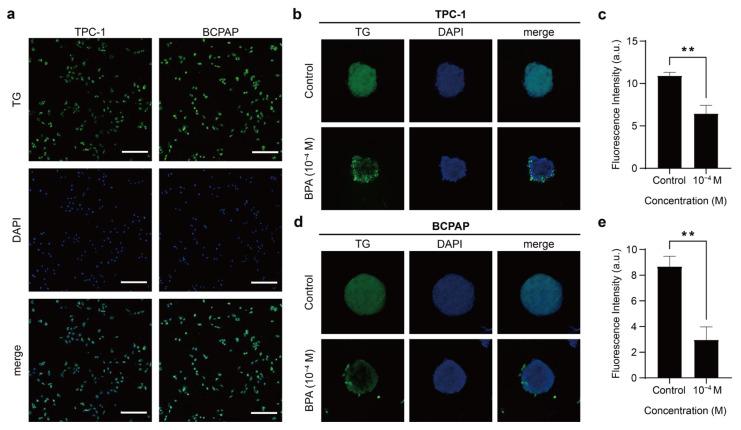
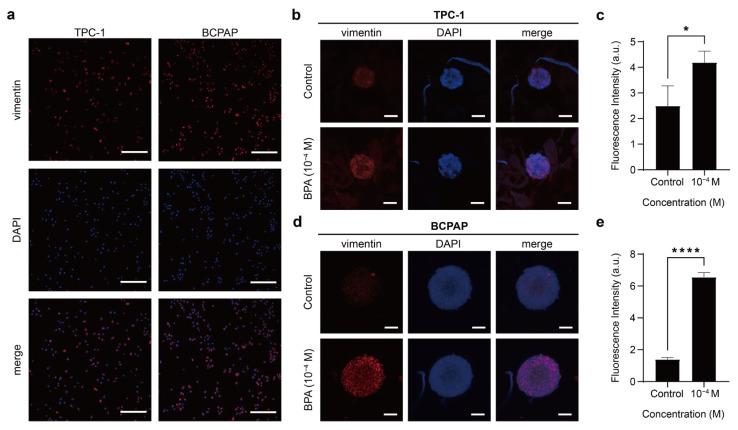
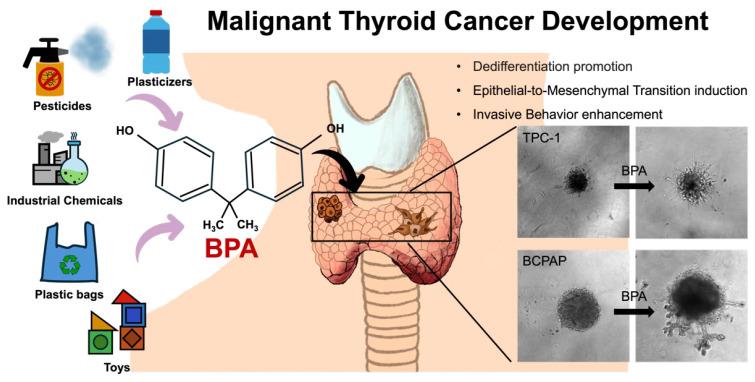
Bisphenol A (BPA) is a prevalent environmental contaminant found in plastics and known for its endocrine-disrupting properties, posing risks to both human health and the environment. Despite its widespread presence, the impact of BPA on papillary thyroid cancer (PTC) progression, especially under realistic environmental conditions, is not well understood. This study examined the effects of BPA on PTC using a 3D thyroid papillary tumor spheroid model, which better mimicked the complex interactions within human tissues compared to traditional 2D models. Our findings demonstrated that BPA, at environmentally relevant concentrations, could induce significant changes in PTC cells, including a decrease in E-cadherin expression, an increase in vimentin expression, and reduced thyroglobulin (TG) secretion. These changes suggest that BPA exposure may promote epithelial-mesenchymal transition (EMT), enhance invasiveness, and reduce cell differentiation, potentially complicating treatment, including by increasing resistance to radioiodine therapy. This research highlights BPA's hazardous nature as an environmental contaminant and emphasizes the need for advanced in vitro models, like 3D tumor spheroids, to better assess the risks posed by such chemicals. It provides valuable insights into the environmental implications of BPA and its role in thyroid cancer progression, enhancing our understanding of endocrine-disrupting chemicals.
双酚A(BPA)是一种在塑料中普遍存在的环境污染物,以其内分泌干扰特性而闻名,对人类健康和环境均构成风险。尽管其广泛存在,但双酚A对甲状腺乳头状癌(PTC)进展的影响,尤其是在实际环境条件下,尚未得到充分了解。本研究使用三维甲状腺乳头状肿瘤球体模型研究了双酚A对PTC的影响,与传统的二维模型相比,该模型能更好地模拟人体组织内的复杂相互作用。我们的研究结果表明,在与环境相关的浓度下,双酚A可引起PTC细胞的显著变化,包括E-钙黏蛋白表达降低、波形蛋白表达增加以及甲状腺球蛋白(TG)分泌减少。这些变化表明,接触双酚A可能促进上皮-间质转化(EMT)、增强侵袭性并降低细胞分化,可能使治疗复杂化,包括增加对放射性碘治疗的抗性。本研究突出了双酚A作为环境污染物的有害性质,并强调需要先进的体外模型,如三维肿瘤球体,以更好地评估此类化学物质带来的风险。它为双酚A的环境影响及其在甲状腺癌进展中的作用提供了有价值的见解,增进了我们对内分泌干扰化学物质的理解。






 Zotero 插件