
饮用水中的双酚 A 会加速乳腺癌发生,并有利于 BALB-T 小鼠的免疫抑制肿瘤微环境。
Bisphenol-A in Drinking Water Accelerates Mammary Cancerogenesis and Favors an Immunosuppressive Tumor Microenvironment in BALB-T Mice.
机构信息
Department of Clinical Sciences and Translational Medicine, University of Rome "Tor Vergata", 00133 Rome, Italy.
Department of Experimental Medicine, University of Rome "Sapienza", 00161 Rome, Italy.
出版信息
Int J Mol Sci. 2024 Jun 6;25(11):6259. doi: 10.3390/ijms25116259.
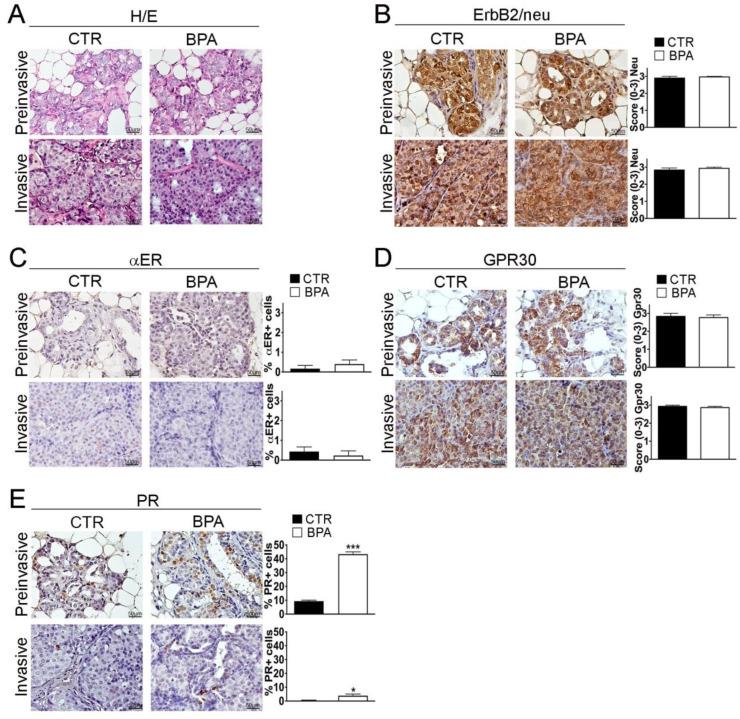
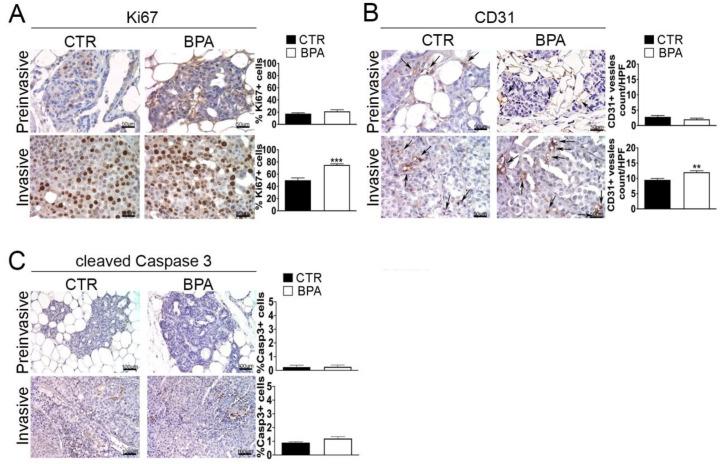
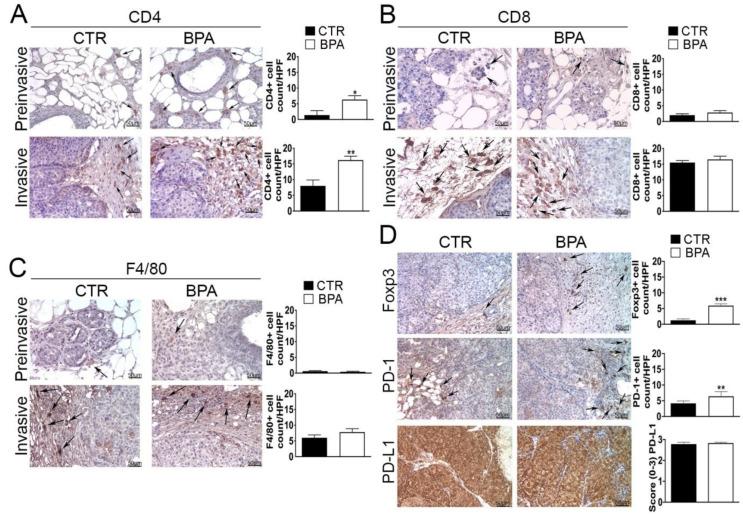
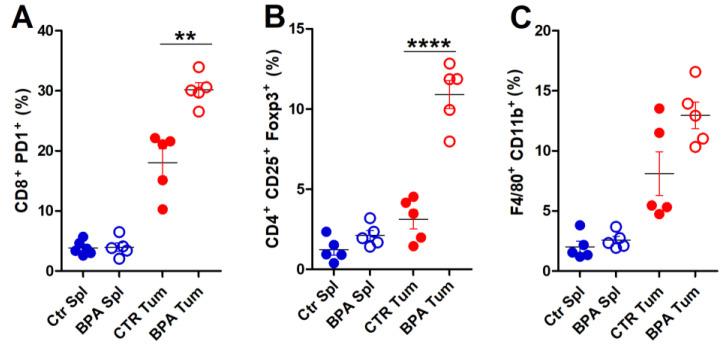
Bisphenol-A (BPA), a synthetic compound ubiquitously present in the environment, can act as an endocrine disruptor by binding to both canonical and non-canonical estrogen receptors (ERs). Exposure to BPA has been linked to various cancers, in particular, those arising in hormone-targeted tissues such as the breast. In this study, we evaluated the effect of BPA intake through drinking water on ErbB2/-driven cancerogenesis in BALB-T mice, transgenic for a mutated ErbB2/ receptor gene, which reproducibly develop carcinomas in all mammary glands. In this model, BPA accelerated mammary cancerogenesis with an increase in the number of tumors per mouse and a concurrent decrease in tumor-free and overall survival. As assessed by immunohistochemistry, BALB-T tumors were ER-negative but expressed high levels of the alternative estrogen receptor GPR30, regardless of BPA exposure. On the other hand, BPA exposure resulted in a marked upregulation of progesterone receptors in preinvasive tumors and of Ki67, CD31, and phosphorylated Akt in invasive tumors. Moreover, based on several infiltration markers of immune cells, BPA favored an immunosuppressive tumor microenvironment. Finally, in vitro cell survival studies performed on a cell line established from a BALB-T breast carcinoma confirmed that BPA's impact on cancer progression can be particularly relevant after chronic, low-dose exposure.
双酚 A(BPA)是一种普遍存在于环境中的合成化合物,可通过与经典和非经典雌激素受体(ER)结合而充当内分泌干扰物。接触 BPA 与各种癌症有关,特别是与激素靶向组织(如乳房)相关的癌症。在这项研究中,我们通过饮用水评估了 BPA 摄入对 BALB-T 小鼠中 ErbB2/-驱动的癌症发生的影响,BALB-T 小鼠是一种转染了突变 ErbB2/受体基因的转基因小鼠,该基因可在所有乳腺中重现地发展为癌。在该模型中,BPA 加速了乳腺癌的发生,导致每只小鼠的肿瘤数量增加,同时肿瘤无和总生存期缩短。如通过免疫组织化学评估的那样,BALB-T 肿瘤为 ER 阴性,但表达高水平的替代雌激素受体 GPR30,无论是否暴露于 BPA。另一方面,BPA 暴露导致侵袭性肿瘤中孕激素受体和 Ki67、CD31 和磷酸化 Akt 的显著上调。此外,基于几种免疫细胞浸润标志物,BPA 有利于免疫抑制性肿瘤微环境。最后,对源自 BALB-T 乳腺癌的细胞系进行的体外细胞存活研究证实,BPA 对癌症进展的影响在慢性低剂量暴露后可能特别相关。



 Zotero 插件