
组蛋白H3E50K重塑染色质以赋予致癌活性并支持上皮-间质转化表型。
Histone H3E50K remodels chromatin to confer oncogenic activity and support an EMT phenotype.
作者信息
Sad Kirti, Fawwal Dorelle V, Jones Celina Y, Hill Emily J, Skinner Katie T, Adams Miranda L, Lustenberger Severin, Lee Richard S, Lohano Sandhya V, Elayavalli Satvik R, Farhi Jonathan, Mehta Christina C, Lemon Laramie D, Fasken Milo B, Hong Andrew L, Sloan Steven A, Corbett Anita H, Spangle Jennifer M
机构信息
Department of Radiation Oncology, Emory University School of Medicine, Atlanta, GA 30322, United States.
Winship Cancer Institute, Emory University School of Medicine, Atlanta, GA 30322, United States.
出版信息
NAR Cancer. 2025 Feb 3;7(1):zcaf002. doi: 10.1093/narcan/zcaf002. eCollection 2025 Mar.
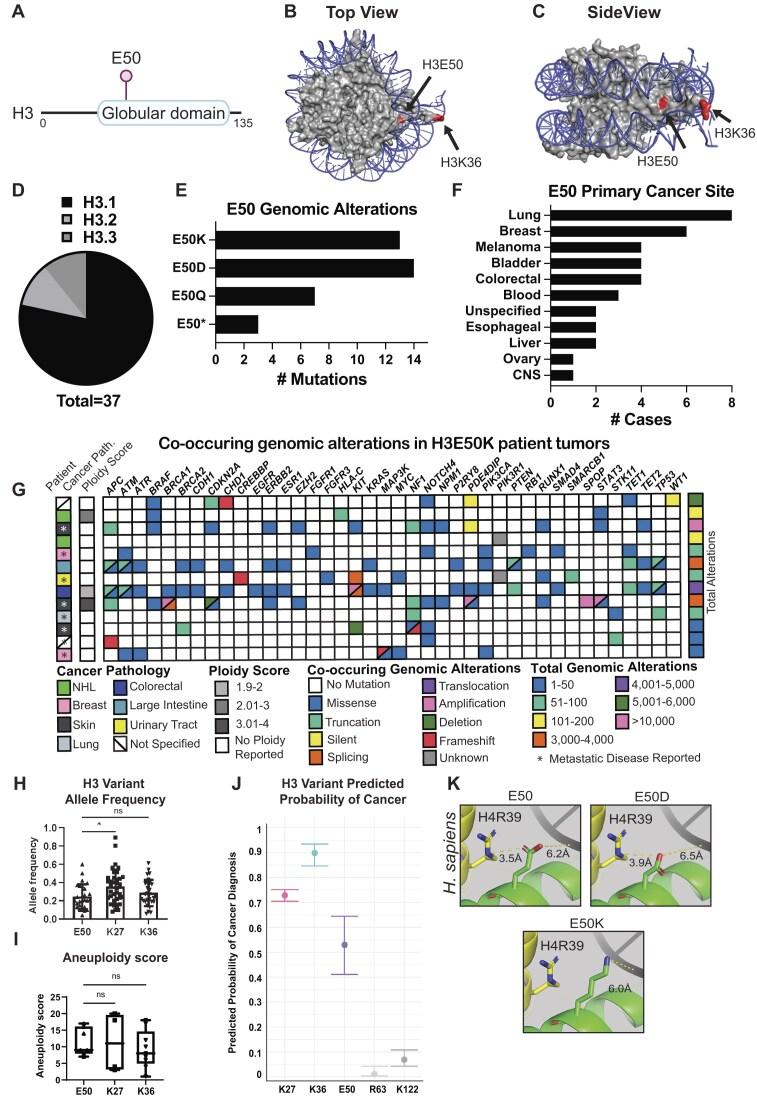
Sequencing of human patient tumors has identified recurrent missense mutations in genes encoding core histones. We report that mutations that convert histone H3 amino acid 50 from a glutamate to a lysine (H3E50K) support an oncogenic phenotype. Expression of H3E50K is sufficient to transform human cells as evidenced by an increase in cell migration and invasion, and an increase in proliferation and clonogenicity. H3E50K also increases the invasive phenotype in the context of co-occurring mutations, which are present in patient tumors characterized by H3E50K. H3E50 lies on the globular domain surface in a region that contacts H4 within the nucleosome. We find that H3E50K selectively increases chromatin accessibility and perturbs proximal H3 post-translational modifications including H3K27me3; together these changes to chromatin dynamics dysregulate gene expression to support the epithelial-to-mesenchymal transition. Functional studies using reveal that, while yeast cells that express H3E50K as the sole copy of histone H3 show sensitivity to cellular stressors, including caffeine, H3E50K cells display some genetic interactions that are distinct from the characterized H3K36M oncohistone yeast model. Taken together, these data suggest that additional H3 mutations have the potential to support oncogenic activity and function through distinct mechanisms that dysregulate gene expression.
对人类患者肿瘤进行测序已确定在编码核心组蛋白的基因中存在复发性错义突变。我们报告称,将组蛋白H3第50位氨基酸由谷氨酸转换为赖氨酸的突变(H3E50K)支持致癌表型。H3E50K的表达足以转化人类细胞,这表现为细胞迁移和侵袭增加,以及增殖和克隆形成能力增强。在同时存在的突变情况下,H3E50K也会增加侵袭表型,这些共发突变存在于以H3E50K为特征的患者肿瘤中。H3E50位于核小体中与H4接触区域的球状结构域表面。我们发现H3E50K选择性地增加染色质可及性,并扰乱近端H3的翻译后修饰,包括H3K27me3;这些染色质动力学的变化共同失调基因表达,以支持上皮-间质转化。使用……进行的功能研究表明,虽然将H3E50K作为组蛋白H3的唯一拷贝进行表达的酵母细胞对包括咖啡因在内的细胞应激源敏感,但H3E50K细胞显示出一些与已表征的H3K36M癌组蛋白酵母模型不同的遗传相互作用。综上所述,这些数据表明,其他H3突变有可能通过失调基因表达的不同机制来支持致癌活性和功能。




 Zotero 插件