
脑脊液中25 kDa突触体相关蛋白(SNAP - 25)水平:对阿尔茨海默病诊断和监测的意义
Synaptosomal-Associated Protein 25 kDA (SNAP-25) Levels in Cerebrospinal Fluid: Implications for Alzheimer's Disease Diagnosis and Monitoring.
作者信息
Wolner Sofia Hjorth, Gleerup Helena Sophia, Musaeus Christian Sandøe, Høgh Peter, Ashton Nicholas J, Brinkmalm Ann, Nilsson Johanna, Grötschel Lana, Zetterberg Henrik, Blennow Kaj, Hasselbalch Steen Gregers, Walls Anne Byriel, Simonsen Anja Hviid
机构信息
Danish Dementia Research Centre, Department of Neurology, Copenhagen University Hospital, Rigshospitalet, Copenhagen, Denmark.
Regional Dementia Research Centre, Department of Neurology, Zealand University Hospital, Roskilde, Denmark.
出版信息
Synapse. 2025 Mar;79(2):e70010. doi: 10.1002/syn.70010.
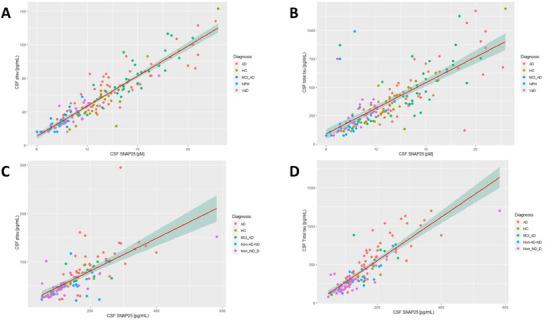
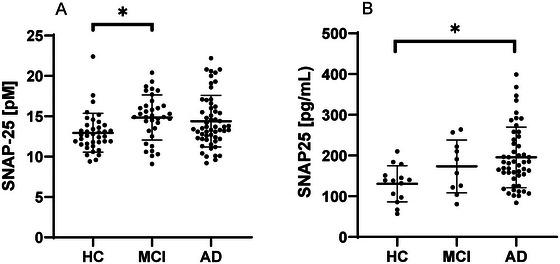
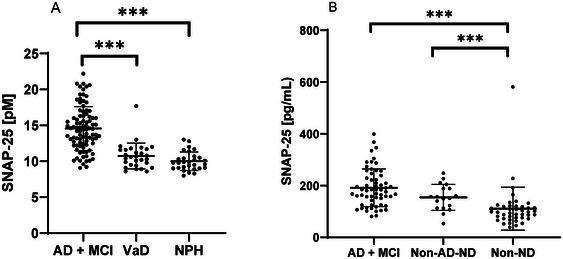
Synaptic degeneration has been linked to cognitive decline. The presynaptic protein, synaptosomal-associated protein 25 kDA (SNAP-25), is crucial for synaptic transmission and has been suggested as a biomarker in Alzheimer's disease (AD). In the current study, we investigated the ability of SNAP-25 to differentiate between heterogenous dementia etiologies and whether SNAP-25 could be a staging marker in AD. SNAP-25 in the cerebrospinal fluid (CSF) from a retrospective (n = 187) and a prospective (n = 134) cohort was investigated with immunoprecipitation mass spectrometry (IP-MS) and single-molecule array (Simoa), respectively. Both cohorts consisted of healthy controls (HC) and patients with cognitive decline of different etiologies. CSF SNAP-25 concentration was higher in AD and non-neurodegenerative diseases (i.e., vascular dementia) compared with controls but did not differ between AD and non-AD neurodegenerative diseases. We found a trend toward an association between SNAP-25 and disease burden when comparing HC, mild cognitive impairment due to AD, and AD. CSF SNAP-25 concentrations were strongly associated with CSF phosphorylated tau (p-tau) concentrations, thus strengthening the link between synaptic dysfunction and tau pathophysiology in AD. Our initial findings suggest that SNAP-25 may be a potential biomarker for differentiating AD from dementia due to other etiologies. However, due to the significant association between SNAP-25 and p-tau proteins, the clinical utility of SNAP-25 as a diagnostic biomarker for AD may be limited, while SNAP-25 may be useful for monitoring disease progression or treatment response.
突触退化与认知衰退有关。突触前蛋白,即突触体相关蛋白25千道尔顿(SNAP - 25),对突触传递至关重要,并被认为是阿尔茨海默病(AD)的一种生物标志物。在本研究中,我们调查了SNAP - 25区分不同痴呆病因的能力,以及SNAP - 25是否可以作为AD的分期标志物。分别采用免疫沉淀质谱法(IP - MS)和单分子阵列法(Simoa)对来自一个回顾性队列(n = 187)和一个前瞻性队列(n = 134)的脑脊液(CSF)中的SNAP - 25进行了研究。两个队列均包括健康对照(HC)和不同病因的认知衰退患者。与对照组相比,AD和非神经退行性疾病(即血管性痴呆)患者的脑脊液SNAP - 25浓度更高,但AD与非AD神经退行性疾病之间无差异。在比较HC、AD所致轻度认知障碍和AD时,我们发现SNAP - 25与疾病负担之间存在关联趋势。脑脊液SNAP - 25浓度与脑脊液磷酸化tau(p - tau)浓度密切相关,从而加强了AD中突触功能障碍与tau病理生理学之间的联系。我们的初步研究结果表明,SNAP - 25可能是区分AD与其他病因所致痴呆的潜在生物标志物。然而,由于SNAP - 25与p - tau蛋白之间存在显著关联,SNAP - 25作为AD诊断生物标志物的临床应用可能有限,而SNAP - 25可能有助于监测疾病进展或治疗反应。
 Zotero 插件