
用于对抗抗生素耐药细菌和生物膜的光激活银纳米颗粒
Light-Activable Silver Nanoparticles for Combatting Antibiotic-Resistant Bacteria and Biofilms.
作者信息
Godakhindi Varsha, Kravitz Elana, Vivero-Escoto Juan Luis
机构信息
Department of Chemistry, University of North Carolina at Charlotte, Charlotte, NC 28223, USA.
Nanoscale Science Program, University of North Carolina at Charlotte, Charlotte, NC 28223, USA.
出版信息
Molecules. 2025 Jan 31;30(3):626. doi: 10.3390/molecules30030626.
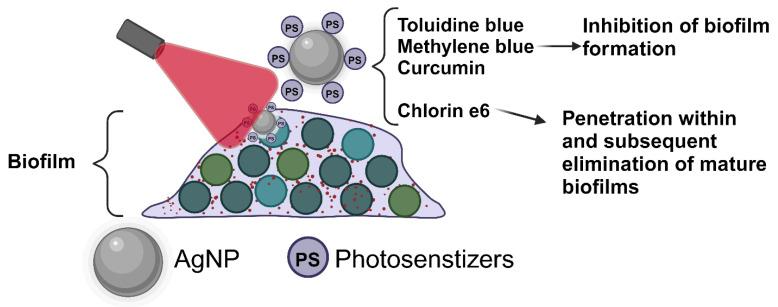
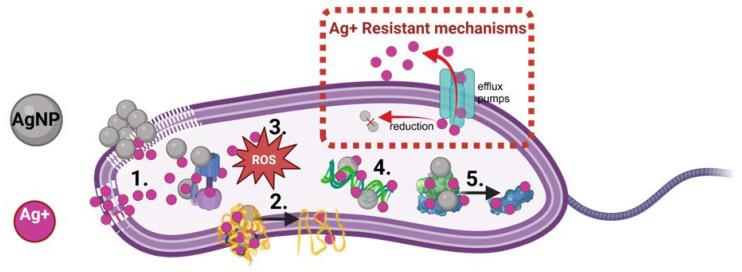
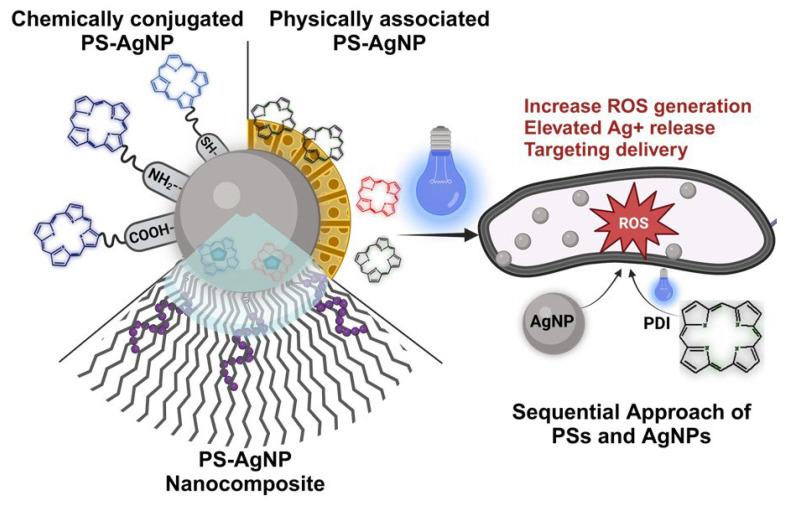
Silver nanoparticles (AgNPs) are among the most widely used nanoparticulate materials for antimicrobial applications. The innate antibacterial properties of AgNPs are closely associated with the release of silver ions (Ag) and the generation of reactive oxygen species (ROS). Multiple reports have elaborated on the synergistic effect against bacteria by combining photosensitizers with AgNPs (PS-AgNPs). This combination allows for the light-activated generation of Ag and ROS from PS-AgNPs. This is an efficient and controlled approach for the effective elimination of pathogens and associated biofilms. This review summarizes the design and synthetic strategies to produce PS-AgNPs reported in the literature. First, we explore multiple bacterial cell death mechanisms associated with AgNPs and possible pathways for resistance against AgNPs and Ag. The next sections summarize the recent findings on the design and application of PS-AgNPs for the inactivation of resistant and non-resistant bacterial strains as well as the elimination and inhibition of biofilms. Finally, the review describes major outcomes in the field and provides a perspective on the future applications of this burgeoning area of research.
银纳米颗粒(AgNPs)是抗菌应用中使用最广泛的纳米颗粒材料之一。AgNPs的固有抗菌特性与银离子(Ag)的释放和活性氧(ROS)的产生密切相关。多项报告阐述了通过将光敏剂与AgNPs(PS-AgNPs)结合对细菌产生的协同效应。这种组合使得PS-AgNPs能够光激活产生Ag和ROS。这是一种有效消除病原体和相关生物膜的高效且可控的方法。本综述总结了文献中报道的制备PS-AgNPs的设计和合成策略。首先,我们探讨了与AgNPs相关的多种细菌细胞死亡机制以及对AgNPs和Ag产生抗性的可能途径。接下来的部分总结了关于PS-AgNPs用于灭活耐药和非耐药菌株以及消除和抑制生物膜的设计和应用的最新研究结果。最后,本综述描述了该领域的主要成果,并对这一新兴研究领域的未来应用提供了展望。
 Zotero 插件