
侵袭性癌症的分子原理。
Molecular principles underlying aggressive cancers.
作者信息
Nussinov Ruth, Yavuz Bengi Ruken, Jang Hyunbum
机构信息
Computational Structural Biology Section, Frederick National Laboratory for Cancer Research, Frederick, MD, 21702, USA.
Cancer Innovation Laboratory, National Cancer Institute at Frederick, Frederick, MD, 21702, USA.
出版信息
Signal Transduct Target Ther. 2025 Feb 17;10(1):42. doi: 10.1038/s41392-025-02129-7.
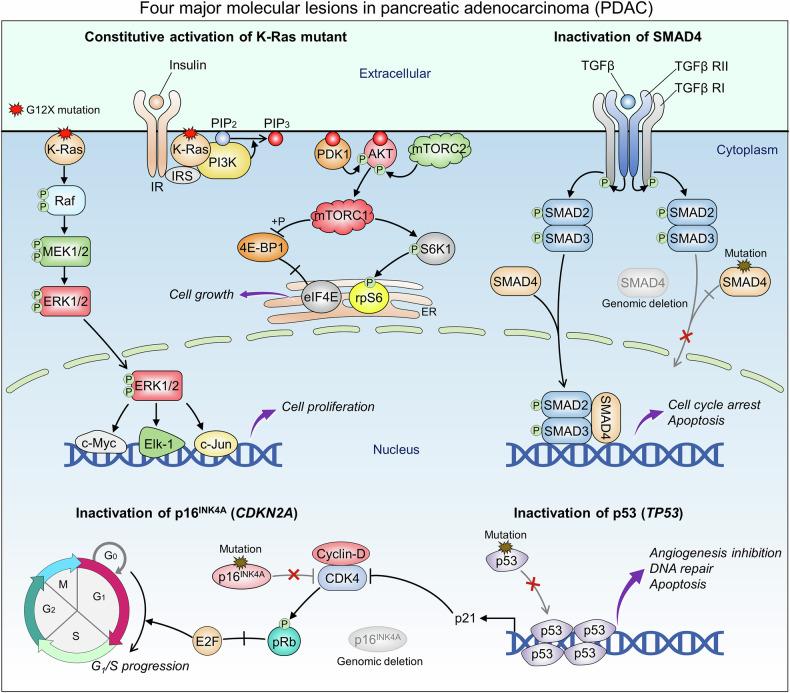
Aggressive tumors pose ultra-challenges to drug resistance. Anti-cancer treatments are often unsuccessful, and single-cell technologies to rein drug resistance mechanisms are still fruitless. The National Cancer Institute defines aggressive cancers at the tissue level, describing them as those that spread rapidly, despite severe treatment. At the molecular, foundational level, the quantitative biophysics discipline defines aggressive cancers as harboring a large number of (overexpressed, or mutated) crucial signaling proteins in major proliferation pathways populating their active conformations, primed for their signal transduction roles. This comprehensive review explores highly aggressive cancers on the foundational and cell signaling levels, focusing on the differences between highly aggressive cancers and the more treatable ones. It showcases aggressive tumors as harboring massive, cancer-promoting, catalysis-primed oncogenic proteins, especially through certain overexpression scenarios, as predisposed aggressive tumor candidates. Our examples narrate strong activation of ERK1/2, and other oncogenic proteins, through malfunctioning chromatin and crosslinked signaling, and how they activate multiple proliferation pathways. They show the increased cancer heterogeneity, plasticity, and drug resistance. Our review formulates the principles underlying cancer aggressiveness on the molecular level, discusses scenarios, and describes drug regimen (single drugs and drug combinations) for PDAC, NSCLC, CRC, HCC, breast and prostate cancers, glioblastoma, neuroblastoma, and leukemia as examples. All show overexpression scenarios of master transcription factors, transcription factors with gene fusions, copy number alterations, dysregulation of the epigenetic codes and epithelial-to-mesenchymal transitions in aggressive tumors, as well as high mutation loads of vital upstream signaling regulators, such as EGFR, c-MET, and K-Ras, befitting these principles.
侵袭性肿瘤对耐药性构成了极大挑战。抗癌治疗往往不成功,而用于揭示耐药机制的单细胞技术仍未取得成果。美国国家癌症研究所从组织层面定义了侵袭性癌症,将其描述为那些尽管接受了严厉治疗仍迅速扩散的癌症。在分子基础层面,定量生物物理学学科将侵袭性癌症定义为在主要增殖途径中含有大量(过表达或突变的)关键信号蛋白,这些蛋白处于活跃构象,准备好发挥其信号转导作用。这篇综述在基础和细胞信号层面探讨了高度侵袭性癌症,重点关注高度侵袭性癌症与更易治疗的癌症之间的差异。它展示了侵袭性肿瘤含有大量促进癌症、引发催化作用的致癌蛋白,特别是通过某些过表达情况,将其作为易患侵袭性肿瘤的候选对象。我们的例子讲述了ERK1/2和其他致癌蛋白如何通过染色质功能失调和交联信号强烈激活,以及它们如何激活多种增殖途径。它们显示出癌症异质性、可塑性和耐药性的增加。我们的综述阐述了分子层面癌症侵袭性的潜在原理,讨论了相关情况,并以胰腺癌、非小细胞肺癌、结直肠癌、肝癌、乳腺癌和前列腺癌、胶质母细胞瘤、神经母细胞瘤和白血病为例,描述了药物治疗方案(单一药物和联合用药)。所有这些都显示了侵袭性肿瘤中主转录因子、具有基因融合的转录因子、拷贝数改变、表观遗传密码失调和上皮-间质转化的过表达情况,以及重要上游信号调节因子如表皮生长因子受体(EGFR)、c-MET和K-Ras的高突变负荷,符合这些原理。


 Zotero 插件