
用于治疗与艾滋病相关的神经认知障碍和物质使用障碍的纳米疗法的最新进展。
Recent advances in nanotherapeutics for HIV-associated neurocognitive disorders and substance use disorders.
作者信息
Lomas Christia, Dubey Ravi Chandra, Perez-Alvarez Gabriela, Lopez Hernandez Yesenia, Atmar Aorzala, Arias Adriana Yndart, Vashist Atul, Aggarwal Saurabh, Manickam Pandiaraj, Lakshmana Madepalli Krishnappa, Vashist Arti
机构信息
Department of Medicine, Herbert Wertheim College of Medicine, Miami, FL, USA.
Department of Cellular and Molecular Medicine, Herbert Wertheim College of Medicine, Miami, FL, USA.
出版信息
Nanomedicine (Lond). 2025 Mar;20(6):603-619. doi: 10.1080/17435889.2025.2461984. Epub 2025 Feb 18.
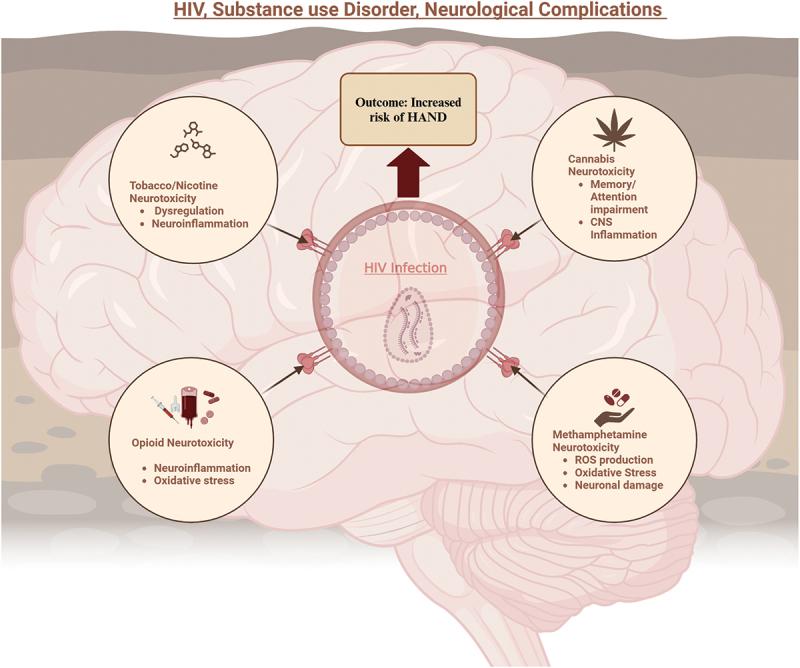
Substance use disorders (SUD) and HIV-associated neurocognitive disorders (HAND) work synergistically as a significant cause of cognitive decline in adults and adolescents globally. Current therapies continue to be limited due to difficulties crossing the blood-brain barrier (BBB) leading to limited precision and effectiveness, neurotoxicity, and lack of co-treatment options for both HAND and SUD. Nanoparticle-based therapeutics have several advantages over conventional therapies including more precise targeting, the ability to cross the BBB, and high biocompatibility which decreases toxicity and optimizes sustainability. These advantages extend to other neurological disorders such as Alzheimer's disease (AD) and amyotrophic lateral sclerosis (ALS). This review summarizes recent advances in nanotechnology for application to HAND, SUD, and co-treatment, as well as other neurological disorders. This review also highlights the potential challenges these therapies face in clinical translation and long-term safety.
物质使用障碍(SUD)和与人类免疫缺陷病毒相关的神经认知障碍(HAND)协同作用,是全球成人和青少年认知能力下降的一个重要原因。由于难以穿过血脑屏障(BBB),目前的治疗方法仍然有限,导致精准度和有效性受限、神经毒性以及缺乏针对HAND和SUD的联合治疗方案。基于纳米颗粒的疗法相对于传统疗法具有几个优势,包括更精准的靶向性、穿过血脑屏障的能力以及高生物相容性,这降低了毒性并优化了可持续性。这些优势也适用于其他神经系统疾病,如阿尔茨海默病(AD)和肌萎缩侧索硬化症(ALS)。本综述总结了纳米技术在HAND、SUD及联合治疗以及其他神经系统疾病应用方面的最新进展。本综述还强调了这些疗法在临床转化和长期安全性方面面临的潜在挑战。


 Zotero 插件