
β-连环蛋白信号活性分析表明,个体发育上不同的齿状颗粒神经元群体存在差异调节。
Analysis of β-Catenin Signalling Activity Suggests Differential Regulation of Ontogenetically Distinct Dentate Granule Neuron Populations.
作者信息
Billmann Charlotte, Schäffner Iris, Heppt Jana, Lie D Chichung
机构信息
Institute for Anatomy, Friedrich-Alexander Universität Erlangen-Nürnberg, Erlangen, Germany.
Institute for Biochemistry, Friedrich-Alexander Universität Erlangen-Nürnberg, Erlangen, Germany.
出版信息
Int J Dev Neurosci. 2025 Feb;85(1):e70009. doi: 10.1002/jdn.70009.
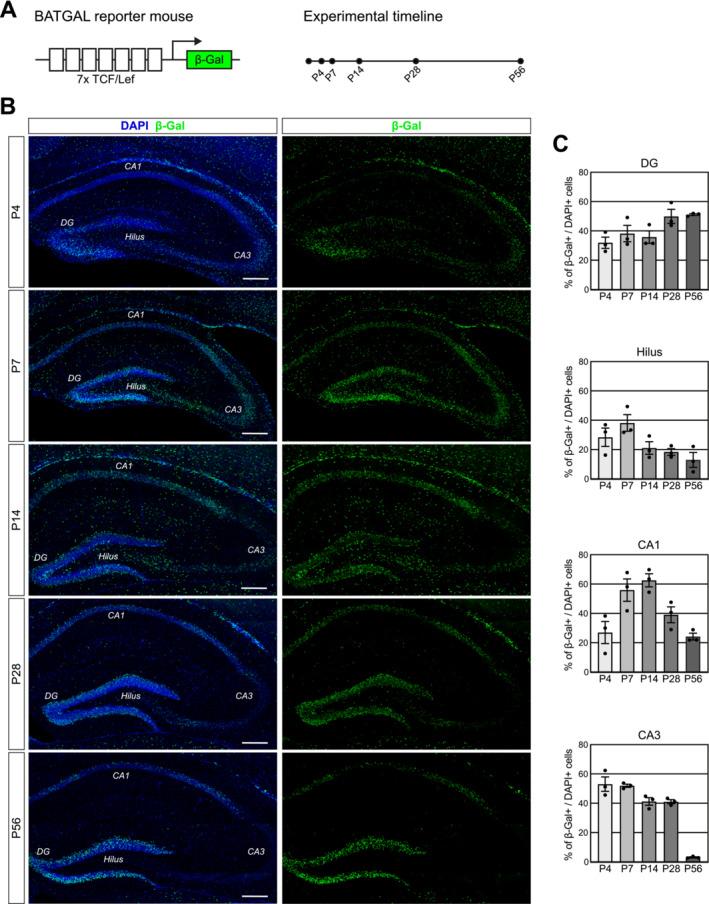
In mammals, the dentate gyrus of the hippocampus is one of the few regions where neurogenesis continues throughout life. As a result, the dentate gyrus harbours neurons of ontogenetically different origin. Notably, ontogenetically different dentate granule neurons (DGNs) are morphologically distinct and fulfil specialized functions in hippocampal information processing and plasticity. Development of adult-born DGNs is tightly controlled by signals released by the complex cellular environment of the adult dentate gyrus. In mice, an adult-like cytoarchitecture of the dentate gyrus is observed only after postnatal Week 2. The question therefore arises when the signalling environment controlling adult neurogenesis is established and whether development of ontogenetically distinct DGNs is subject to the same regulatory pathways. Here, we analyse BATGAL reporter mice to determine the temporal development of β-catenin-signalling activity in the murine DGN lineage. We show that the β-catenin-signalling pattern, which is essential for precise dendritogenesis and neuronal maturation in adulthood, emerges only around 2 weeks after birth and continues to be refined over the next weeks. These results indicate that the signalling environment controlling adult neurogenesis is only gradually established and suggest that the development of ontogenetically distinct DGNs is controlled by different mechanisms.
在哺乳动物中,海马体的齿状回是少数几个终生都有神经发生的区域之一。因此,齿状回包含起源于不同个体发育阶段的神经元。值得注意的是,个体发育起源不同的齿状颗粒神经元(DGNs)在形态上是不同的,并且在海马体信息处理和可塑性方面发挥着特殊功能。成年后生成的DGNs的发育受到成年齿状回复杂细胞环境释放的信号的严格控制。在小鼠中,只有在出生后第2周后才能观察到类似成年的齿状回细胞结构。因此,问题就出现了:控制成年神经发生的信号环境是何时建立的,以及个体发育不同的DGNs的发育是否受相同的调控途径支配。在这里,我们分析了BATGAL报告基因小鼠,以确定小鼠DGN谱系中β-连环蛋白信号活性的时间发育过程。我们发现,β-连环蛋白信号模式在成年期对精确的树突形成和神经元成熟至关重要,它在出生后约2周才出现,并在接下来的几周内持续完善。这些结果表明,控制成年神经发生的信号环境是逐渐建立的,并表明个体发育不同的DGNs的发育受不同机制的控制。


 Zotero 插件