
186990名孕期前接种新冠疫苗的女性的新冠疫苗接种情况及分娩结局:一项全英格兰队列研究
COVID-19 vaccination and birth outcomes of 186,990 women vaccinated before pregnancy: an England-wide cohort study.
作者信息
Suseeladevi Arun K, Denholm Rachel, Retford Matthew, Raffetti Elena, Burden Christy, Birchenall Katherine, Male Victoria, Walker Venetia, Tomlinson Christopher, Wood Angela M, Zuccolo Luisa
机构信息
Population Health Sciences, Bristol Medical School, University of Bristol, Bristol, UK.
NIHR Bristol Biomedical Research Centre, University of Bristol, Bristol, UK.
出版信息
Lancet Reg Health Eur. 2024 Aug 13;45:101025. doi: 10.1016/j.lanepe.2024.101025. eCollection 2024 Oct.
BACKGROUND
COVID-19 vaccination in pregnancy is recommended by the World Health Organisation as effective and safe. However, there remains a lack of robust evidence to inform vaccination choices for women of childbearing potential in relation to their future pregnancies. Here we investigated the association between starting a course of COVID-19 vaccination before pregnancy and birth outcomes.
METHODS
We analysed England-wide linked electronic health records for all pregnancies reaching at least 24 weeks gestation between 25th May 2021 and 28th October 2022. We estimated incidence rates and hazard ratios for birth and pregnancy outcomes by pre-pregnancy COVID-19 vaccination status.
FINDINGS
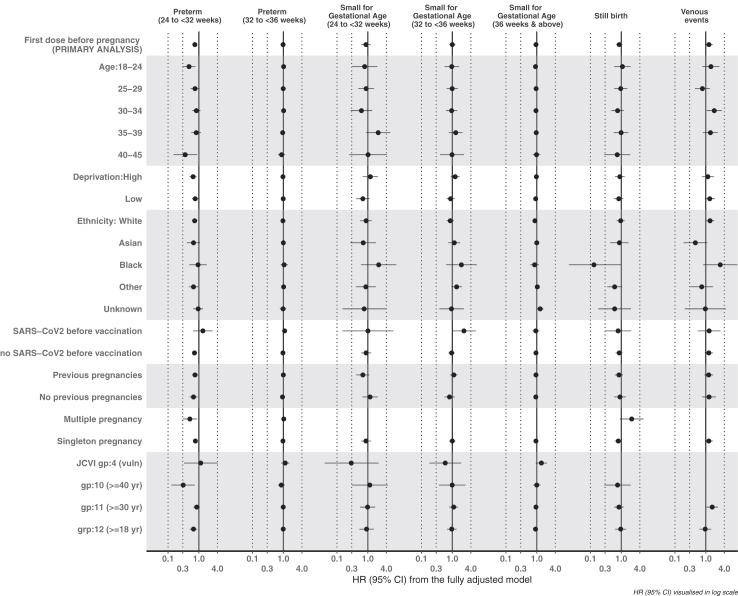
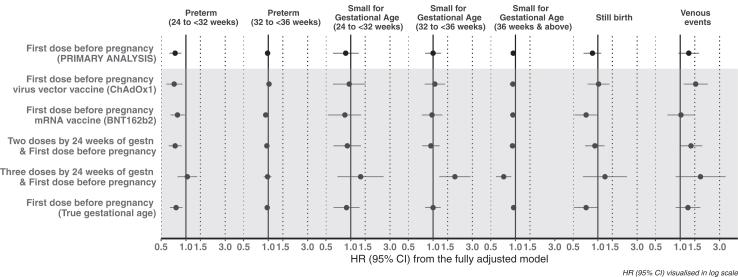
Based on 186,990 women, compared to starting a pregnancy unvaccinated, receiving COVID-19 vaccination within 12 months before pregnancy was associated with lower risks of very and extremely preterm birth and small-for-gestational age in term babies for any vaccine type (adjusted hazard ratio and 95% confidence interval: 0.74 [0.63, 0.88] and 0.94 [0.88, 1.00], respectively), and lower stillbirth risk in those receiving an mRNA vaccine (0.72 [0.52, 1.00]). Incidence of venous thromboembolism during pregnancy was higher amongst women receiving a viral-vector, but not an mRNA vaccine (1.54 [1.10, 2.16] and 1.02 [0.70, 1.50], respectively). Results were generally consistent for different dose regimens and across sensitivity analyses.
INTERPRETATION
We found evidence that pregnancies starting within 12 months from a first COVID-19 vaccination, compared to those in unvaccinated women, experienced fewer adverse birth outcomes, overall or in selected subgroups of the general population, accounting for potential confounders. An mRNA vaccine should be preferred to a viral-vector vaccine, to minimise safety issues, but where the latter is the only choice, it is still to be preferred to starting a pregnancy unvaccinated. The venous thromboembolism risk of the viral-vector vaccine was substantially lower compared to that attributable to SARS-CoV-2 infection in pregnancy or to commonly used medications such as hormone replacement therapy and oral contraceptives in the non-pregnant population.
FUNDING
UK National Institute for Health and Care Research (NIHR), UKRIMedical Research Council, UK Research and Innovation, The Alan Turing Institute, Health Data Research UK, the Department of Health and Social Care.
背景
世界卫生组织建议孕期接种新冠病毒疫苗,认为其有效且安全。然而,对于有生育潜力的女性在未来怀孕时的疫苗接种选择,仍缺乏有力证据。在此,我们调查了怀孕前开始接种新冠病毒疫苗疗程与出生结局之间的关联。
方法
我们分析了2021年5月25日至2022年10月28日期间英格兰范围内所有孕周至少达到24周的怀孕相关的电子健康记录。我们根据怀孕前的新冠病毒疫苗接种状况估算出生和怀孕结局的发病率及风险比。
结果
基于186,990名女性,与未接种疫苗怀孕相比,怀孕前12个月内接种新冠病毒疫苗与任何疫苗类型的晚期和极晚期早产以及足月儿小于胎龄儿的风险降低相关(调整后的风险比及95%置信区间分别为:0.74 [0.63, 0.88]和0.94 [0.88, 1.00]),接种mRNA疫苗者的死产风险更低(0.72 [0.52, 1.00])。接受病毒载体疫苗而非mRNA疫苗的女性孕期静脉血栓栓塞发生率更高(分别为1.54 [1.10, 2.16]和1.02 [0.70, 1.50])。不同剂量方案及敏感性分析的结果总体一致。
解读
我们发现有证据表明,与未接种疫苗的女性相比,首次接种新冠病毒疫苗后12个月内怀孕的女性总体或在一般人群的特定亚组中不良出生结局更少,同时考虑了潜在混杂因素。为尽量减少安全问题,应优先选择mRNA疫苗而非病毒载体疫苗,但如果后者是唯一选择,仍比未接种疫苗怀孕更可取。与孕期感染新冠病毒或非孕期常用药物(如激素替代疗法和口服避孕药)所致的静脉血栓栓塞风险相比,病毒载体疫苗的风险要低得多。
资金来源
英国国家健康与照护研究中心(NIHR)、英国医学研究理事会、英国研究与创新署、艾伦·图灵研究所、英国健康数据研究中心、卫生与社会保健部。
 Zotero 插件