
新型组蛋白修饰与肝癌:表观遗传调控的新前沿
Novel histone modifications and liver cancer: emerging frontiers in epigenetic regulation.
作者信息
Wang Zhonghua, Liu Ziwen, Lv Mengxin, Luan Zhou, Li Tao, Hu Jinhua
机构信息
Department of Gastroenterology, Shandong Provincial Hospital Affiliated to Shandong First Medical University, No. 324, Jingwu Road, Jinan, 250021, Shandong, People's Republic of China.
出版信息
Clin Epigenetics. 2025 Feb 20;17(1):30. doi: 10.1186/s13148-025-01838-8.
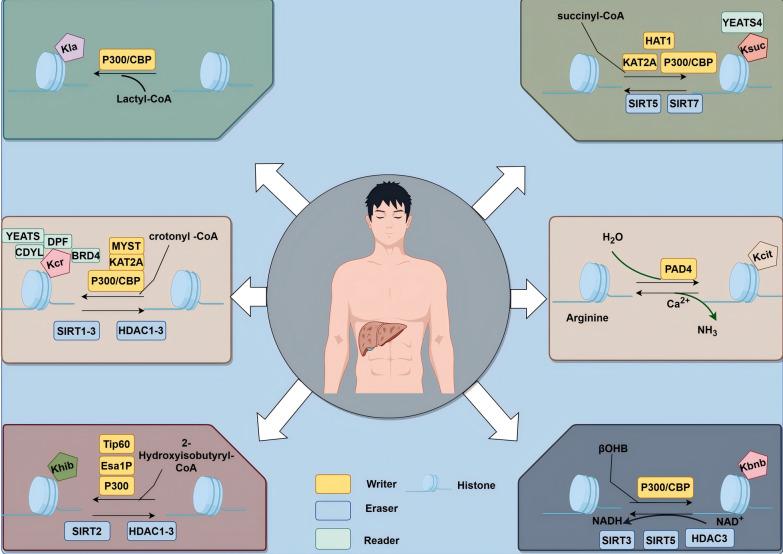
Hepatocellular carcinoma (HCC) is one of the leading causes of cancer-related death worldwide, and its onset and progression are closely associated with epigenetic modifications, particularly post-translational modifications of histones (HPTMs). In recent years, advances in mass spectrometry (MS) have revealed a series of novel HPTMs, including succinylation (Ksuc), citrullination (Kcit), butyrylation (Kbhb), lactylation (Kla), crotonylation (Kcr), and 2-hydroxyisobutyrylation (Khib). These modifications not only expand the histone code but also play significant roles in key carcinogenic processes such as tumor proliferation, metastasis, and metabolic reprogramming in HCC. This review provides the first comprehensive analysis of the impact of novel HPTMs on gene expression, cellular metabolism, immune evasion, and the tumor microenvironment. It specifically focuses on their roles in promoting tumor stem cell characteristics, epithelial-mesenchymal transition (EMT), and therapeutic resistance. Additionally, the review highlights the dynamic regulation of these modifications by specific enzymes, including "writers," "readers," and "erasers."
肝细胞癌(HCC)是全球癌症相关死亡的主要原因之一,其发生和进展与表观遗传修饰密切相关,尤其是组蛋白的翻译后修饰(HPTMs)。近年来,质谱(MS)技术的进展揭示了一系列新的HPTMs,包括琥珀酰化(Ksuc)、瓜氨酸化(Kcit)、丁酰化(Kbhb)、乳酸化(Kla)、巴豆酰化(Kcr)和2-羟基异丁酰化(Khib)。这些修饰不仅扩展了组蛋白密码,而且在HCC的关键致癌过程中发挥重要作用,如肿瘤增殖、转移和代谢重编程。本综述首次全面分析了新型HPTMs对基因表达、细胞代谢、免疫逃逸和肿瘤微环境的影响。它特别关注它们在促进肿瘤干细胞特性、上皮-间质转化(EMT)和治疗抗性中的作用。此外,该综述强调了这些修饰由特定酶进行的动态调节,包括“书写者”、“阅读者”和“擦除者”。

 Zotero 插件