
利用高通量检测技术开发对革兰氏阴性菌具有更广泛谱的嵌合AMP-内溶素
Development of Chimera AMP-Endolysin with Wider Spectra Against Gram-Negative Bacteria Using High-Throughput Assay.
作者信息
Kogawa Masato, Yoda Takuya, Matsuhashi Ayumi, Matsushita Ai, Otsuka Yoshiki, Shibagaki Shohei, Hosokawa Masahito, Tsuda Soichiro
机构信息
bitBiome, Inc., 513 Wasedatsurumaki-Cho, Shinjuku-Ku 162-0041, Tokyo, Japan.
Graduate School of Advanced Science and Engineering, Waseda University, 2-2 Wakamatsu-Cho, Shinjuku-Ku 162-8480, Tokyo, Japan.
出版信息
Viruses. 2025 Jan 30;17(2):200. doi: 10.3390/v17020200.
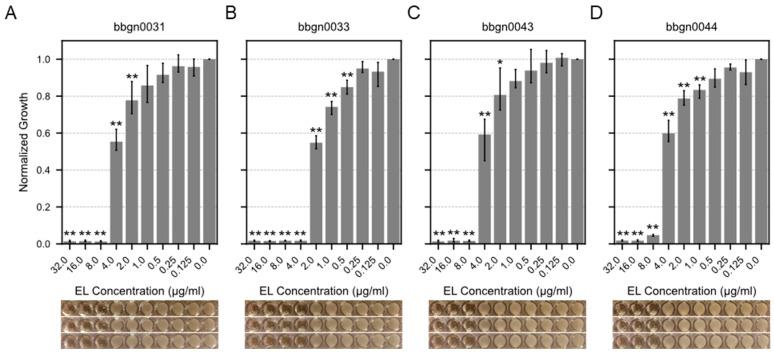
Bacteriophage-derived endolysins are being developed as an alternative to antimicrobials. The development of endolysins against Gram-negative bacteria requires the discovery of effective endolysins against the target species and the capability to penetrate the outer membrane of bacteria by endolysin. Here, we propose an efficient endolysin development approach that combines a data-driven endolysin search utilizing bacterial genomes with high-throughput laboratory assays. As a proof of concept, we analyzed endolysin genes detected in 273 bacterial genomes of , , and . Firstly, we conducted assays of 192 recombinants of endolysin genes obtained through in silico search from bacterial genomes and identified natural endolysins degrading peptidoglycan of . Then, we performed high-throughput screening against Gram-negative bacteria for hundreds of chimera AMP-endolysins, natural endolysin conjugated with antimicrobial peptide. As a result, we obtained four chimera AMP-endolysins against A. baumannii, which demonstrated the minimum inhibitory concentration ranging from 4 to 8 μg/mL. Moreover, we assessed the antimicrobial spectra of these chimera AMP-endolysins, validating that two endolysins exhibited antimicrobial efficacy against and with <32 μg/mL of concentration. This endolysin development approach can be applied to other Gram-negative bacterial targets and is expected to facilitate the acquisition of effective novel endolysins.
噬菌体衍生的溶菌酶正被开发作为抗菌剂的替代品。开发针对革兰氏阴性菌的溶菌酶需要发现针对目标物种的有效溶菌酶以及溶菌酶穿透细菌外膜的能力。在此,我们提出一种高效的溶菌酶开发方法,该方法将利用细菌基因组的数据驱动溶菌酶搜索与高通量实验室检测相结合。作为概念验证,我们分析了在273个[具体细菌名称1]、[具体细菌名称2]和[具体细菌名称3]的细菌基因组中检测到的溶菌酶基因。首先,我们对通过计算机搜索从细菌基因组中获得的192个溶菌酶基因重组体进行了检测,并鉴定出能降解[具体细菌名称1]肽聚糖的天然溶菌酶。然后,我们针对革兰氏阴性菌对数百种嵌合AMP-溶菌酶(与抗菌肽缀合的天然溶菌酶)进行了高通量筛选。结果,我们获得了四种针对鲍曼不动杆菌的嵌合AMP-溶菌酶,其最低抑菌浓度范围为4至8μg/mL。此外,我们评估了这些嵌合AMP-溶菌酶的抗菌谱,验证了两种溶菌酶在浓度<32μg/mL时对[具体细菌名称4]和[具体细菌名称5]具有抗菌效果。这种溶菌酶开发方法可应用于其他革兰氏阴性菌靶点,有望促进获得有效的新型溶菌酶。


 Zotero 插件