
细菌对抗生素和抗菌肽耐药性的进化轨迹 于……(原文此处不完整)
Evolutionary trajectory of bacterial resistance to antibiotics and antimicrobial peptides in .
作者信息
Yu Feiyu, Wang Dejuan, Zhang Haijie, Wang Zhiqiang, Liu Yuan
机构信息
Jiangsu Co-innovation Center for Prevention and Control of Important Animal Infectious Diseases and Zoonoses, College of Veterinary Medicine, Yangzhou University, Yangzhou, China.
Joint International Research Laboratory of Agriculture and Agri-Product Safety, The Ministry of Education of China, Yangzhou University, Yangzhou, China.
出版信息
mSystems. 2025 Mar 18;10(3):e0170024. doi: 10.1128/msystems.01700-24. Epub 2025 Feb 27.
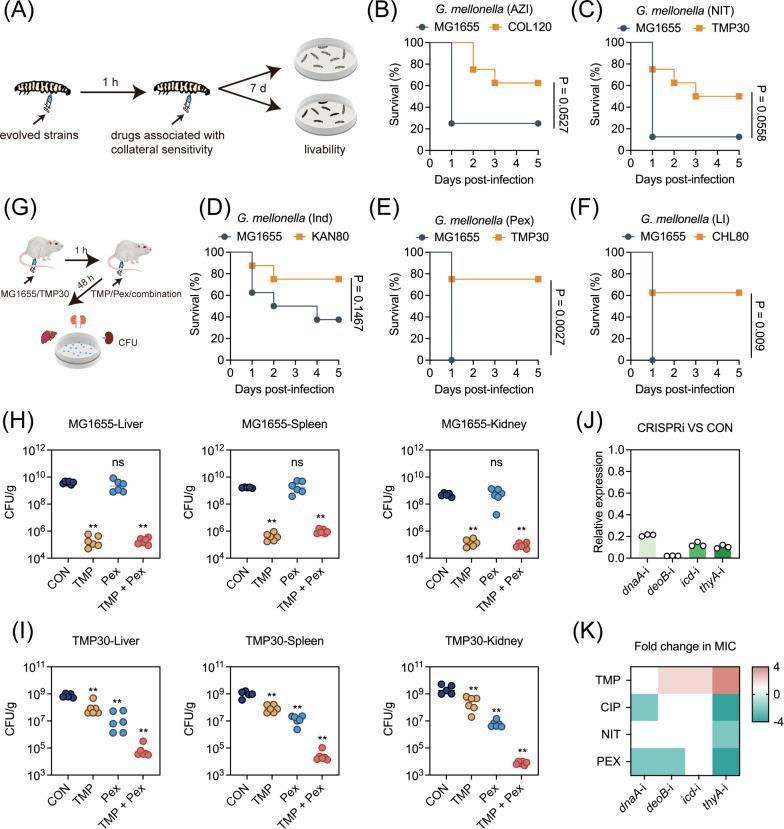
The global crisis of antimicrobial resistance poses a major threat to human health, underscoring the urgency of developing new antibacterial strategies. Antimicrobial peptides (AMPs) are promising alternatives to antibiotic therapy, yet potential microbial resistance is of great concern. Resistance is often accompanied by fitness costs, which may in turn influence the spread of drug-resistant bacteria and their susceptibility to other antimicrobial agents. Herein, we investigate the evolutionary trajectory of bacterial resistance to antibiotics and AMPs in , and evaluate the fitness costs and collateral sensitivity of drug-resistant strains. We reveal that develops resistance to antibiotics, particularly ciprofloxacin and kanamycin, at a notably faster rate than to AMPs. Moreover, antibiotic-evolved strains exhibit slightly higher fitness costs than AMP-evolved bacteria, primarily manifested in reduced bacterial growth and swimming motility. Notably, we demonstrate that trimethoprim-resistant with mutations in gene, displays enhanced susceptibility to pexiganan, as evidenced by both and studies. Overall, our findings shed new insights for the clinical deployment of AMPs and propose innovative therapeutic strategies for combating antibiotic-resistant bacterial infections.IMPORTANCEThe global spread of antimicrobial resistance necessitates the development of innovative anti-infective strategies. Antimicrobial peptides (AMPs) represent promising alternatives in the post-antibiotic era. By monitoring the evolutionary trajectory of bacterial resistance to eight antibiotics and ten AMPs in , we demonstrate that exhibits slower emergence of resistance against AMPs compared with antibiotics. Additionally, these antibiotic-resistant strains incur significant fitness costs, particularly in bacterial growth and motility. Most importantly, we find that some antibiotic-resistant strains show collateral sensitivity to specific AMPs in both and animal infection models, which is conducive to accelerating the development of AMP-based antibacterial treatment.
全球抗菌药物耐药性危机对人类健康构成重大威胁,凸显了开发新抗菌策略的紧迫性。抗菌肽(AMPs)是抗生素治疗的有前景的替代方案,但潜在的微生物耐药性备受关注。耐药性通常伴随着适应性代价,这反过来可能影响耐药菌的传播及其对其他抗菌剂的敏感性。在此,我们研究了细菌对[具体物种]中抗生素和抗菌肽的耐药性进化轨迹,并评估了耐药菌株的适应性代价和协同敏感性。我们发现[具体物种]对抗生素,特别是环丙沙星和卡那霉素产生耐药性的速度明显快于对抗菌肽。此外,抗生素进化菌株表现出比抗菌肽进化细菌略高的适应性代价,主要表现为细菌生长和游动能力降低。值得注意的是,我们证明,在[基因名称]基因发生突变的对甲氧苄啶耐药的[具体物种],对pexiganan的敏感性增强,体外和动物研究均证明了这一点。总体而言,我们的研究结果为抗菌肽的临床应用提供了新见解,并提出了对抗耐抗生素细菌感染的创新治疗策略。重要性抗菌药物耐药性的全球传播需要开发创新的抗感染策略。抗菌肽(AMPs)在后抗生素时代是有前景的替代方案。通过监测[具体物种]对八种抗生素和十种抗菌肽的耐药性进化轨迹,我们证明与抗生素相比,[具体物种]对抗菌肽产生耐药性的速度较慢。此外,这些抗生素耐药菌株会产生显著的适应性代价,特别是在细菌生长和运动方面。最重要的是,我们发现一些抗生素耐药菌株在体外和动物感染模型中对特定抗菌肽表现出协同敏感性,这有利于加速基于抗菌肽的抗菌治疗的开发。


 Zotero 插件