
实体瘤临床试验中的循环肿瘤DNA:挑战与当前应用
Circulating tumor DNA in clinical trials for solid tumors: Challenges and current applications.
作者信息
Parisi Claudia, Tagliamento Marco, Belcaid Laila, Aldea Mihaela, Bayle Arnaud, Remon-Masip Jordi, Italiano Antoine, Planchard David, Besse Benjamin, Barlesi Fabrice
机构信息
Drug Development Department (DITEP), Gustave Roussy, Villejuif, France.
Department of Medical and Surgical Sciences and Translational Medicine, St Andrea University Hospital, Sapienza University, Rome, Italy.
出版信息
J Liq Biopsy. 2023 Aug 29;1:100007. doi: 10.1016/j.jlb.2023.100007. eCollection 2023 Sep.
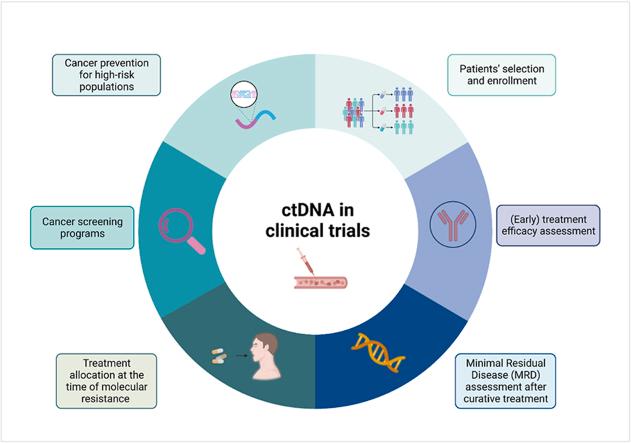
Tumor derived biomarkers including circulating tumor DNA (ctDNA) and/or circulating tumors cells (CTCs) may be detected and quantified through liquid biopsy (LB). ctDNA analysis through LB is a validated tool for monitoring response to systemic treatment and detecting molecular mechanisms of resistance at the time of progression of advanced stage malignancies. Several applications of ctDNA have been investigated in the diagnostic phase of cancer or in the post-curative treatment surveillance phase (e.g., minimal residual disease assessment after neoadjuvant or adjuvant therapy). Recently, the improvement of ctDNA technology and its implementation have affected early phase trials design, with significant changes in the inclusion and randomization phases. Implementation of LB has resulted in large-scale development of academic programs aimed at exploiting all the potential applications of ctDNA, such as patients extended molecular screening, molecular oriented treatment decision making, monitoring of anti-cancer treatments response. In this rapid evolving field, the challenge is no longer the technique, but the evaluation of the results and the interpretation of their impact on diagnosis, prognosis, or therapeutic decision. Leading research cancer centers may favor education for scientific community, by capturing data on this evolving technology and sharing knowledge. In this review we summarize the main applications and challenges of ctDNA genotyping in clinical trials, with special focus on ongoing studies. We finally describe the most important next generation academic and industry-sponsored programs addressing early cancer detection and prevention in high-risk populations through ctDNA genotyping.
包括循环肿瘤DNA(ctDNA)和/或循环肿瘤细胞(CTC)在内的肿瘤衍生生物标志物可通过液体活检(LB)进行检测和定量。通过液体活检进行ctDNA分析是监测全身治疗反应以及在晚期恶性肿瘤进展时检测耐药分子机制的有效工具。ctDNA的几种应用已在癌症诊断阶段或治愈后治疗监测阶段进行了研究(例如,新辅助或辅助治疗后的微小残留病评估)。最近,ctDNA技术的改进及其应用影响了早期试验设计,在纳入和随机分组阶段发生了重大变化。液体活检的应用导致了旨在利用ctDNA所有潜在应用的学术项目的大规模发展,如患者扩展分子筛查、分子导向治疗决策、抗癌治疗反应监测。在这个快速发展的领域,挑战不再是技术,而是结果的评估及其对诊断、预后或治疗决策影响的解读。领先的癌症研究中心可能通过收集关于这一不断发展技术的数据并分享知识,来推动科学界的教育。在这篇综述中,我们总结了ctDNA基因分型在临床试验中的主要应用和挑战,特别关注正在进行的研究。我们最后描述了通过ctDNA基因分型在高危人群中进行早期癌症检测和预防的最重要的下一代学术和行业资助项目。
 Zotero 插件