
到2050年195个国家和地区帕金森病患病率及其驱动因素的预测:2021年全球疾病负担研究的建模研究
Projections for prevalence of Parkinson's disease and its driving factors in 195 countries and territories to 2050: modelling study of Global Burden of Disease Study 2021.
作者信息
Su Dongning, Cui Yusha, He Chengzhang, Yin Peng, Bai Ruhai, Zhu Jinqiao, Lam Joyce S T, Zhang Junjiao, Yan Rui, Zheng Xiaoqing, Wu Jiayi, Zhao Dong, Wang Anxin, Zhou Maigeng, Feng Tao
机构信息
Center for Movement Disorders, Department of Neurology, Beijing Tiantan Hospital, Capital Medical University, Beijing, China.
China National Clinical Research Center for Neurological Diseases, Beijing Tiantan Hospital, Capital Medical University, Beijing, China.
出版信息
BMJ. 2025 Mar 5;388:e080952. doi: 10.1136/bmj-2024-080952.
OBJECTIVE
To predict the global, regional, and national prevalence of Parkinson's disease by age, sex, year, and Socio-demographic Index to 2050 and quantify the factors driving changes in Parkinson's disease cases.
DESIGN
Modelling study.
DATA SOURCE
Global Burden of Disease Study 2021.
MAIN OUTCOME MEASURES
Prevalent number, all age prevalence and age standardised prevalence of Parkinson's disease in 2050, and average annual percentage change of prevalence from 2021 to 2050; contribution of population ageing, population growth, and changes in prevalence to the growth in Parkinson's disease cases; population attributable fractions for modifiable factors.
RESULTS
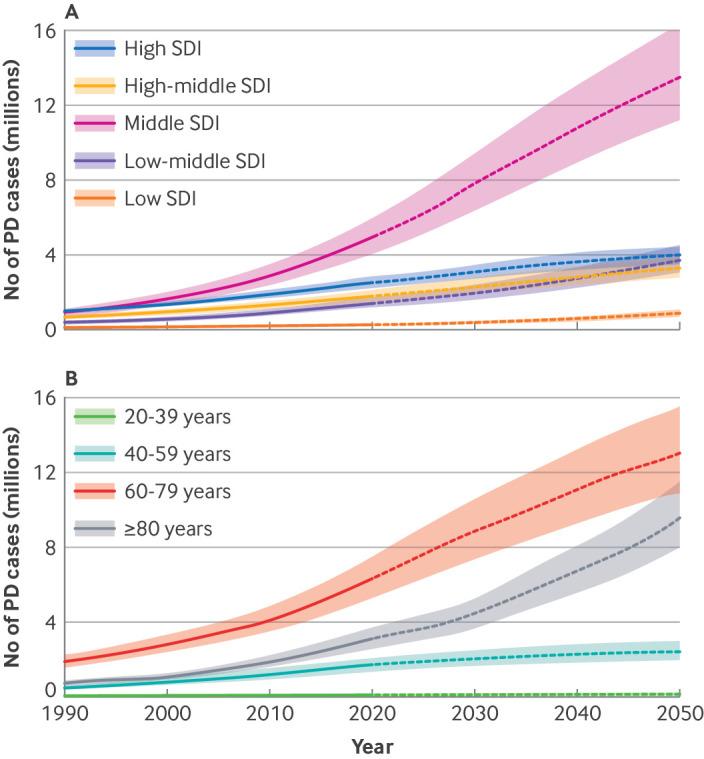
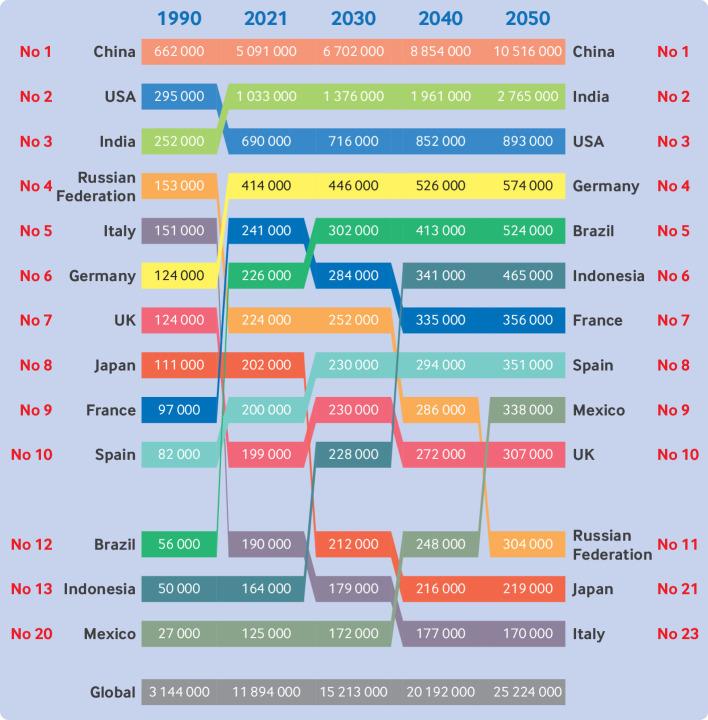
25.2 (95% uncertainty interval 21.7 to 30.1) million people were projected to be living with Parkinson's disease worldwide in 2050, representing a 112% (95% uncertainty interval 71% to 152%) increase from 2021. Population ageing (89%) was predicted to be the primary contributor to the growth in cases from 2021 to 2050, followed by population growth (20%) and changes in prevalence (3%). The prevalence of Parkinson's disease was forecasted to be 267 (230 to 320) cases per 100 000 in 2050, indicating a significant increase of 76% (56% to 125%) from 2021, whereas the age standardised prevalence was predicted to be 216 (168 to 281) per 100 000, with an increase of 55% (50% to 60%) from 2021. Countries in the middle fifth of Socio-demographic Index were projected to have the highest percentage increase in the all age prevalence (144%, 87% to 183%) and age standardised prevalence (91%, 82% to 101%) of Parkinson's disease between 2021 and 2050. Among Global Burden of Disease regions, East Asia (10.9 (9.0 to 13.3) million) was projected to have the highest number of Parkinson's disease cases in 2050, with western Sub-Saharan Africa (292%, 266% to 362%) experiencing the most significant increase from 2021. The ≥80 years age group was projected to have the greatest increase in the number of Parkinson's disease cases (196%, 143% to 235%) from 2021 to 2050. The male-to-female ratios of age standardised prevalence of Parkinson's disease were projected to increase from 1.46 in 2021 to 1.64 in 2050 globally.
CONCLUSIONS
By 2050 Parkinson's disease will have become a greater public health challenge for patients, their families, care givers, communities, and society. The upward trend is expected to be more pronounced among countries with middle Socio-demographic Index, in the Global Burden of Disease East Asia region, and among men. This projection could serve as an aid in promoting health research, informing policy decisions, and allocating resources.
目的
预测到2050年帕金森病在全球、区域和国家层面按年龄、性别、年份及社会人口学指数划分的患病率,并量化推动帕金森病病例数变化的因素。
设计
建模研究。
数据来源
《2021年全球疾病负担研究》。
主要结局指标
2050年帕金森病的患病数、全年龄患病率和年龄标准化患病率,以及2021年至2050年患病率的年均变化百分比;人口老龄化、人口增长和患病率变化对帕金森病病例数增长的贡献;可改变因素的人群归因分数。
结果
预计到2050年全球将有2520万(95%不确定区间为2170万至3010万)人患有帕金森病,较2021年增长112%(95%不确定区间为71%至152%)。预计人口老龄化(89%)是2021年至2050年病例数增长的主要因素,其次是人口增长(20%)和患病率变化(3%)。预计2050年帕金森病的患病率将达到每10万人267例(230至320例),较2021年显著增长76%(56%至125%),而年龄标准化患病率预计为每10万人216例(168至281例),较2021年增长55%(50%至60%)。预计社会人口学指数处于中间五分位的国家,2021年至2050年帕金森病全年龄患病率(144%,87%至183%)和年龄标准化患病率(91%,82%至101%)的增长百分比最高。在全球疾病负担研究的各个区域中,预计东亚地区(1090万(900万至1330万))在2050年帕金森病病例数最多,而撒哈拉以南非洲西部地区(292%,266%至362%)从2021年起增长最为显著。预计80岁及以上年龄组帕金森病病例数从2021年到2050年增长幅度最大(196%,143%至235%)。预计全球帕金森病年龄标准化患病率的男女性别比将从2021年的1.46升至2050年的1.64。
结论
到2050年,帕金森病将对患者、其家庭、护理人员、社区和社会构成更大的公共卫生挑战。这种上升趋势预计在社会人口学指数处于中等水平的国家、全球疾病负担研究中的东亚地区以及男性中更为明显。这一预测可为促进健康研究、为政策决策提供信息以及资源分配提供帮助。





 Zotero 插件