
1990年至2021年帕金森病的全球负担:一项基于人群的研究。
Global burden of Parkinson's disease from 1990 to 2021: a population-based study.
作者信息
Li Mimi, Ye Xiaofang, Huang Zhengping, Ye Lichao, Chen Chunnuan
机构信息
Second Affiliated Hospital of Fujian Medical University, Quanzhou, Fujian, China.
Second Affiliated Hospital of Fujian Medical University, Quanzhou, Fujian, China
出版信息
BMJ Open. 2025 Apr 27;15(4):e095610. doi: 10.1136/bmjopen-2024-095610.
OBJECTIVES
Parkinson's disease (PD) has become a public health concern with global ageing. With a focus on PD, this study sought to project its burden and trends at the national, regional and worldwide levels between 1990 and 2021.
STUDY DESIGN
Population-based study.
METHODS
The Global Burden of Disease (GBD) 2021 provided the PD burden data. The GBD data are considered globally and regionally representative, as it integrates multiple data sources and employs standardised estimation methods. The age-standardised rate (ASR) and estimated annual percentage change (EAPC) were used to estimate trends in the incidence, prevalence, mortality and disability-adjusted life years (DALYs) of PD from 1990 to 2021. ASR was used to calculate the EAPCs using a linear regression model. A Bayesian age-period-cohort model was used to predict future trends up to 2046.
RESULTS
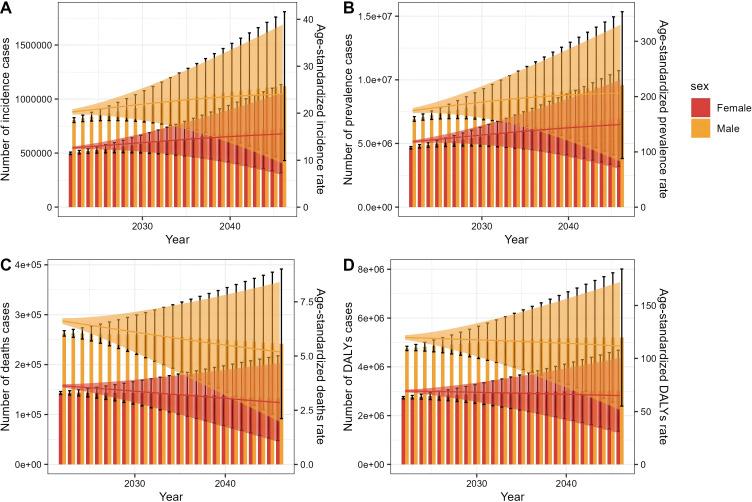
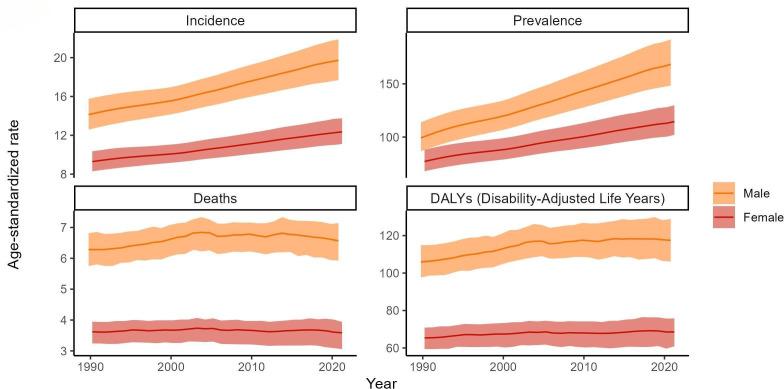
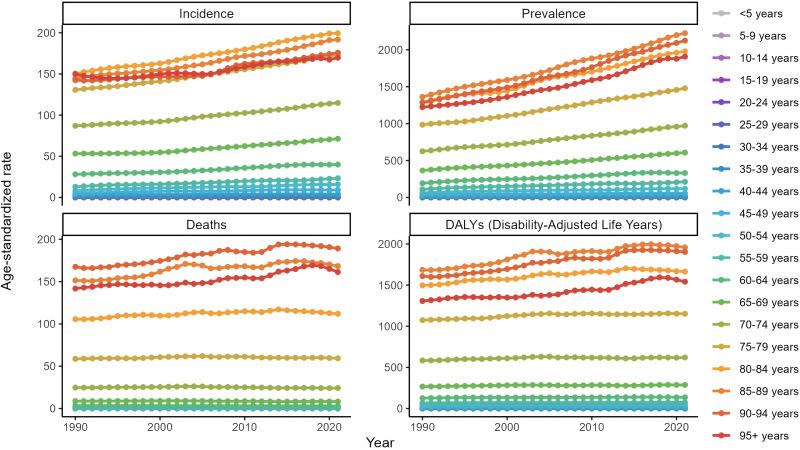
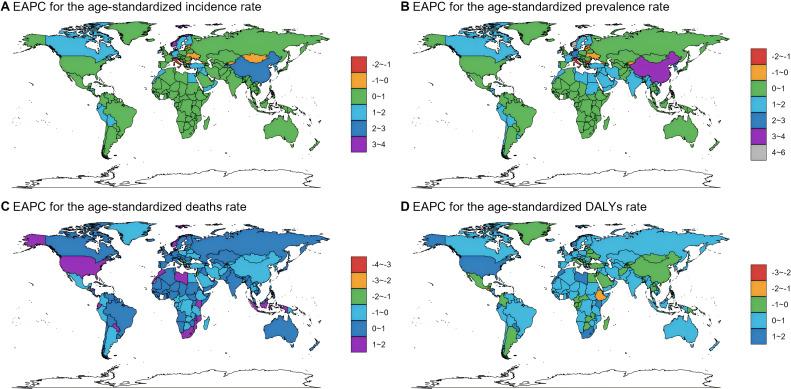
Globally, the overall ASR of PD incidence, prevalence, DALYs and mortality increased from 1990 to 2021. The EAPCs were 1.09 (95% CI: 1.07 to 1.11) for incidence, 1.52 (95% CI: 1.49 to 1.54) for prevalence, 0.32 (95% CI: 0.28 to 0.36) for DALYs and 0.18 (95% CI: 0.13 to 0.23) for mortality. The incidence, prevalence, mortality and DALYs of PD in 2021 were higher in men than in women. The age-standardized incidence rate (ASIR) was 18.52 per 100 000 in men and 12.92 per 100 000 in women (EAPC: 1.11, 95% CI: 1.09 to 1.13 vs 1.07, 95% CI: 1.05 to 1.09). The age-standardized prevalence rate (ASPR) was 157.42 per 100 000 in men and 121.84 per 100 000 in women (EAPC: 1.70, 95% CI: 1.67 to 1.73 vs 1.25, 95% CI: 1.22 to 1.27). The ASMR was 6.57 per 100 000 in men and 3.59 per 100 000 in women (EAPC: 0.21, 95% CI: 0.14 to 0.28 vs -0.01, 95% CI: -0.04 to 0.03). The ASDR was 97.12 per 100 000 in men and 81.23 per 100 000 in women (EAPC: 0.37, 95% CI: 0.33 to 0.42 vs 0.14, 95% CI: 0.10 to 0.18). From 1990 to 2021, the burden of PD remained consistently higher in men than in women, with the gender difference widening with age. The prevalence, incidence, DALYs and mortality rates of PD increased with age before declining, peaking in the 80-84 age group for prevalence and incidence, while peaking in the 90-94 age group for mortality. DALY rates peaked in the 85-89 age group. The ASR of incidence and prevalence increased significantly in Norway (EAPC=3.39, 95% CI: 3.15 to 3.64; EAPC=5.04, 95% CI: 4.65 to 5.43). Lesotho was the nation with the highest rise in age-standardised DALYs for PD (EAPC=1.67, 95% CI: 1.41 to 1.93). The United Arab Emirates had the fastest increase in age-standardised mortality for PD (EAPC=1.98, 95% CI: 1.24 to 2.71). The global ASPR of PD is projected to show a continuous upward trend.
CONCLUSIONS
From 1990 to 2021, there were rising trends in the prevalence and burden of PD in most areas and nations worldwide. Our research indicates that the management and control of PD need significant improvement, particularly in light of the ageing population.
目的
随着全球老龄化,帕金森病(PD)已成为一个公共卫生问题。本研究聚焦于帕金森病,旨在预测1990年至2021年期间其在国家、区域和全球层面的负担及趋势。
研究设计
基于人群的研究。
方法
全球疾病负担(GBD)2021提供了帕金森病负担数据。GBD数据被认为具有全球和区域代表性,因为它整合了多个数据源并采用标准化估计方法。采用年龄标准化率(ASR)和估计年百分比变化(EAPC)来估计1990年至2021年期间帕金森病的发病率、患病率、死亡率和伤残调整生命年(DALY)趋势。使用线性回归模型通过ASR计算EAPC。采用贝叶斯年龄-时期-队列模型预测直至2046年的未来趋势。
结果
全球范围内,1990年至2021年帕金森病发病率、患病率、DALY和死亡率的总体ASR均有所上升。发病率的EAPC为1.09(95%CI:1.07至1.11),患病率为1.52(95%CI:1.49至1.54),DALY为0.32(95%CI:0.28至0.36),死亡率为0.18(95%CI:0.13至0.23)。2021年,男性帕金森病的发病率、患病率、死亡率和DALY均高于女性。男性年龄标准化发病率(ASIR)为每10万人18.52例,女性为每10万人12.92例(EAPC:1.11,95%CI:1.09至1.13对比1.07,95%CI:1.05至1.09)。男性年龄标准化患病率(ASPR)为每10万人157.42例,女性为每10万人121.84例(EAPC:1.70,95%CI:1.67至1.73对比1.25,95%CI:1.22至1.27)。男性年龄标准化死亡率(ASMR)为每10万人6.57例,女性为每10万人3.59例(EAPC:0.21,95%CI:0.14至0.28对比 -0.01,95%CI:-0.04至0.03)。男性年龄标准化伤残调整率(ASDR)为每10万人97.12例,女性为每10万人81.23例(EAPC:0.37,95%CI:0.33至0.42对比0.14,95%CI:0.10至0.18)。1990年至2021年,帕金森病在男性中的负担始终高于女性,且性别差异随年龄增大而扩大。帕金森病的患病率、发病率、DALY和死亡率随年龄增长先上升后下降,患病率和发病率在80 - 84岁年龄组达到峰值,死亡率在90 - 94岁年龄组达到峰值。DALY率在85 - 89岁年龄组达到峰值。挪威的发病率和患病率ASR显著上升(EAPC = 3.39,95%CI:3.15至3.64;EAPC = 5.04,95%CI:4.65至5.43)。莱索托是帕金森病年龄标准化DALY上升最高的国家(EAPC = 1.67,95%CI:1.41至1.93)。阿拉伯联合酋长国帕金森病年龄标准化死亡率上升最快(EAPC = 1.98,95%CI:1.24至2.71)。预计全球帕金森病ASPR将呈持续上升趋势。
结论
1990年至2021年,全球大多数地区和国家帕金森病的患病率和负担呈上升趋势。我们的研究表明,帕金森病的管理和控制需要显著改善,尤其是鉴于人口老龄化的情况。

 Zotero 插件