
肿瘤微环境在肝细胞癌免疫检查点阻断治疗耐药中的复杂作用。
Sophisticated roles of tumor microenvironment in resistance to immune checkpoint blockade therapy in hepatocellular carcinoma.
作者信息
Zhang Yi-Zhe, Ma Yunshu, Ma Ensi, Chen Xizhi, Zhang Yue, Yin Baobing, Zhao Jing
机构信息
Hepatobiliary Surgery Center, Department of General Surgery, Huashan Hospital, Fudan University, Shanghai 200040, China.
Authors contributed equally.
出版信息
Cancer Drug Resist. 2025 Feb 26;8:10. doi: 10.20517/cdr.2024.165. eCollection 2025.
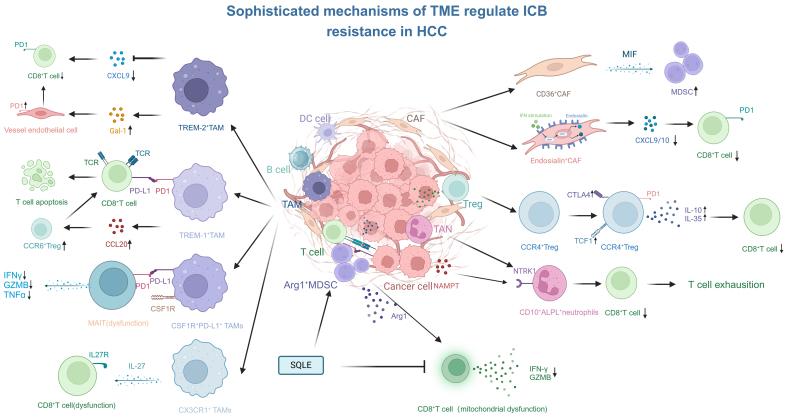
Hepatocellular carcinoma (HCC) remains a serious threat to global health, with rising incidence and mortality rates. Therapeutic options for advanced HCC are quite limited, and the overall prognosis remains poor. Recent advancements in immunotherapy, particularly immune-checkpoint blockade (ICB) targeting anti-PD1/PD-L1 and anti-CTLA4, have facilitated a paradigm shift in cancer treatment, demonstrating substantial survival benefits across various cancer types, including HCC. However, only a subset of HCC patients exhibit a favorable response to ICB therapy, and its efficacy is often hindered by the development of resistance. There are many studies to explore the underlying mechanisms of ICB response. In this review, we compiled the latest progression in immunotherapies for HCC and systematically summarized the sophisticated mechanisms by which components of the tumor microenvironment (TME) regulate resistance to ICB therapy. Additionally, we also outlined some scientific rationale strategies to boost antitumor immunity and enhance the efficacy of ICB in HCC. These insights may serve as a roadmap for future research and help improve outcomes for HCC patients.
肝细胞癌(HCC)仍然是对全球健康的严重威胁,其发病率和死亡率不断上升。晚期HCC的治疗选择非常有限,总体预后仍然很差。免疫疗法的最新进展,特别是针对抗PD1/PD-L1和抗CTLA4的免疫检查点阻断(ICB),推动了癌症治疗的范式转变,在包括HCC在内的各种癌症类型中都显示出显著的生存益处。然而,只有一部分HCC患者对ICB治疗表现出良好反应,其疗效常常受到耐药性发展的阻碍。有许多研究探索ICB反应的潜在机制。在本综述中,我们汇总了HCC免疫疗法的最新进展,并系统总结了肿瘤微环境(TME)成分调节对ICB治疗耐药性的复杂机制。此外,我们还概述了一些增强抗肿瘤免疫力和提高ICB在HCC中疗效的科学合理策略。这些见解可能为未来的研究提供路线图,并有助于改善HCC患者的治疗结果。
 Zotero 插件