
巨噬细胞特异性颗粒蛋白缺乏通过抑制下丘脑和脂肪组织炎症预防饮食诱导的肥胖。
Macrophage-Specific Progranulin Deficiency Prevents Diet-Induced Obesity through the Inhibition of Hypothalamic and Adipose Tissue Inflammation.
作者信息
Lee Chan Hee, Park Chae Beom, Kim Hyun-Kyong, Jang Won Hee, Min Se Hee, Kim Jae Bum, Kim Min-Seon
机构信息
Department of Biomedical Science, Hallym University, Chuncheon, Korea.
Department of Biomedical Science, Asan Medical Institute of Convergence Science and Technology, Asan Medical Center, University of Ulsan College of Medicine, Seoul, Korea.
出版信息
Diabetes Metab J. 2025 Jul;49(4):784-797. doi: 10.4093/dmj.2024.0486. Epub 2025 Mar 11.
BACKGRUOUND
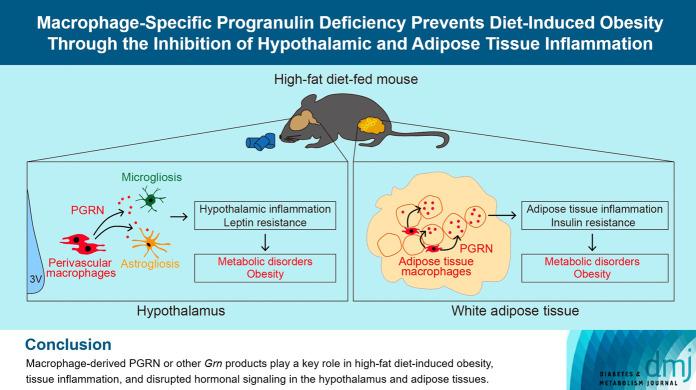
Chronic low-grade inflammation in multiple metabolic organs contributes to the development of insulin resistance induced by obesity. Progranulin (PGRN) is an evolutionarily-conserved secretory protein implicated in immune modulation. The generalized deletion of the PGRN-encoded Grn gene improves insulin resistance and glucose intolerance in obese mice fed a high-fat diet (HFD). However, it remains unclear which cells or organs are responsible for the beneficial metabolic effect of Grn depletion.
METHODS
Considering the critical role of macrophages in HFD-induced obesity and inflammation, we generated mice with a macrophage-specific Grn depletion (Grn-MΦKO mice) by mating lysozyme M (LysM)-Cre and Grn-floxed mice. Body weight, food intake, energy expenditure, and glucose and insulin tolerance were compared between Grn-MΦKO mice and their wildtype (WT) controls under normal chow diet (NCD)- or HFD-fed conditions. We also examined macrophage activation and inflammation- related gene expression in the visceral adipose tissue and hypothalamus along with insulin and leptin signaling.
RESULTS
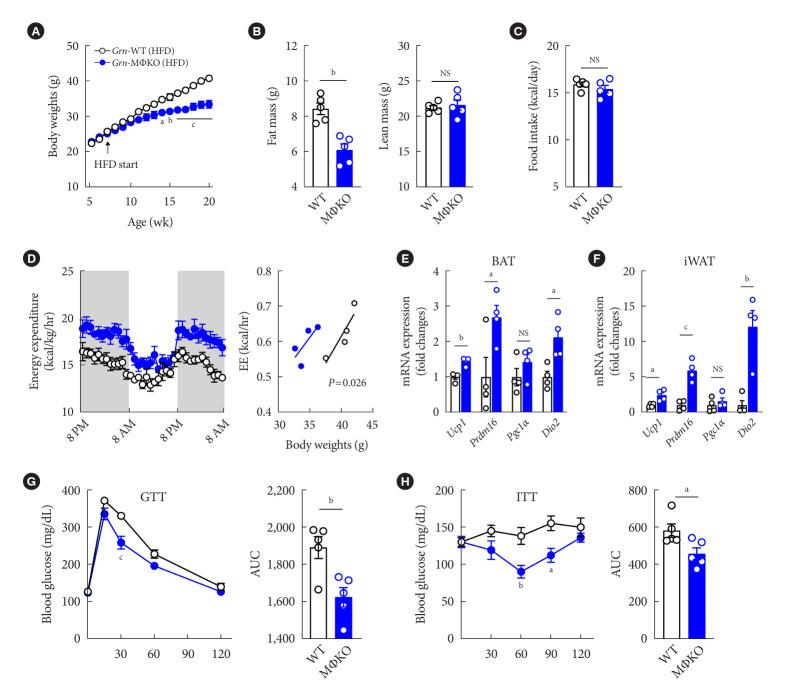
Grn-MΦKO mice showed no alteration in metabolic phenotypes under NCD-fed conditions. However, upon HFD feeding, these mice exhibited less weight gain and improved glucose and insulin tolerance compared to WT mice. Moreover, HFD-induced macrophage activation and proinflammatory cytokine expression were significantly reduced in both the adipose tissue and hypothalamus of Grn-MΦKO mice, while HFD-induced impairments in leptin and insulin signaling showed improvement.
CONCLUSION
Macrophage-derived PGRN and possibly other Grn products play a critical role in the development of HFD-induced obesity, tissue inflammation, and impaired hormonal signaling in both central and peripheral metabolic organs.
背景
多个代谢器官中的慢性低度炎症会导致肥胖诱导的胰岛素抵抗的发展。前颗粒蛋白(PGRN)是一种参与免疫调节的进化保守分泌蛋白。编码PGRN的Grn基因的全身性缺失可改善高脂饮食(HFD)喂养的肥胖小鼠的胰岛素抵抗和葡萄糖不耐受。然而,尚不清楚哪些细胞或器官对Grn缺失的有益代谢作用负责。
方法
考虑到巨噬细胞在HFD诱导的肥胖和炎症中的关键作用,我们通过将溶菌酶M(LysM)-Cre小鼠与Grn基因 floxed 小鼠交配,生成了巨噬细胞特异性Grn缺失的小鼠(Grn-MΦKO小鼠)。在正常 Chow 饮食(NCD)或HFD喂养条件下,比较了Grn-MΦKO小鼠与其野生型(WT)对照的体重、食物摄入量、能量消耗以及葡萄糖和胰岛素耐受性。我们还检查了内脏脂肪组织和下丘脑的巨噬细胞活化以及炎症相关基因表达,以及胰岛素和瘦素信号传导。
结果
在NCD喂养条件下,Grn-MΦKO小鼠的代谢表型没有改变。然而,在HFD喂养后,与WT小鼠相比,这些小鼠体重增加较少,葡萄糖和胰岛素耐受性得到改善。此外,HFD诱导的Grn-MΦKO小鼠脂肪组织和下丘脑的巨噬细胞活化和促炎细胞因子表达均显著降低,而HFD诱导的瘦素和胰岛素信号传导损伤有所改善。
结论
巨噬细胞衍生的PGRN以及可能的其他Grn产物在HFD诱导的肥胖、组织炎症以及中枢和外周代谢器官中激素信号传导受损的发展中起关键作用。



 Zotero 插件