
糖尿病介导了心脏代谢指数与肾结石之间的倒L形关联:一项基于2007 - 2020年美国国家健康与营养检查调查(NHANES)的横断面研究。
Diabetes mediates an inverted L-shaped association between cardiometabolic index and kidney stones: a cross-sectional study from NHANES 2007-2020.
作者信息
Bi Jinghui, Du Jianwei, Yan Xiaoyi, Chen Rongxin
机构信息
Department of Urology, Liaocheng People's Hospital, Liaocheng, Shandong, China.
Department of Critical Care Medicine, Weifang People's Hospital, Shandong Second Medical University, Weifang, Shandong, China.
出版信息
Front Endocrinol (Lausanne). 2025 Feb 25;16:1535724. doi: 10.3389/fendo.2025.1535724. eCollection 2025.
BACKGROUND
Kidney stones are a chronic metabolic disorder. The cardiometabolic index (CMI) is a new and easily accessible measure used to assess metabolic status. However, the relationship between CMI and the incidence of kidney stones remains unclear.
METHODS
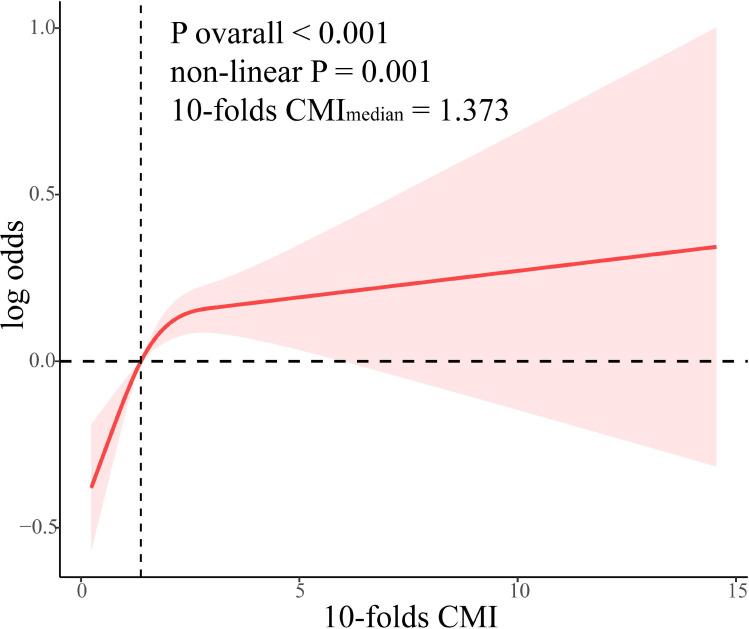
Data from the National Health and Nutrition Examination Survey (NHANES) was used in our cross-sectional study. A weighted multivariable logistic regression analysis was conducted to assess the relationship between CMI and kidney stone incidence. Subgroup and restricted cubic spline regression analyses were utilized to confirm robustness and assess the non-linearity of the association between CMI and kidney stone incidence.
RESULTS
This study involved 18,043 individuals, of whom 9.89% were diagnosed with kidney stones. After controlling for all covariates, CMI showed a significant positive association with kidney stone incidence (OR: 1.07, 95%CI: 1.02-1.12). Individuals in the highest CMI quartile experienced a 50% higher incidence of kidney stones than those in the lowest quartile (OR: 1.50, 95%CI: 1.18-1.92). Additionally, a significant interaction was observed in the subgroup with a history of diabetes (p < 0.05).
CONCLUSION
The study identified a notable non-linear relationship between elevated CMI levels and a greater occurrence of kidney stones. This finding suggests that by routinely monitoring CMI levels, physicians can identify individuals at risk for kidney stones early, allowing for timely intervention to mitigate disease progression.
背景
肾结石是一种慢性代谢紊乱疾病。心脏代谢指数(CMI)是一种用于评估代谢状态的新型且易于获取的指标。然而,CMI与肾结石发病率之间的关系仍不明确。
方法
我们的横断面研究使用了来自美国国家健康与营养检查调查(NHANES)的数据。进行加权多变量逻辑回归分析以评估CMI与肾结石发病率之间的关系。采用亚组分析和受限立方样条回归分析来确认稳健性并评估CMI与肾结石发病率之间关联的非线性。
结果
本研究涉及18043名个体,其中9.89%被诊断患有肾结石。在控制所有协变量后,CMI与肾结石发病率呈现显著正相关(比值比:1.07,95%置信区间:1.02 - 1.12)。CMI最高四分位数的个体肾结石发病率比最低四分位数的个体高50%(比值比:1.50,95%置信区间:1.18 - 1.92)。此外,在有糖尿病史的亚组中观察到显著的交互作用(p < 0.05)。
结论
该研究发现CMI水平升高与肾结石发生率增加之间存在显著的非线性关系。这一发现表明,通过常规监测CMI水平,医生可以早期识别有肾结石风险的个体,从而及时进行干预以减缓疾病进展。

 Zotero 插件