
源自人乳铁蛋白的新型乳源抗菌肽hLFT - 68和hLFT - 309以及源自牛β-乳球蛋白的bLGB - 111的皮肤伤口愈合功能
Cutaneous wound healing functions of novel milk-derived antimicrobial peptides, hLFT-68 and hLFT-309 from human lactotransferrin, and bLGB-111 from bovine β-lactoglobulin.
作者信息
Li Xixian, Zhang Wanning, Yu Wenhao, Yu Yang, Cheng Huiyuan, Lin Yuyang, Feng Jingwen, Zhao Muxin, Jin Yan
机构信息
Department of Plastic Surgery, The Second Affiliated Hospital of Dalian Medical University, No.467, Zhongshan Road, Dalian, 116023, Liaoning, China.
CAS Key Laboratory of Separation Science for Analytical Chemistry, Dalian Institute of Chemical Physics, Chinese Academy of Sciences, No.457, Zhongshan Road, Dalian, 116023, Liaoning, China.
出版信息
Sci Rep. 2025 Mar 22;15(1):9965. doi: 10.1038/s41598-025-90685-x.
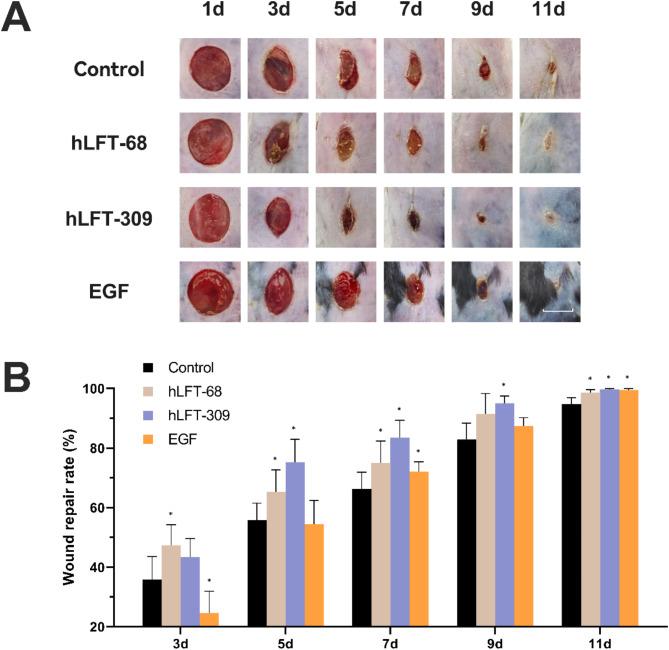
The absence of multi-functional antimicrobial agents in clinical settings hinders cutaneous wound healing. Milk-derived antimicrobial peptides (MAPs) may be the imperative solution to wound repair, combining the dermatic curative properties of antimicrobial peptides with the biological activity of milk. Three novel MAPs, which were hLFT-68 (IAENRADAV) and hLFT-309 (GSPSGQKDLLF) identified in human milk and bLGB-111 (LDTDYKKY) identified in bovine milk in our previous work, were initially investigated for their function in wound healing. In vitro, the antibacterial activity and cellular mechanism of the MAPs were examined. It was found that they presented inhibition for Staphylococcus aureus and Escherichia coli, decreased the secretion of inflammatory factors (IL-1β, IL-6, and TNF-α), and promoted fibroblast and keratinocyte proliferation. An infected wound model was established to evaluate the in vivo anti-inflammatory and regeneration properties of the MAPs. The wound area shrank more rapidly, and the wound inflammation was reduced by MAP treatment. Especially on days 3-5 after mouse modeling, the wound repair rate increased by up to 35%. Furthermore, it was suggested that they encouraged collagen synthesis and deposition, and tissue regeneration. The presented results indicated that MAPs accelerated the recovery of infected wounds, possessing the potential for developing wound-healing therapy.
临床环境中缺乏多功能抗菌剂阻碍了皮肤伤口愈合。源自牛奶的抗菌肽(MAPs)可能是伤口修复的必要解决方案,它将抗菌肽的皮肤治疗特性与牛奶的生物活性结合在一起。在我们之前的工作中,在人乳中鉴定出的三种新型MAPs,即hLFT - 68(IAENRADAV)和hLFT - 309(GSPSGQKDLLF),以及在牛乳中鉴定出的bLGB - 111(LDTDYKKY),最初被研究它们在伤口愈合中的功能。在体外,检测了MAPs的抗菌活性和细胞机制。发现它们对金黄色葡萄球菌和大肠杆菌有抑制作用,减少了炎症因子(IL - 1β、IL - 6和TNF - α)的分泌,并促进了成纤维细胞和角质形成细胞的增殖。建立了感染伤口模型以评估MAPs的体内抗炎和再生特性。经MAP治疗后,伤口面积缩小得更快,伤口炎症减轻。特别是在小鼠建模后的第3 - 5天,伤口修复率提高了高达35%。此外,表明它们促进了胶原蛋白的合成和沉积以及组织再生。所呈现的结果表明,MAPs加速了感染伤口的恢复,具有开发伤口愈合疗法的潜力。




 Zotero 插件