
肌痛性脑脊髓炎/慢性疲劳综合征患者痰液中EB病毒、人疱疹病毒6型、人巨细胞病毒、人腺病毒、严重急性呼吸综合征冠状病毒2型及I型干扰素自身抗体的患病率
Prevalence of EBV, HHV6, HCMV, HAdV, SARS-CoV-2, and Autoantibodies to Type I Interferon in Sputum from Myalgic Encephalomyelitis/Chronic Fatigue Syndrome Patients.
作者信息
Hannestad Ulf, Allard Annika, Nilsson Kent, Rosén Anders
机构信息
Department of Biomedical & Clinical Sciences, Division of Cell & Neurobiology, Linköping University, SE-58185 Linköping, Sweden.
Department of Clinical Microbiology, Clinical Virology, Umeå University, SE-90185 Umeå, Sweden.
出版信息
Viruses. 2025 Mar 14;17(3):422. doi: 10.3390/v17030422.
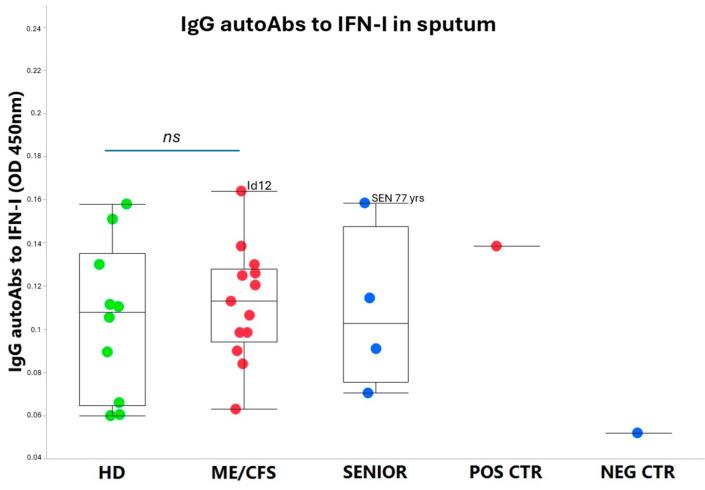
An exhausted antiviral immune response is observed in myalgic encephalomyelitis/chronic fatigue syndrome (ME/CFS) and post-SARS-CoV-2 syndrome, also termed long COVID. In this study, potential mechanisms behind this exhaustion were investigated. First, the viral load of Epstein-Barr virus (EBV), human adenovirus (HAdV), human cytomegalovirus (HCMV), human herpesvirus 6 (HHV6), and severe acute respiratory syndrome coronavirus 2 (SARS-CoV-2) was determined in sputum samples (n = 29) derived from ME/CFS patients (n = 13), healthy controls (n = 10), elderly healthy controls (n = 4), and immunosuppressed controls (n = 2). Secondly, autoantibodies (autoAbs) to type I interferon (IFN-I) in sputum were analyzed to possibly explain impaired viral immunity. We found that ME/CFS patients released EBV at a significantly higher level compared to controls ( = 0.0256). HHV6 was present in ~50% of all participants at the same level. HAdV was detected in two cases with immunosuppression and severe ME/CFS, respectively. HCMV and SARS-CoV-2 were found only in immunosuppressed controls. Notably, anti-IFN-I autoAbs in ME/CFS and controls did not differ, except in a severe ME/CFS case showing an increased level. We conclude that ME/CFS patients, compared to controls, have a significantly higher load of EBV. IFN-I autoAbs cannot explain IFN-I dysfunction, with the possible exception of severe cases, also reported in severe SARS-CoV-2. We forward that additional mechanisms, such as the viral evasion of IFN-I effect via the degradation of IFN-receptors, may be present in ME/CFS, which demands further studies.
在肌痛性脑脊髓炎/慢性疲劳综合征(ME/CFS)和新冠后综合征(也称为长期新冠)中观察到抗病毒免疫反应耗竭。在本研究中,对这种耗竭背后的潜在机制进行了调查。首先,在来自ME/CFS患者(n = 13)、健康对照(n = 10)、老年健康对照(n = 4)和免疫抑制对照(n = 2)的痰液样本(n = 29)中测定了爱泼斯坦-巴尔病毒(EBV)、人腺病毒(HAdV)、人巨细胞病毒(HCMV)、人疱疹病毒6型(HHV6)和严重急性呼吸综合征冠状病毒2(SARS-CoV-2)的病毒载量。其次,分析痰液中针对I型干扰素(IFN-I)的自身抗体(autoAbs),以可能解释病毒免疫受损。我们发现,与对照组相比,ME/CFS患者释放EBV的水平显著更高(P = 0.0256)。HHV6在所有参与者的约50%中以相同水平存在。分别在2例免疫抑制和严重ME/CFS患者中检测到HAdV。仅在免疫抑制对照中发现了HCMV和SARS-CoV-2。值得注意的是,ME/CFS患者和对照组中的抗IFN-I自身抗体没有差异,除了1例严重ME/CFS病例显示水平升高。我们得出结论,与对照组相比,ME/CFS患者的EBV载量显著更高。IFN-I自身抗体无法解释IFN-I功能障碍,严重病例可能除外,严重新冠中也有此类报道。我们提出,ME/CFS中可能存在其他机制,如通过IFN受体降解实现病毒对IFN-I效应的逃避,这需要进一步研究。


 Zotero 插件