
光谱学和晶体学将类胡萝卜素加氧酶定义为单核非血红素铁酶的一个新亚类。
Spectroscopy and crystallography define carotenoid oxygenases as a new subclass of mononuclear non-heme Fe enzymes.
作者信息
DeWeese Dory E, Everett Michael P, Babicz Jeffrey T, Daruwalla Anahita, Solomon Edward I, Kiser Philip D
机构信息
Department of Chemistry, Stanford University, Stanford, California, USA.
Department of Physiology & Biophysics, University of California, Irvine School of Medicine, Irvine, California, USA.
出版信息
J Biol Chem. 2025 Mar 25;301(5):108444. doi: 10.1016/j.jbc.2025.108444.
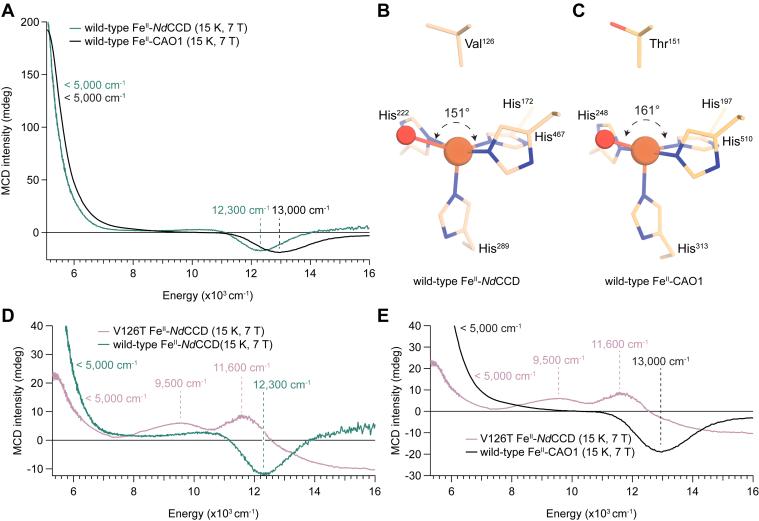
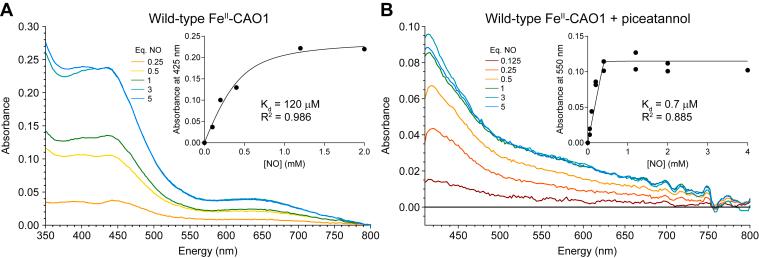
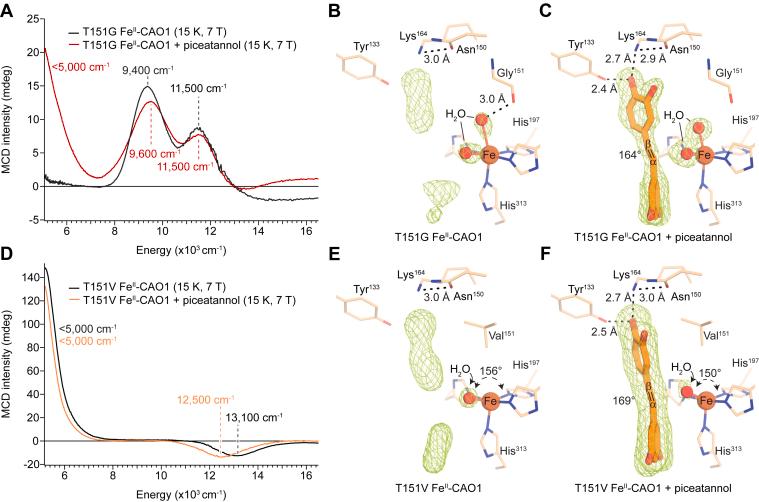
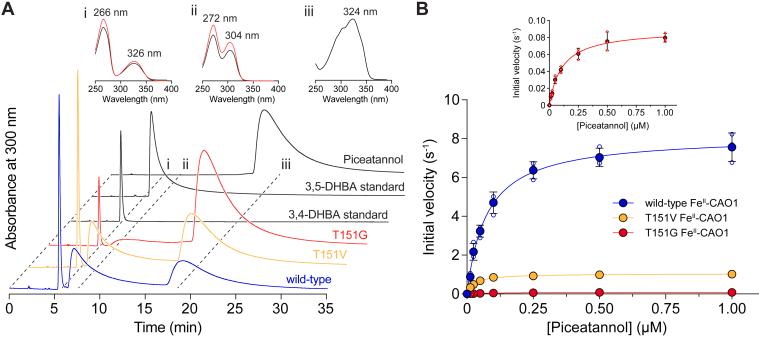
Carotenoid cleavage dioxygenases (CCDs) are non-heme Fe enzymes that catalyze the oxidative cleavage of alkene bonds in carotenoids, stilbenoids, and related compounds. How these enzymes control the reaction of dioxygen (O) with their alkene substrates is unclear. Here, we apply spectroscopy in conjunction with X-ray crystallography to define the iron coordination geometry of a model CCD, CAO1 (Neurospora crassa carotenoid oxygenase 1), in its resting state and following substrate binding and coordination sphere substitutions. Resting CAO1 exhibits a five-coordinate (5C), square pyramidal Fe center that undergoes steric distortion toward a trigonal bipyramidal geometry in the presence of piceatannol. Titrations with the O-analog, nitric oxide, show a >100-fold increase in iron-nitric oxide affinity upon substrate binding, defining a crucial role for the substrate in activating the Fe site for O reactivity. The importance of the 5C Fe structure for reactivity was probed through mutagenesis of the second-sphere Thr151 residue of CAO1, which occludes ligand binding at the sixth coordination position. A T151G substitution resulted in the conversion of the iron center to a six-coordinate state and a 135-fold reduction in apparent catalytic efficiency toward piceatannol compared with the wildtype enzyme. Substrate complexation resulted in partial six-coordinate to 5C conversion, indicating solvent dissociation from the iron center. Additional substitutions at this site demonstrated a general functional importance of the occluding residue within the CCD superfamily. Taken together, these data suggest an ordered mechanism of CCD catalysis occurring via substrate-promoted solvent replacement by O. CCDs thus represent a new class of mononuclear non-heme Fe enzymes.
类胡萝卜素裂解双加氧酶(CCDs)是一类非血红素铁酶,可催化类胡萝卜素、芪类化合物及相关化合物中烯烃键的氧化裂解。目前尚不清楚这些酶如何控制双加氧(O)与烯烃底物的反应。在此,我们结合光谱学和X射线晶体学,来确定模型CCDs(CAO1,粗糙脉孢菌类胡萝卜素加氧酶1)在静止状态下、底物结合后以及配位球取代后的铁配位几何结构。静止状态下的CAO1呈现出五配位(5C)的四方锥铁中心,在紫檀芪存在时会向三方双锥几何结构发生空间扭曲。用O类似物一氧化氮进行滴定表明,底物结合后铁-一氧化氮亲和力增加了100倍以上,这表明底物在激活铁位点以促进O反应性方面起着关键作用。通过对CAO1的第二配位层Thr151残基进行诱变,探究了5C铁结构对反应性的重要性,该残基会阻碍第六配位位置的配体结合。与野生型酶相比,T151G取代导致铁中心转变为六配位状态,对紫檀芪的表观催化效率降低了135倍。底物络合导致部分六配位向5C转变,表明溶剂从铁中心解离。该位点的其他取代表明,CCDs超家族中封闭残基具有普遍的功能重要性。综上所述,这些数据表明CCDs催化的有序机制是通过底物促进O取代溶剂而发生的。因此,CCDs代表了一类新的单核非血红素铁酶。


 Zotero 插件