
1990年至2021年老年人因高体重指数导致的全球哮喘负担及到2050年的预测:2021年全球疾病负担研究分析
Global burden of asthma attributable to high body mass index in older adults 1990-2021 and prediction to 2050: An analysis of Global Burden of Disease Study 2021.
作者信息
Wang Zhikang, Liu Yifang, Li Yilin, Wang Qi, Liu Junan
机构信息
Department of Social Medicine and Health Management, School of Public Health, Tongji Medical College, Huazhong University of Science and Technology, Wuhan, Hubei Province, China.
Department of Epidemiology and Biostatistics, School of Public Health, Tongji Medical College, Huazhong University of Science and Technology, Wuhan, 430030, China.
出版信息
World Allergy Organ J. 2025 Mar 12;18(3):101040. doi: 10.1016/j.waojou.2025.101040. eCollection 2025 Mar.
BACKGROUND
Previous studies have shown that high body mass index was a primary risk factor for asthma, particularly impacting older adults. This study aimed to assess the spatial and temporal trends for asthma burden attributable to high body mass index in older adults from 1990 to 2021 and to project trends up to 2050.
METHOD
We extracted data from the Global Burden of Disease Study 2021 for population aged over 60 years with asthma attributable to high BMI. Relevant indicators included number of deaths, disability-adjusted life years, mortality, and disability-adjusted life years rates and the rates were directly standardized. Spearman rank correlation test tested the burden against the Socio-demographic Index (SDI). Decomposition analysis was used to decompose changes in burden according to population structure, population growth, and epidemiologic changes. The Bayesian age-period-cohort model was used to predict the burden.
RESULTS
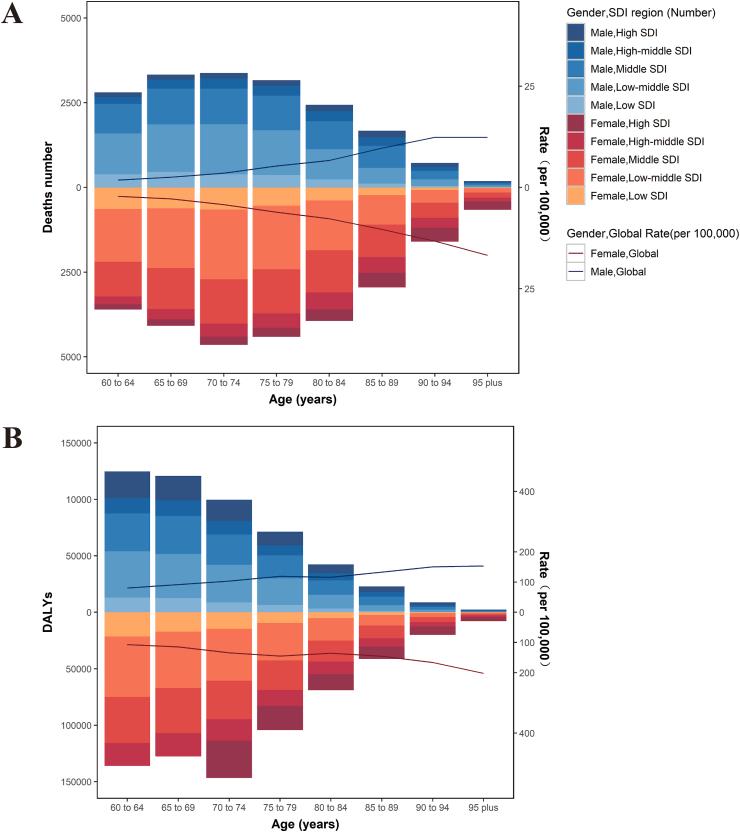
From 1990 to 2021, despite downward trends in global mortality and disability-adjusted life-year rates, global asthma deaths, and disability-adjusted life years attributable to high body mass index increase by 69% and 46%, rising to 43,628 cases (95% CI: 18,366-71 088) and 1,223,969 years (95% CI: 526,972-1 945,426). Age-standardized mortality rates and disability-adjusted life years rates were more severe in regions with lower SDI, such as Oceania. Mortality rates and disability-adjusted life-year rates increased with age, with a higher burden observed in females compared to males. Population growth had a significant impact on the increase in deaths and disability-adjusted life years from 1990 to 2021, contributing approximately 158% and 222%, respectively. Asthma deaths and disability-adjusted life years attributable to high body mass index will continue to rise to 101,252 cases and 2,941,172 years up to 2050.
CONCLUSION
The global asthma burden due to high body mass index in older adults has risen significantly and is expected to continue this trend, highlighting the importance of developing public health strategies to address this issue.
背景
先前的研究表明,高体重指数是哮喘的主要危险因素,对老年人的影响尤为显著。本研究旨在评估1990年至2021年老年人中因高体重指数导致的哮喘负担的时空趋势,并预测至2050年的趋势。
方法
我们从《2021年全球疾病负担研究》中提取了60岁以上因高体重指数导致哮喘的人群数据。相关指标包括死亡人数、伤残调整生命年、死亡率、伤残调整生命年率,且这些率进行了直接标准化。Spearman等级相关检验用于检验负担与社会人口指数(SDI)之间的关系。分解分析用于根据人口结构、人口增长和流行病学变化来分解负担的变化。贝叶斯年龄-时期-队列模型用于预测负担。
结果
1990年至2021年期间,尽管全球死亡率和伤残调整生命年率呈下降趋势,但因高体重指数导致的全球哮喘死亡人数和伤残调整生命年分别增加了69%和46%,增至43,628例(95%置信区间:18,366 - 71,088)和1,223,969年(95%置信区间:526,972 - 1,945,426)。年龄标准化死亡率和伤残调整生命年率在SDI较低的地区更为严重,如大洋洲。死亡率和伤残调整生命年率随年龄增长而增加,女性的负担高于男性。人口增长对1990年至2021年期间死亡人数和伤残调整生命年的增加有显著影响,分别贡献了约158%和222%。到2050年,因高体重指数导致的哮喘死亡人数和伤残调整生命年将继续增至101,252例和2,941,172年。
结论
老年人中因高体重指数导致的全球哮喘负担显著上升,预计这一趋势将持续,凸显了制定公共卫生策略以解决这一问题的重要性。




 Zotero 插件