
氨通过降低成熟穿孔素水平来抑制自然杀伤细胞和T细胞的抗肿瘤活性。
Ammonia Suppresses the Antitumor Activity of Natural Killer Cells and T Cells by Decreasing Mature Perforin.
作者信息
Domagala Joanna, Grzywa Tomasz M, Baranowska Iwona, Justyniarska Magdalena, Tannir Ryan, Graczyk-Jarzynka Agnieszka, Kusowska Aleksandra, Lecka Maria, Poreba Marcin, Fidyt Klaudyna, Marhelava Katsiaryna, Pilch Zofia, Picard Lea K, Wegierski Tomasz, Jastrzebski Kamil, Krawczyk Marta, Klopotowska Marta, Granica Monika, Urlaub Doris, Hajduk Szymon, Neeser Alexandra, Moros Spencer, Kozlowski Pawel, Bobrowicz Malgorzata, Miaczynska Marta, Ma Leyuan, Watzl Carsten, Winiarska Magdalena
机构信息
Department of Immunology, Medical University of Warsaw, Warsaw, Poland.
Department of Immunology, Mossakowski Medical Research Institute, Polish Academy of Sciences, Warsaw, Poland.
出版信息
Cancer Res. 2025 Jul 2;85(13):2448-2467. doi: 10.1158/0008-5472.CAN-24-0749.
UNLABELLED
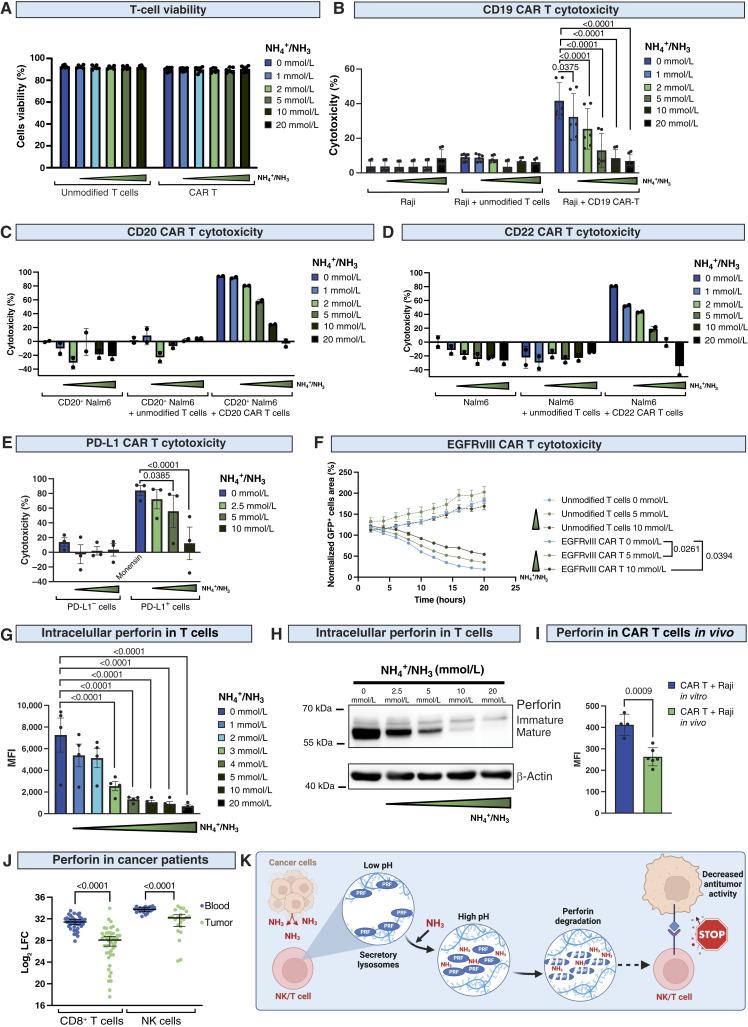
Immunotherapy revolutionized cancer treatment in the last decade. Both NK cells and T cells are key components of host immunity against malignant cells that are being extensively investigated in the field of cancer immunotherapy. While approaches have been developed to improve the antitumor activity of NK and T cells, the tumor microenvironment remains an obstacle to effective NK and T-cell-based therapies. Here, we demonstrated that cancer-conditioned medium suppresses the antitumor activity of NK cells. Ammonia, a by-product of cancer cell metabolism, accumulated in cancer-conditioned medium and in the tumor microenvironment, and impaired the cytotoxicity of NK cells as well as the efficacy of antibody-based and chimeric antigen receptor (CAR) NK and CAR T-cell-based therapies in vitro. Ammonia induced NK and T-cell dysfunction by decreasing the amount of mature perforin in secretory lysosomes, which was dependent on its lysosomotropic features and ability to increase pH in acidic compartments. These findings demonstrate that, in addition to its previously described role in promoting tumor growth as a source of nitrogen for tumor biomass, ammonia promotes tumor immune escape by inhibiting both NK and CAR T-cell cytotoxicity.
SIGNIFICANCE
Ammonia is elevated in the tumor microenvironment and functions as an immunoinhibitory metabolite in cancer by reducing perforin levels, inhibiting NK and T-cell-mediated immunity and limiting the efficacy of immunotherapies.
未标注
免疫疗法在过去十年中彻底改变了癌症治疗。自然杀伤(NK)细胞和T细胞都是宿主抗恶性细胞免疫的关键组成部分,在癌症免疫治疗领域受到广泛研究。虽然已经开发出提高NK细胞和T细胞抗肿瘤活性的方法,但肿瘤微环境仍然是基于NK和T细胞的有效治疗的障碍。在这里,我们证明了癌症条件培养基会抑制NK细胞的抗肿瘤活性。氨是癌细胞代谢的副产物,在癌症条件培养基和肿瘤微环境中积累,并损害NK细胞的细胞毒性以及体外基于抗体和嵌合抗原受体(CAR)的NK细胞和CAR T细胞疗法的疗效。氨通过减少分泌性溶酶体中成熟穿孔素的量来诱导NK细胞和T细胞功能障碍,这取决于其溶酶体亲和特性和在酸性区室中提高pH值的能力。这些发现表明,除了其先前描述的作为肿瘤生物量氮源促进肿瘤生长的作用外,氨还通过抑制NK细胞和CAR T细胞的细胞毒性来促进肿瘤免疫逃逸。
意义
肿瘤微环境中氨水平升高,通过降低穿孔素水平、抑制NK细胞和T细胞介导的免疫以及限制免疫疗法的疗效,在癌症中作为一种免疫抑制代谢物发挥作用。


 Zotero 插件