
衰老对骨骼肌中钙通道的影响。
Effects of aging on calcium channels in skeletal muscle.
作者信息
Dong Mingyi, Maturana Andrés Daniel
机构信息
Department of Applied Biosciences, Graduate School of Bioagricultural Science, Nagoya University, Nagoya, Japan.
出版信息
Front Mol Biosci. 2025 Mar 19;12:1558456. doi: 10.3389/fmolb.2025.1558456. eCollection 2025.
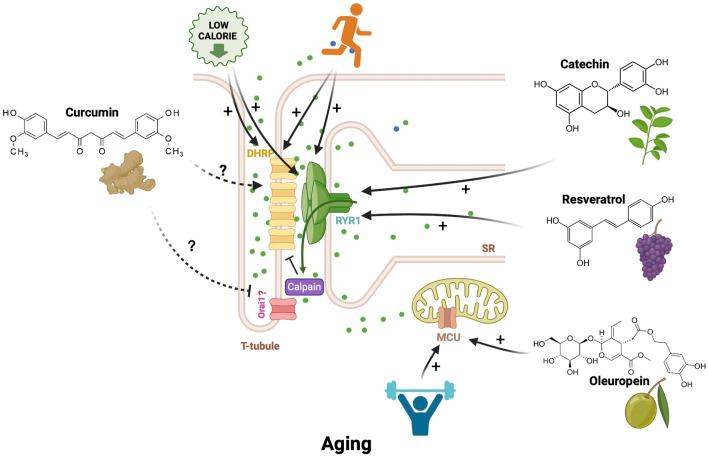
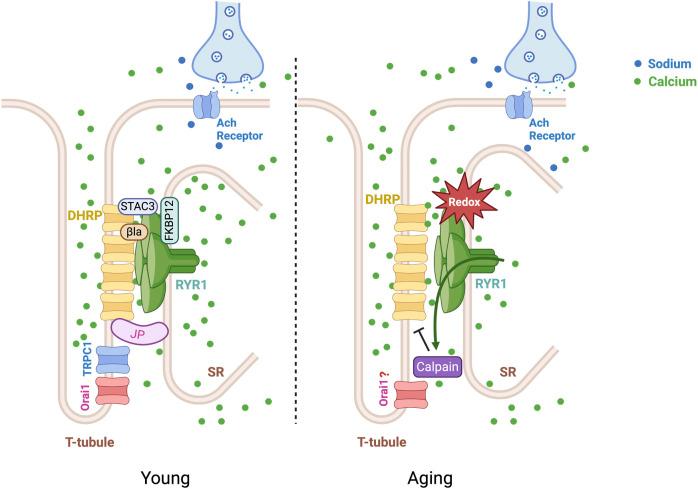
In skeletal muscle, calcium is not only essential to stimulate and sustain their contractions but also for muscle embryogenesis, regeneration, energy production in mitochondria, and fusion. Different ion channels contribute to achieving the various functions of calcium in skeletal muscles. Muscle contraction is initiated by releasing calcium from the sarcoplasmic reticulum through the ryanodine receptor channels gated mechanically by four dihydropyridine receptors of T-tubules. The calcium influx through store-operated calcium channels sustains the contraction and stimulates muscle regeneration. Mitochondrial calcium uniporter allows the calcium entry into mitochondria to stimulate oxidative phosphorylation. Aging alters the expression and activity of these different calcium channels, resulting in a reduction of skeletal muscle force generation and regeneration capacity. Regular physical training and bioactive molecules from nutrients can prevent the effects of aging on calcium channels. This review focuses on the current knowledge of the effects of aging on skeletal muscles' calcium channels.
在骨骼肌中,钙不仅对于刺激和维持肌肉收缩至关重要,而且对肌肉胚胎发育、再生、线粒体中的能量产生以及融合也必不可少。不同的离子通道有助于实现钙在骨骼肌中的各种功能。肌肉收缩是通过肌浆网中的钙通过由T小管的四个二氢吡啶受体机械门控的兰尼碱受体通道释放而启动的。通过储存-操纵性钙通道的钙内流维持收缩并刺激肌肉再生。线粒体钙单向转运体允许钙进入线粒体以刺激氧化磷酸化。衰老会改变这些不同钙通道的表达和活性,导致骨骼肌力量产生和再生能力下降。定期体育锻炼和来自营养物质的生物活性分子可以预防衰老对钙通道的影响。本综述聚焦于衰老对骨骼肌钙通道影响的当前知识。

 Zotero 插件