
巴拉圭食用动物中的非伤寒型:主要血清型和耐药表型
Non-typhoidal in food animals in Paraguay: predominant serovars and resistance phenotypes.
作者信息
Irrazábal Rossana, Iriarte María V, Alvarez Julio
机构信息
Department of Epidemiologic Surveillance, National Animal Health and Quality Service (SENACSA), San Lorenzo, Paraguay.
Faculty of Veterinary Medicine, University of Republic, Montevideo, Uruguay.
出版信息
Front Vet Sci. 2025 Mar 25;12:1521469. doi: 10.3389/fvets.2025.1521469. eCollection 2025.
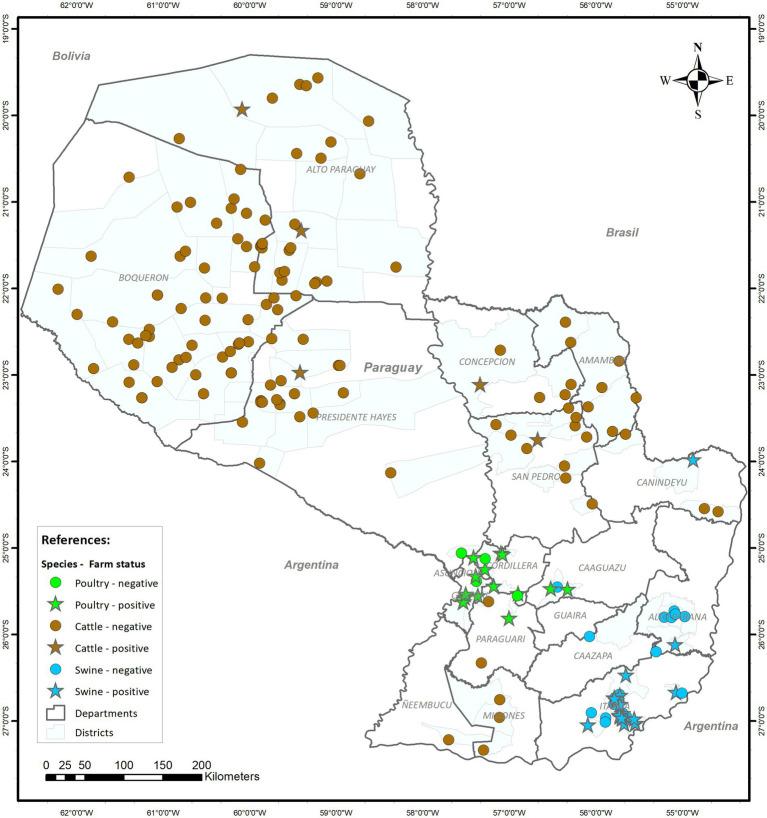
Surveillance of antimicrobial resistance (AMR) in in livestock (poultry, pig, and cattle) is crucial to maintain food safety. Given the lack of information on the situation in livestock in Paraguay, the aim of this study was to determine the most frequent serovars in poultry, pig and cattle sampled in slaughterhouses in the country in 2020-22 along with their AMR phenotypes using data from a national pilot program. Out of 1,161 samples collected from slaughtered animals originating from 189 farms nationwide, was isolated from 91/384 (23.7%) samples from poultry, 52/390 (13.3%) from pigs and 6/387 (1.6%) from cattle. Seven serovars were identified in poultry, with Heidelberg being the most frequent (82.4% of 91 isolates), while the most frequent serovars in pigs were Panama (48.1%) and Typhimurium (38.5%), and only two serovars (Cerro and Braenderup) were identified in cattle. The proportion of resistant isolates ranged from extremely high (70-83% for nalidixic acid and tetracycline) and high (25-40% for nitrofurantoin and ampicilin) to low-moderate (8-18% for cefixime, cefotaxime, amoxicillin, and trimethoprim- sulfamethoxazole) and very low-low (<6% for ciprofloxacin and gentamicin) depending on the antimicrobial. Up to 23 different resistance profiles were found, ranging from pansusceptible (18/143 isolates) to resistance to 2-7 antimicrobials (median = 2), with the predominant serovars in poultry and swine typically being resistant to ≥3 antimicrobials. These results should be backed-up with genomic analyses to determine the genetic mechanisms involved in the resistance profiles observed in order to support coordinated actions for AMR surveillance and control in the country.
监测家畜(家禽、猪和牛)的抗菌药物耐药性(AMR)对于维持食品安全至关重要。鉴于巴拉圭缺乏家畜情况的相关信息,本研究的目的是利用一项国家试点项目的数据,确定2020 - 2022年该国屠宰场采样的家禽、猪和牛中最常见的血清型及其AMR表型。在从全国189个农场的屠宰动物采集的1161份样本中,在家禽的91/384份(23.7%)样本、猪的52/390份(13.3%)样本和牛的6/387份(1.6%)样本中分离出了[具体物质未给出]。在家禽中鉴定出7种血清型,其中海德堡血清型最为常见(91株分离株中的82.4%),而猪中最常见的血清型是巴拿马型(48.1%)和鼠伤寒型(38.5%),牛中仅鉴定出两种血清型(塞罗型和布伦德鲁普型)。耐药分离株的比例从极高(萘啶酸和四环素为70 - 83%)、高(呋喃妥因和氨苄西林为25 - 40%)到低 - 中度(头孢克肟、头孢噻肟、阿莫西林和甲氧苄啶 - 磺胺甲恶唑为8 - 18%)以及极低 - 低(环丙沙星和庆大霉素<6%),具体取决于抗菌药物。发现了多达23种不同的耐药谱,范围从全敏感(18/143株分离株)到对2 - 7种抗菌药物耐药(中位数 = 2),家禽和猪中的主要血清型通常对≥3种抗菌药物耐药。这些结果应用基因组分析予以支持,以确定所观察到的耐药谱中涉及的遗传机制,从而支持该国AMR监测和控制的协调行动。

 Zotero 插件