
植物药汤剂通过NOX4/TGF-β1/SMAD3信号通路减轻肺部炎症。
and botanical drug decoction mitigates lung inflammation through NOX4/TGF-β1/SMAD3 signaling.
作者信息
Yang Zhifeng, Chang Yuqian, Zhou Tong, Sui Wenwen, Dai Ping, Wei Yuan, Wang Jia-Sheng, Zhou Jun, Wen Chengli, Zhang Haidong
机构信息
Shandong Academy of Occupational Health and Occupational Medicine, Shandong First Medical University and Shandong Academy of Medical Sciences, Jinan, Shandong, China.
Affiliated Hospital of Shandong University of Traditional Chinese Medicine, Jinan, Shandong, China.
出版信息
Front Pharmacol. 2025 Mar 26;16:1565569. doi: 10.3389/fphar.2025.1565569. eCollection 2025.
INTRODUCTION
and are botanical drugs rich in beneficial nutrients and health-promoting metabolites. Their roots can be decocted to a botanical drug decoction "Danggui Buxue Tang (DBT)," demonstrating human anti-inflammatory.
METHODS
Here, we evaluate the mitigating function of DBT on lung inflammation and early fibrosis in a rat model. The model was established by tracheal dripping of silica suspension for 28 days. Positive intervention effects of DBT were observed in a dose-dependent manner after consecutive gavage of DBT (1.9, 3.8, and 7.6 g/kg·bw/d) for 28 days and 42 days. To explore the underlying molecular mechanism. DBT metabolites were profiled using a liquid chromatograph-mass spectrometer and the Chemspider database.
RESULTS
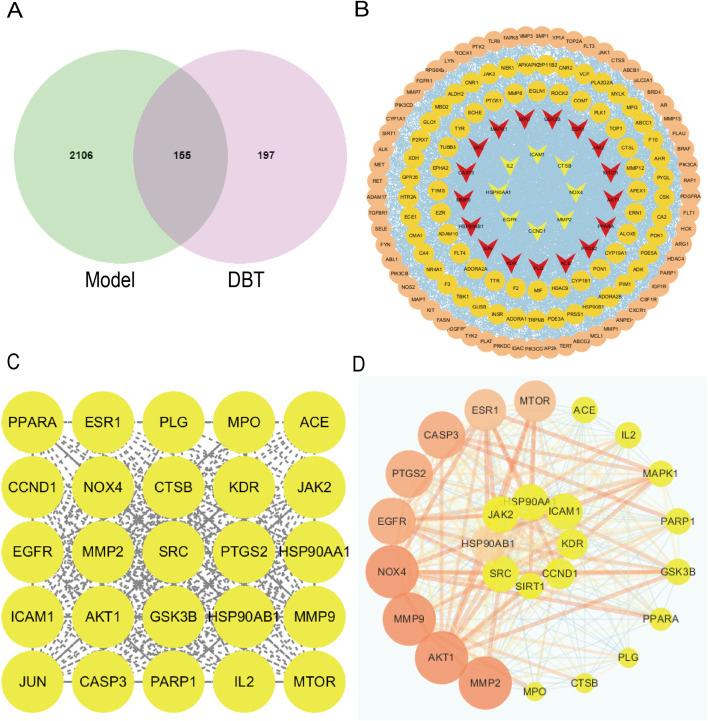
Lung inflammation and fibrosis were confirmed using functional tests and histopathologic analysis. Metabolite target analysis identified nicotinamide adenine dinucleotide phosphate (NADPH) oxidase 4 (NOX4) as a key target of DBT in regulating pulmonary fibrosis. Gene ontology (GO) analysis estimated that oxidative stress, inflammatory response, myofibroblast differentiation, and extracellular matrix (ECM) deposition were the major target pathways of DBT. KEGG analysis found that DBT might modulate pulmonary fibrosis through the transforming growth factor-β (TGF-β) pathway. GO chord and signaling pathway maps revealed that NOX4 contributes to oxidative stress, inflammatory response, and TGF-β pathway regulation. The analyses confirmed that DBT significantly reduces NOX4 protein expression, inhibits oxidative stress and inflammatory responses, and reduces TGF-β1, p-SMAD3, fibronectin 1 (FN1), and smooth muscle actin (α-SMA) protein expression.
DISCUSSION
These findings demonstrate the lung-protecting function of DBT in a rat model and identify critical target proteins associated with the underlying mechanism.
引言
[具体药物1]和[具体药物2]是富含有益营养成分和促进健康代谢物的植物药。它们的根可煎制成植物药汤剂“当归补血汤(DBT)”,具有抗炎作用。
方法
在此,我们评估DBT对大鼠模型肺部炎症和早期纤维化的缓解作用。通过气管滴注二氧化硅悬浮液28天建立模型。连续灌胃DBT(1.9、3.8和7.6 g/kg·bw/d)28天和42天后,以剂量依赖方式观察到DBT的阳性干预效果。为探究潜在的分子机制,使用液相色谱 - 质谱仪和Chemspider数据库对DBT代谢物进行分析。
结果
通过功能测试和组织病理学分析证实了肺部炎症和纤维化。代谢物靶点分析确定烟酰胺腺嘌呤二核苷酸磷酸(NADPH)氧化酶4(NOX4)是DBT调节肺纤维化的关键靶点。基因本体(GO)分析估计氧化应激、炎症反应、肌成纤维细胞分化和细胞外基质(ECM)沉积是DBT的主要靶点途径。KEGG分析发现DBT可能通过转化生长因子 - β(TGF - β)途径调节肺纤维化。GO弦图和信号通路图显示NOX4参与氧化应激、炎症反应和TGF - β途径调节。[具体分析方法]分析证实DBT显著降低NOX4蛋白表达,抑制氧化应激和炎症反应,并降低TGF - β1、p - SMAD3、纤连蛋白1(FN1)和平滑肌肌动蛋白(α - SMA)蛋白表达。
讨论
这些发现证明了DBT在大鼠模型中的肺保护功能,并确定了与潜在机制相关的关键靶蛋白。




 Zotero 插件