
模拟创伤性脑损伤和神经损伤:斑马鱼带来的见解
Modeling traumatic brain and neural injuries: insights from zebrafish.
作者信息
Murashova Lada, Dyachuk Vyacheslav
机构信息
Almazov National Medical Research Centre, Saint Petersburg, Russia.
出版信息
Front Mol Neurosci. 2025 Mar 27;18:1552885. doi: 10.3389/fnmol.2025.1552885. eCollection 2025.
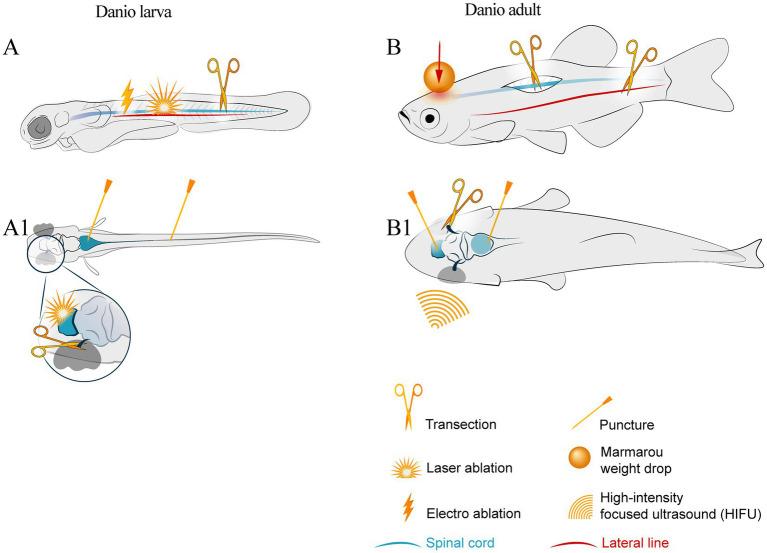
A traumatic injury to the nervous system has significant consequences for mammals, including long-term disability, loss of functions, and neuropathic pain. In contrast to mammals, zebrafish () exhibits a markedly enhanced neuroregenerative capacity, which can be attributed to the phenomenon of adult neurogenesis and to the distinctive characteristics of the inflammatory response at the injury site. The post-traumatic recovery of zebrafish under different experimental injury conditions was demonstrated in numerous studies, which has substantially advanced our understanding of the cellular and molecular mechanisms of neuroregeneration in this animal. In view of the significant differences in molecular mechanisms depending on the injury site, lesion severity, and harmful agents, selecting an appropriate model for investigations is of paramount importance. This review discusses some approaches to modeling neural injury in zebrafish and considers the effect of cellular interactions in post-traumatic neurogenesis, with focus on the animal's age and the specific damaging factor that may be used to select an optimum model for certain nervous system lesions.
神经系统的创伤性损伤对哺乳动物有重大影响,包括长期残疾、功能丧失和神经性疼痛。与哺乳动物不同,斑马鱼表现出明显增强的神经再生能力,这可归因于成体神经发生现象以及损伤部位炎症反应的独特特征。众多研究证明了斑马鱼在不同实验性损伤条件下的创伤后恢复情况,这极大地推进了我们对该动物神经再生细胞和分子机制的理解。鉴于分子机制因损伤部位、损伤严重程度和有害因素存在显著差异,选择合适的研究模型至关重要。本综述讨论了一些在斑马鱼中模拟神经损伤的方法,并考虑了细胞相互作用在创伤后神经发生中的作用,重点关注动物的年龄以及可用于为某些神经系统损伤选择最佳模型的特定损伤因素。

 Zotero 插件