
肠道准备后接受丙泊酚镇静结肠镜检查患者的液体反应性和低血压:一项前瞻性队列研究。
Fluid responsiveness and hypotension in patients undergoing propofol-based sedation for colonoscopy following bowel preparation: a prospective cohort study.
作者信息
Allen Megan L, Kluger Michael, Schneider Frank, Jordan Kaylee, Xie John, Leslie Kate
机构信息
Department of Anaesthesia and Pain Management, Royal Melbourne Hospital, Melbourne, VIC, Australia.
Department of Critical Care, Melbourne Medical School, University of Melbourne, Melbourne, VIC, Australia.
出版信息
Can J Anaesth. 2025 Apr;72(4):529-539. doi: 10.1007/s12630-025-02939-x. Epub 2025 Apr 11.
PURPOSE
Fasting and bowel preparation may deplete intravascular volume in patients undergoing colonoscopy. Nevertheless, rigorous demonstration of volume depletion and assessment of clinical consequences is lacking. We designed this study to explore the relationship between intravascular volume status and intraprocedural hypotension and to compare transthoracic echocardiography (TTE) and the ClearSight™ (Edwards Lifesciences, Irvine, CA, USA) noninvasive cardiac output monitor to measure intravascular volume status.
METHODS
We recruited adult patients undergoing elective colonoscopy following bowel preparation at the Royal Melbourne Hospital. We assessed the volume status preprocedure by taking TTE and ClearSight measurements in patients in the semirecumbent position and following passive leg raising. Patients received propofol-based sedation, and significant intraprocedural hypotension was defined as a mean arterial pressure (MAP) < 60 mm Hg. The primary outcome was the occurrence of intravascular volume depletion as assessed by a positive result in a passive leg raise test on TTE (a 15% increase in the subaortic velocity time integral).
RESULTS
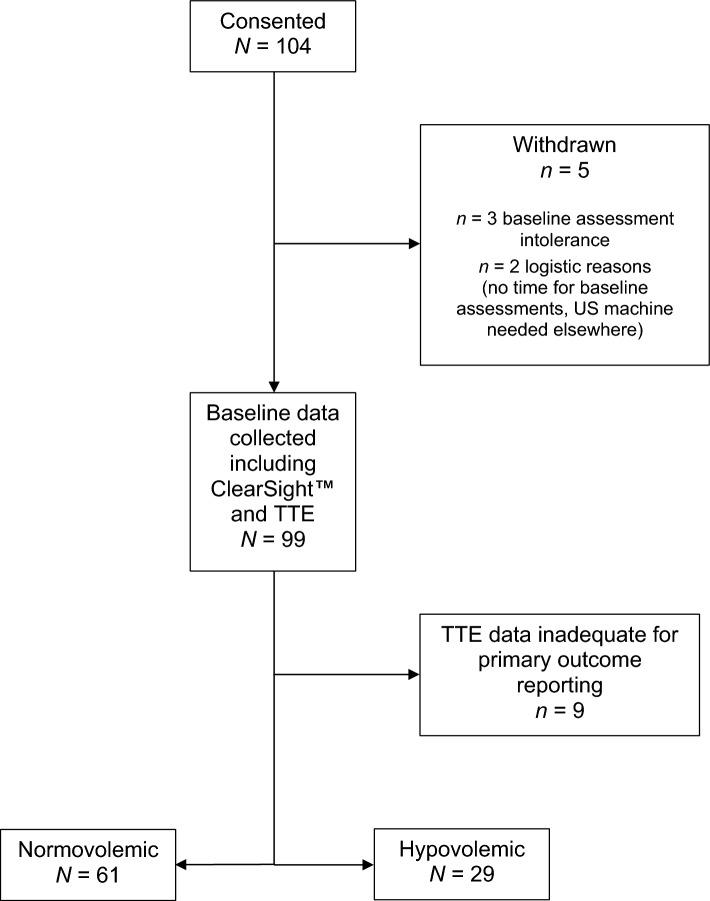
Ninety-nine patients completed the study. The primary outcome was recorded in 29 of the 90 patients with adequate TTE images (32%; 95% confidence interval, 23 to 43). There was inadequate agreement between average TTE and ClearSight measurements of stroke volume at baseline or after passive leg raising. More patients experienced significant intraprocedural hypotension in the fluid-responsive group (48%) than in the normovolemic group (21%).
CONCLUSION
Patients undergoing elective colonoscopy after bowel preparation were often fluid responsive. These patients were more likely to have significant intraprocedural hypotension than patients who were volume replete. Transthoracic echocardiography assessment of volume status cannot be readily replaced by ClearSight monitoring.
STUDY REGISTRATION
ANZCTR.org.au ( ACTRN12616000614493 ); first registered 11 May 2016.
目的
禁食和肠道准备可能会使接受结肠镜检查的患者血管内容量减少。然而,目前尚缺乏对容量减少的严格论证以及对临床后果的评估。我们设计了这项研究,以探讨血管内容量状态与术中低血压之间的关系,并比较经胸超声心动图(TTE)和ClearSight™(美国爱德华生命科学公司,加利福尼亚州欧文市)无创心输出量监测仪在测量血管内容量状态方面的效果。
方法
我们招募了在皇家墨尔本医院接受肠道准备后进行择期结肠镜检查的成年患者。在患者半卧位及被动抬腿后,通过TTE和ClearSight测量来评估术前的容量状态。患者接受丙泊酚镇静,术中显著低血压定义为平均动脉压(MAP)<60 mmHg。主要结局是通过TTE被动抬腿试验阳性结果评估的血管内容量减少的发生情况(主动脉瓣下速度时间积分增加15%)。
结果
99例患者完成了研究。在90例有足够TTE图像的患者中,29例记录到主要结局(32%;95%置信区间,23%至43%)。在基线或被动抬腿后,TTE和ClearSight测量的每搏输出量之间的一致性不足。与血容量正常组(21%)相比,液体反应性组更多患者出现术中显著低血压(48%)。
结论
接受肠道准备后进行择期结肠镜检查的患者通常对液体有反应。与血容量充足的患者相比,这些患者更有可能出现术中显著低血压。ClearSight监测不能轻易替代经胸超声心动图对容量状态的评估。
研究注册
ANZCTR.org.au(ACTRN12616000614493);首次注册于2016年5月11日。
 Zotero 插件