
由……诱导的椎间盘退变的分子机制
Molecular Mechanisms of Intervertebral Disc Degeneration Induced by .
作者信息
Yang Weichao, Xu Yude, Tan Yong, Lin Jinzhi, Chen Huan, Li Shaojin, Miao Haixiong, Ye Dongping
机构信息
Guangzhou Red Cross Hospital, Guangzhou Red Cross Hospital of Jinan University, Guangzhou, China.
Department of Pain Medicine, Guangzhou Red Cross Hospital, Guangzhou Red Cross Hospital of Jinan University, Guangzhou, China.
出版信息
Biomed Res Int. 2025 Apr 15;2025:5513856. doi: 10.1155/bmri/5513856. eCollection 2025.
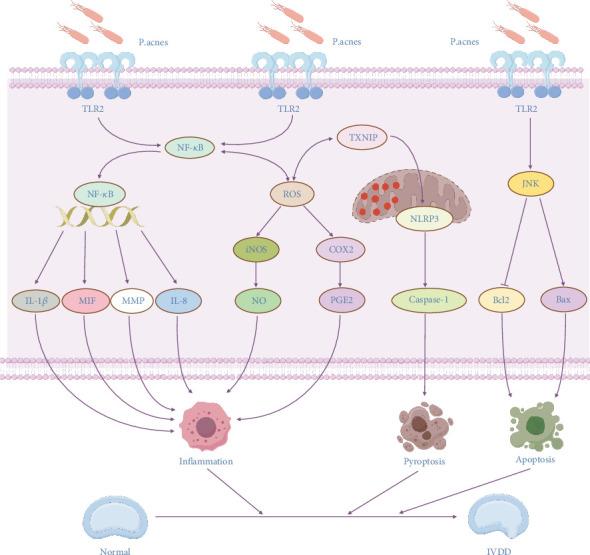
Intervertebral disc degeneration (IVDD), a prevalent degenerative disorder with substantial socioeconomic impacts, is closely linked to endplate inflammation and chronic low back pain. Its pathogenesis involves multifactorial mechanisms, including long-term chronic mechanical loading, external trauma, and hereditary factors. Emerging evidence highlights (), a gram-positive bacterium with potent proinflammatory properties, as a key contributor to IVDD progression. This review systematically analyses the latest literature on related studies, focusing on the molecular mechanisms of IVDD induced by . Three molecules play an important role in the induction of IVDD by , namely, IL-1, MIF, and MMP. In addition, induces IVDD through three core mechanisms, namely, proinflammatory (activation of TLR2, production of large amounts of ROS to promote inflammation), pyroptosis (production of large amounts of NLRP3 through the TXNIP-NLRP3 axis and the ROS-NLRP3 axis), and apoptosis (promotion of Bax and inhibition of Bcl-2 expression through the TLR2-JNK pathway). The dissection of these related important molecules and pathogenic mechanisms can lead to a better understanding of the role of in IVDD. It can provide an important theoretical basis for future research. However, the current study's lack of large-scale clinical validation, unresolved colonization controversies, and limited experimental methods are limitations. Therefore, in the future, it is still necessary to improve the relevant theories and resolve the current controversies through more advanced experimental methods and higher quality clinical studies. In conclusion, the study of -induced IVDD is promising, and further research can be conducted in the future, which is expected to develop novel therapeutic approaches for , thus effectively slowing down the development of IVDD.
椎间盘退变(IVDD)是一种普遍存在的退行性疾病,具有重大的社会经济影响,与终板炎症和慢性腰痛密切相关。其发病机制涉及多因素机制,包括长期慢性机械负荷、外部创伤和遗传因素。新出现的证据表明,[某种细菌名称],一种具有强大促炎特性的革兰氏阳性菌,是IVDD进展的关键因素。本综述系统分析了相关研究的最新文献,重点关注[某种细菌名称]诱导IVDD的分子机制。三种分子在[某种细菌名称]诱导IVDD中起重要作用,即白细胞介素-1、巨噬细胞移动抑制因子(MIF)和基质金属蛋白酶(MMP)。此外,[某种细菌名称]通过三种核心机制诱导IVDD,即促炎(激活Toll样受体2(TLR2),产生大量活性氧(ROS)以促进炎症)、细胞焦亡(通过硫氧还蛋白相互作用蛋白(TXNIP)-核苷酸结合寡聚化结构域样受体蛋白3(NLRP3)轴和ROS-NLRP3轴产生大量NLRP3)和细胞凋亡(通过TLR2-应激活化蛋白激酶(JNK)途径促进Bax表达并抑制Bcl-2表达)。剖析这些相关重要分子和致病机制可以更好地理解[某种细菌名称]在IVDD中的作用。它可以为未来的研究提供重要的理论基础。然而,目前该研究缺乏大规模临床验证、未解决的定植争议以及有限的实验方法是其局限性。因此,未来仍有必要完善相关理论,并通过更先进的实验方法和更高质量的临床研究解决当前的争议。总之,对[某种细菌名称]诱导的IVDD的研究前景广阔,未来可进一步开展研究,有望开发出针对[某种细菌名称]的新型治疗方法,从而有效减缓IVDD的发展。

 Zotero 插件