
肿瘤相关巨噬细胞在人乳头瘤病毒诱导的宫颈癌中的作用。
The role of tumor-associated macrophages in HPV induced cervical cancer.
作者信息
Chen Zeping, Zhao Binzhu
机构信息
Department of Gynecology, Chengdu Pidu District Hospital of Traditional Chinese Medicine, Chengdu, China.
出版信息
Front Immunol. 2025 Apr 8;16:1586806. doi: 10.3389/fimmu.2025.1586806. eCollection 2025.
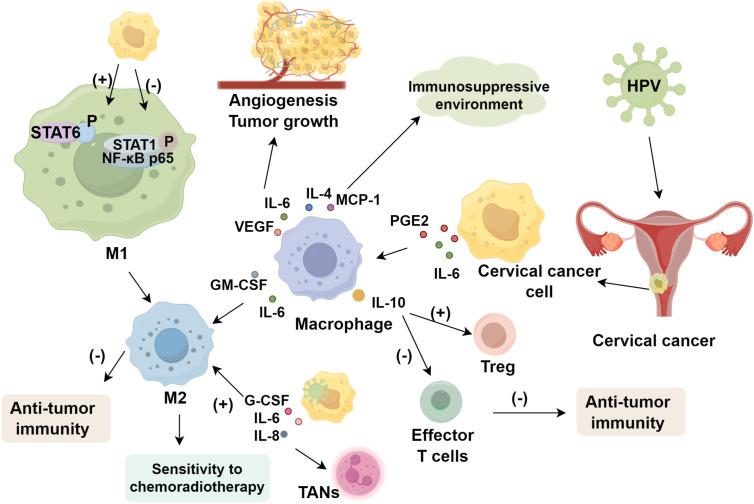
Human papillomavirus (HPV), a double-stranded DNA virus linked to various malignancies, poses a significant global public health challenge. In cervical cancer, persistent infection with high-risk HPV genotypes, particularly HPV-16 and HPV-18, initiates immune evasion mechanisms within the tumor microenvironment. The polarization of tumor-associated macrophages (TAMs) from M1 to M2 phenotypes promotes cervical carcinogenesis, metastasis, and therapeutic resistance via establishing an immunosuppressive microenvironment. This review provides a comprehensive overview of HPV-induced immune evasion pathways, including MHC downregulation, T-cell impairment, regulatory T cell induction, and cGAS-STING pathway inhibition. Furthermore, describe the pivotal role of TAMs in cervical cancer progression, focusing on their phenotypic plasticity, pro-tumoral functions, and potential as therapeutic targets. By elucidating these cellular and molecular dynamics, this review aims to support advanced research. Targeting TAM polarization through immunotherapies and nanomedicine-based strategies represents a promising strategy for enhancing patient outcomes.
人乳头瘤病毒(HPV)是一种与多种恶性肿瘤相关的双链DNA病毒,对全球公共卫生构成重大挑战。在宫颈癌中,高危HPV基因型的持续感染,尤其是HPV-16和HPV-18,会在肿瘤微环境中启动免疫逃逸机制。肿瘤相关巨噬细胞(TAM)从M1表型向M2表型的极化通过建立免疫抑制微环境促进宫颈癌的发生、转移和治疗抵抗。本综述全面概述了HPV诱导的免疫逃逸途径,包括MHC下调、T细胞损伤、调节性T细胞诱导和cGAS-STING途径抑制。此外,描述了TAM在宫颈癌进展中的关键作用,重点关注其表型可塑性、促肿瘤功能以及作为治疗靶点的潜力。通过阐明这些细胞和分子动力学,本综述旨在支持深入研究。通过免疫疗法和基于纳米医学的策略靶向TAM极化是改善患者预后的一种有前景的策略。
 Zotero 插件