
聚肌胞苷酸(Poly(I:C))佐剂与流感血凝素(HA)抗原配制的舌下疫苗在小鼠和猕猴中的安全性评估:与鼻内疫苗的比较
Safety Assessment of a Sublingual Vaccine Formulated with Poly(I:C) Adjuvant and Influenza HA Antigen in Mice and Macaque Monkeys: Comparison with Intranasal Vaccine.
作者信息
Yamamoto Tetsuro, Mitsunaga Fusako, Kotani Atsushi, Tajima Kazuki, Wasaki Kunihiko, Nakamura Shin
机构信息
Innovation Research Center, EPS Holdings, Inc., 2-1 Tsukudohachimancho, Shinjuku-ku, Tokyo 162-0815, Japan.
EP Mediate Co., Ltd., 1-8 Tsukudocho, Shinjuku-ku, Tokyo 162-0821, Japan.
出版信息
Vaccines (Basel). 2025 Feb 28;13(3):261. doi: 10.3390/vaccines13030261.
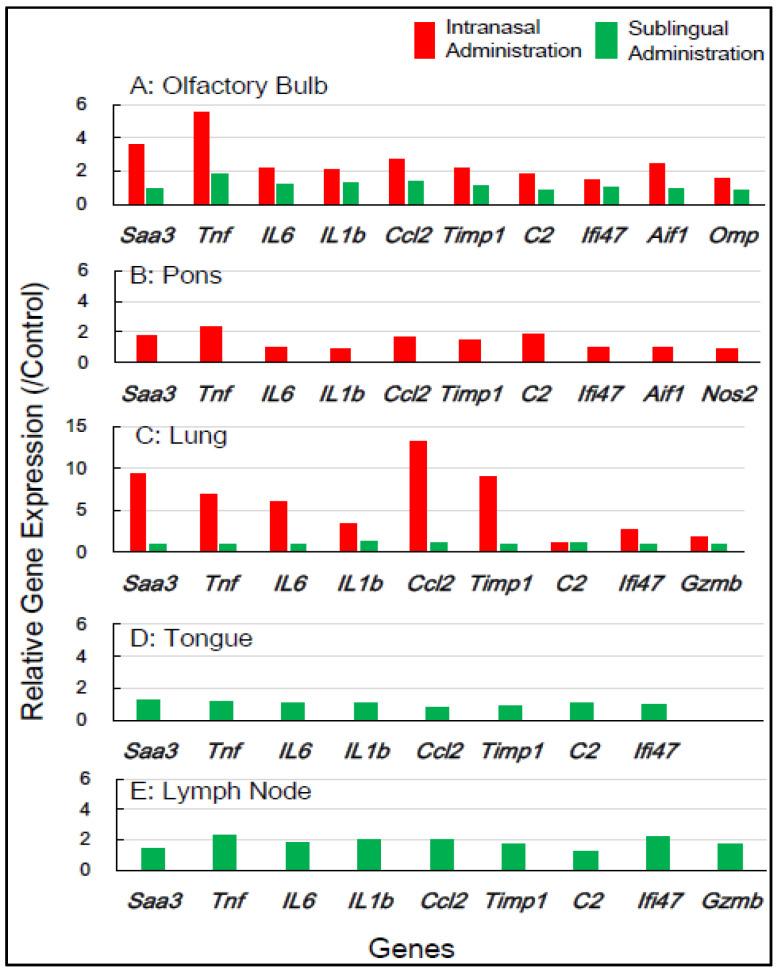
A sublingual vaccine comprising the Poly(I:C) adjuvant and influenza HA antigen was evaluated for safety in both mice and macaque monkeys relative to its intranasal counterpart. Safety was assessed in terms of harmful effects corresponding to the upregulation of the inflammation-associated genes , , , , , , , , , , , and/or in mice and , , , , , , , , and in macaques. Quantitative gene expression analyses were performed using RT-qPCR with RNA samples from four tissue types, the olfactory bulb, pons, lung, tongue, and lymph node, from both mice and macaques. In mice, the intranasally delivered vaccine markedly upregulated the inflammation-related genes in the olfactory bulb 1 day and 7 days after vaccination. The adverse effects of intranasal vaccination were also observed in macaques, albeit to a lesser extent than in mice. The intranasal vaccination also upregulated these genes in the pons of both mice and macaques. In contrast, the sublingual vaccine did not adversely affect the olfactory bulb or pons in either mice or macaques. The intranasally administered vaccine significantly upregulated these genes in the lungs only 1 day after vaccination, but not 7 days later, in both mice and macaques. We conclude that intranasal vaccination results in unfavorable side effects corresponding to upregulated inflammatory genes in the brain (olfactory bulb and pons). Sublingual vaccination, however, did not induce these side effects in either mice or macaques and was hence evaluated as safe.
一种包含聚肌胞苷酸(Poly(I:C))佐剂和流感血凝素(HA)抗原的舌下疫苗,已针对其鼻内给药对应物,在小鼠和猕猴中进行了安全性评估。安全性根据与炎症相关基因(在小鼠中为 、 、 、 、 、 、 、 、 、 、 ,在猕猴中为 、 、 、 、 、 、 、 )上调相对应的有害影响进行评估。使用逆转录定量聚合酶链反应(RT-qPCR)对来自小鼠和猕猴的四种组织类型(嗅球、脑桥、肺、舌和淋巴结)的RNA样本进行定量基因表达分析。在小鼠中,鼻内给药的疫苗在接种后1天和7天显著上调了嗅球中与炎症相关的基因。在猕猴中也观察到了鼻内接种疫苗的不良反应,尽管程度比小鼠轻。鼻内接种疫苗在小鼠和猕猴的脑桥中也上调了这些基因。相比之下,舌下疫苗对小鼠或猕猴的嗅球或脑桥均无不良影响。鼻内给药的疫苗仅在接种后1天显著上调了小鼠和猕猴肺部的这些基因,但7天后未上调。我们得出结论,鼻内接种疫苗会导致与大脑(嗅球和脑桥)中炎症基因上调相对应的不良副作用。然而,舌下接种疫苗在小鼠或猕猴中均未引发这些副作用,因此被评估为安全。




 Zotero 插件