
ESCRT机制在乙肝病毒生命周期中的作用:自噬和膜动力学在病毒致病过程中的双重作用
ESCRT Machinery in HBV Life Cycle: Dual Roles in Autophagy and Membrane Dynamics for Viral Pathogenesis.
作者信息
Li Jia, Prange Reinhild, Lu Mengji
机构信息
Institute for Virology, University Hospital Essen, University of Duisburg-Essen, 45122 Essen, Germany.
Institute for Virology, University Medical Center, Johannes Gutenberg University Mainz, 55131 Mainz, Germany.
出版信息
Cells. 2025 Apr 16;14(8):603. doi: 10.3390/cells14080603.
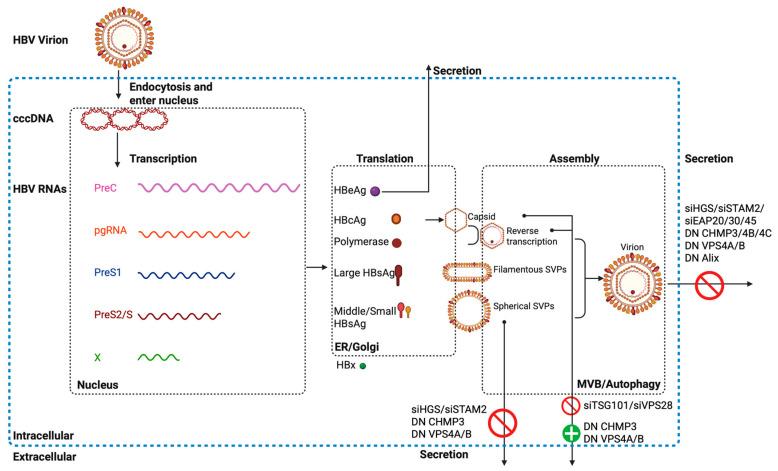
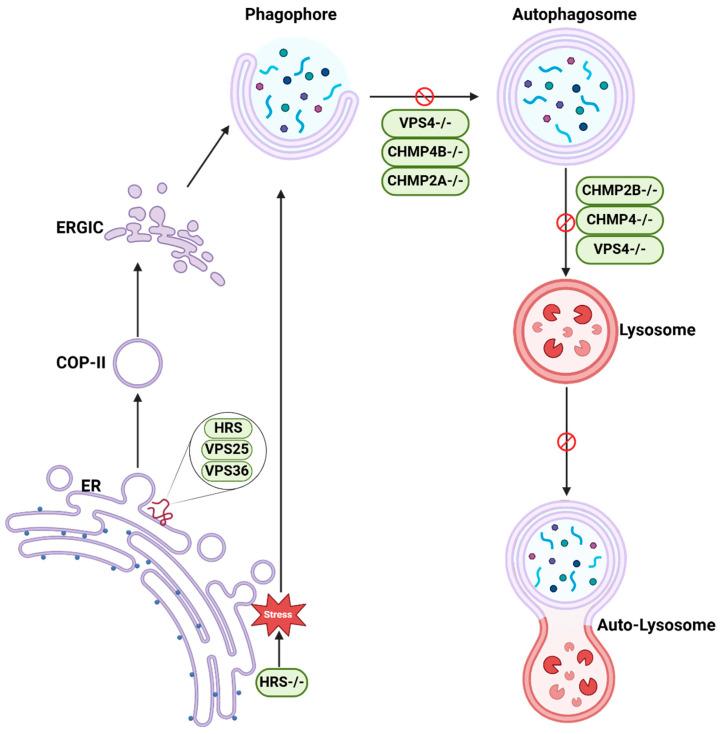
The endosomal sorting complexes required for transport (ESCRT) comprise a fundamental cellular machinery with remarkable versatility in membrane remodeling. It is multifunctional in the multivesicular body (MVB) biogenesis, exosome formation and secretion, virus budding, cytokinesis, plasma membrane repair, neuron pruning, and autophagy. ESCRT's involvement in cellular mechanisms extends beyond basic membrane trafficking. By directly interacting with autophagy-related (ATG) proteins and facilitating autophagosome-lysosome fusion, ESCRT ensures cellular homeostasis. Dysregulation in ESCRT function has been implicated in cancer, neurodegenerative disorders, and infectious diseases, underscoring its critical role in numerous pathologies. Hepatitis B virus (HBV) is an enveloped virus that exploits ESCRT and autophagy pathways for viral replication, assembly, and secretion. This review synthesizes recent mechanistic insights into ESCRT's multifaceted roles, particularly focusing on its interactions with autophagy formation and the HBV lifecycle.
转运所需的内体分选复合物(ESCRT)是一种基本的细胞机制,在膜重塑方面具有非凡的多功能性。它在多泡体(MVB)生物发生、外泌体形成与分泌、病毒出芽、胞质分裂、质膜修复、神经元修剪和自噬中具有多种功能。ESCRT参与细胞机制的范围超出了基本的膜运输。通过直接与自噬相关(ATG)蛋白相互作用并促进自噬体-溶酶体融合,ESCRT确保细胞内稳态。ESCRT功能失调与癌症、神经退行性疾病和传染病有关,凸显了其在众多病理过程中的关键作用。乙型肝炎病毒(HBV)是一种包膜病毒,利用ESCRT和自噬途径进行病毒复制、组装和分泌。本综述综合了对ESCRT多方面作用的最新机制见解,特别关注其与自噬形成和HBV生命周期的相互作用。
 Zotero 插件