
肿瘤微环境中的免疫细胞:最新进展与相互联系
Immunocytes in the tumor microenvironment: recent updates and interconnections.
作者信息
Yu Jiyao, Fu Li, Wu Rui, Che Linyi, Liu Guodong, Ran Qinwen, Xia Zhiwei, Liang Xisong, Zhao Guanjian
机构信息
Department of Ultrasound, The Second Affiliated Hospital, Chongqing Medical University, Chongqing, China.
Institute of Psychiatry, Psychology and Neuroscience, King's College London, London, United Kingdom.
出版信息
Front Immunol. 2025 Apr 14;16:1517959. doi: 10.3389/fimmu.2025.1517959. eCollection 2025.
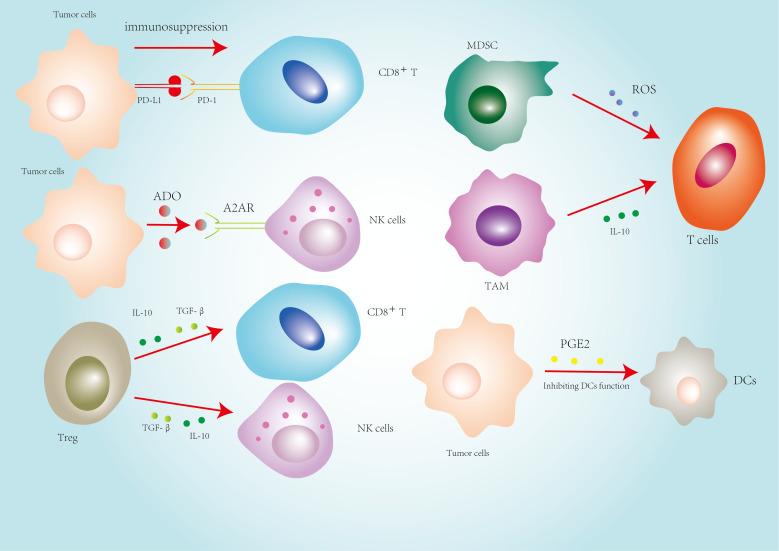
The tumor microenvironment (TME) is a complex, dynamic ecosystem where tumor cells interact with diverse immune and stromal cell types. This review provides an overview of the TME's evolving composition, emphasizing its transition from an early pro-inflammatory, immune-promoting state to a later immunosuppressive milieu characterized by metabolic reprogramming and hypoxia. It highlights the dual roles of key immunocytes-including T lymphocytes, natural killer cells, macrophages, dendritic cells, and myeloid-derived suppressor cells-which can either inhibit or support tumor progression based on their phenotypic polarization and local metabolic conditions. The article further elucidates mechanisms of immune cell plasticity, such as the M1/M2 macrophage switch and the balance between effector T cells and regulatory T cells, underscoring their impact on tumor growth and metastasis. Additionally, emerging therapeutic strategies, including checkpoint inhibitors and chimeric antigen receptor (CAR) T and NK cell therapies, as well as approaches targeting metabolic pathways, are discussed as promising avenues to reinvigorate antitumor immunity. By integrating recent molecular insights and clinical advancements, the review underscores the importance of deciphering the interplay between immunocytes and the TME to develop more effective cancer immunotherapies.
肿瘤微环境(TME)是一个复杂、动态的生态系统,肿瘤细胞在其中与多种免疫细胞和基质细胞类型相互作用。本综述概述了TME不断演变的组成,强调其从早期促炎、免疫促进状态向后期以代谢重编程和缺氧为特征的免疫抑制环境的转变。它突出了关键免疫细胞(包括T淋巴细胞、自然杀伤细胞、巨噬细胞、树突状细胞和髓源性抑制细胞)的双重作用,这些细胞可根据其表型极化和局部代谢条件抑制或支持肿瘤进展。文章进一步阐明了免疫细胞可塑性的机制,如M1/M2巨噬细胞转换以及效应T细胞和调节性T细胞之间的平衡,强调了它们对肿瘤生长和转移的影响。此外,还讨论了新兴的治疗策略,包括检查点抑制剂、嵌合抗原受体(CAR)T细胞和NK细胞疗法,以及针对代谢途径的方法,这些都是重振抗肿瘤免疫的有前景的途径。通过整合最新的分子见解和临床进展,本综述强调了解析免疫细胞与TME之间相互作用对于开发更有效的癌症免疫疗法的重要性。


 Zotero 插件