
定制个性化的热缓解策略以优化精英运动员的表现。
Customizing individual heat mitigation strategies to optimize performance in elite athletes.
作者信息
Sekiguchi Yasuki, Adams William M, Hosokawa Yuri, Benjamin Courteney L, Stearns Rebecca L, Huggins Robert A, Casa Douglas J
机构信息
Sports Performance Laboratory, Department of Kinesiology and Sport Management, Texas Tech University, Lubbock, TX, United States.
Department of Sports Medicine, United States Olympic and Paralympic Committee, Colorado Springs, CO, United States.
出版信息
Front Physiol. 2025 Apr 16;16:1380645. doi: 10.3389/fphys.2025.1380645. eCollection 2025.
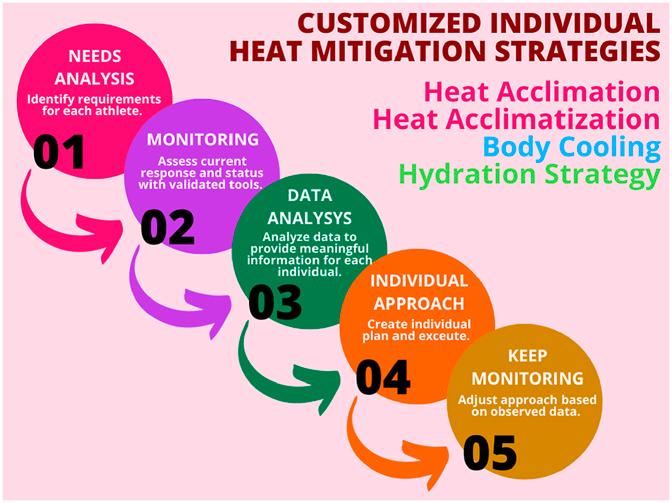
The aim of this review is twofold: 1) provide a brief discussion surrounding the interindividual variability that has been observed within the context of heat acclimation/acclimatization, body cooling, and hydration strategies, and 2) provide the reader with a practitioner-focused approach for creating individualized heat mitigation strategies. Considering individual variability for heat acclimation and heat acclimatization, various body cooling strategies, and hydration assessment/fluid replacement is important to maximize effects of these strategies, which lead to better performance and health outcomes. There are many factors to consider, and comprehensive approaches are required. The evidenced-informed decision is critical when making an individual approach, and data will help to make decisions effectively. It is important to keep adjusting the approach based on observed data as data is useful information to check if the approach is effective. Specific considerations to individualize the plan are discussed in this review.
本综述的目的有两个
1)围绕在热适应、身体降温及补水策略背景下观察到的个体间差异展开简要讨论;2)为读者提供一种以从业者为重点的方法,用于制定个性化的热缓解策略。考虑到热适应和热习服、各种身体降温策略以及水合评估/补液的个体差异,对于最大化这些策略的效果很重要,而这些策略会带来更好的表现和健康结果。有许多因素需要考虑,并且需要综合方法。在制定个性化方法时,基于证据的决策至关重要,数据将有助于有效做出决策。根据观察到的数据不断调整方法很重要,因为数据是检验方法是否有效的有用信息。本综述讨论了使计划个性化的具体考虑因素。




 Zotero 插件