
具有ETV4结合位点的远端增强子对棕色脂肪中UCP1的表达和产热至关重要。
A distal enhancer with ETV4 binding is critical for UCP1 expression and thermogenesis in brown fat.
作者信息
Xue Pengya, Holloway Nicholas, Tran Alexander, Lin Frances, Dinh Jennie, Yang Caleb, Wang Yuhui, Yi Danielle, Sul Hei Sook
机构信息
Department of Nutritional Sciences and Toxicology, University of California, Berkeley, Berkeley, California 94720, USA.
Endocrinology Program, University of California, Berkeley, Berkeley, California 94720, USA.
出版信息
Genes Dev. 2025 Jul 1;39(13-14):808-825. doi: 10.1101/gad.352748.125.
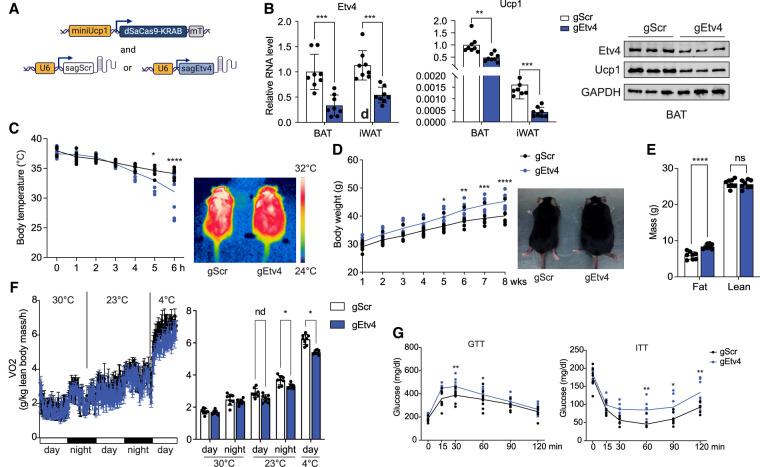
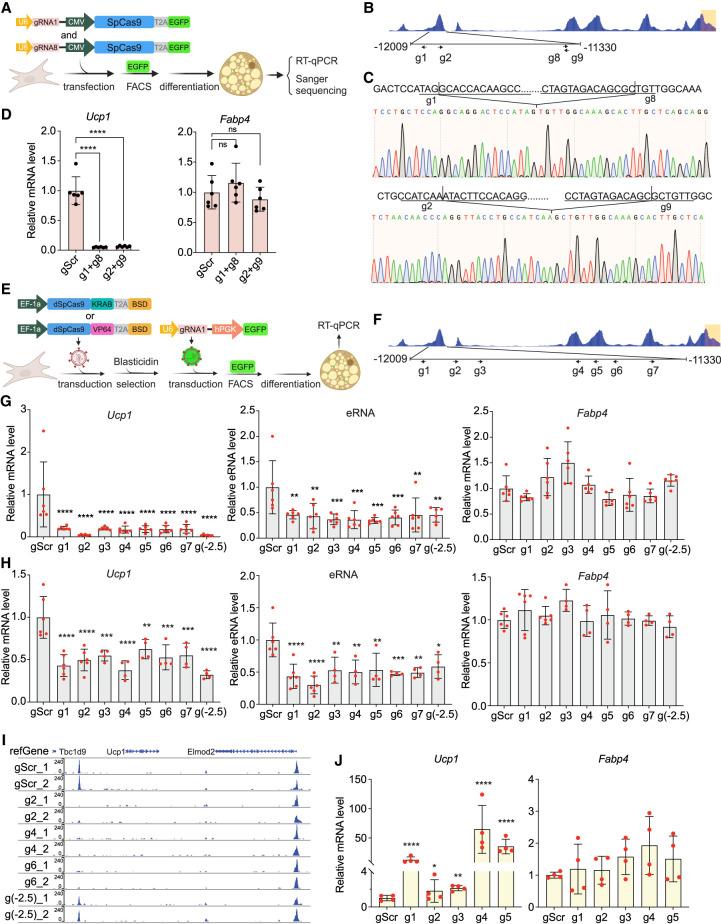
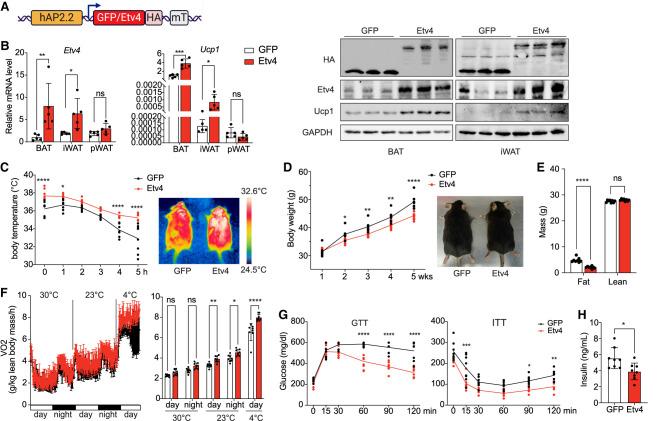
Brown adipose tissue (BAT) dissipates energy as heat in maintaining body temperature, and BAT mass inversely correlates with adiposity. During thermogenesis, BAT generates heat by uncoupling respiration through UCP1, and the -2.5 kb enhancer of gene is known to activate expression upon cold or β-adrenergic stimulation. Here, we identify a critical enhancer located at 12 kb upstream of the gene locus that functions through chromatin looping and uncover its essential role in activation and thermogenesis by CRISPR activation and CRISPR interference in mice. Importantly, we identify ETV4 as a key regulator of expression by binding the -12 kb enhancer to promote chromatin accessibility and histone acetylation. Using gain- and loss-of-function approaches, we reveal that ETV4 enhances uncoupled respiration and thermogenesis, thereby protecting mice from diet-induced obesity and insulin resistance. The -12 kb enhancer and ETV4 can be potential therapeutic targets for combating obesity and improving metabolic health.
棕色脂肪组织(BAT)在维持体温过程中以热量形式消耗能量,且BAT量与肥胖程度呈负相关。在产热过程中,BAT通过解偶联蛋白1(UCP1)使呼吸解偶联来产生热量,并且已知该基因的-2.5 kb增强子在寒冷或β-肾上腺素能刺激时可激活其表达。在此,我们鉴定出一个位于该基因座上游12 kb处的关键增强子,其通过染色质环化发挥作用,并通过在小鼠中进行CRISPR激活和CRISPR干扰揭示了其在基因激活和产热中的重要作用。重要的是,我们通过结合-12 kb增强子以促进染色质可及性和组蛋白乙酰化,鉴定出ETV4是该基因表达的关键调节因子。使用功能获得和功能丧失方法,我们发现ETV4增强了解偶联呼吸和产热,从而保护小鼠免受饮食诱导的肥胖和胰岛素抵抗。-12 kb增强子和ETV4可能是对抗肥胖和改善代谢健康的潜在治疗靶点。


 Zotero 插件