
整合免疫文库筛选与基于结构的计算设计,以开发针对新兴严重急性呼吸综合征冠状病毒2(SARS-CoV-2)变体的强效中和纳米抗体。
Integrating immune library probing with structure-based computational design to develop potent neutralizing nanobodies against emerging SARS-CoV-2 variants.
作者信息
Cerdán Lidia, Silva Katixa, Rodríguez-Martín Daniel, Pérez Patricia, Noriega María A, Esteban Martín Ana, Gutiérrez-Adán Alfonso, Margolles Yago, Corbera Juan A, Martín-Acebes Miguel A, García-Arriaza Juan, Fernández-Recio Juan, Fernández Luis A, Casasnovas José M
机构信息
Department of Microbial Biotechnology, Consejo Superior de Investigaciones Científicas (CNB-CSIC), Madrid, Spain.
Department of Macromolecular Structures, Consejo Superior de Investigaciones Científicas (CNB-CSIC), Madrid, Spain.
出版信息
MAbs. 2025 Dec;17(1):2499595. doi: 10.1080/19420862.2025.2499595. Epub 2025 May 6.
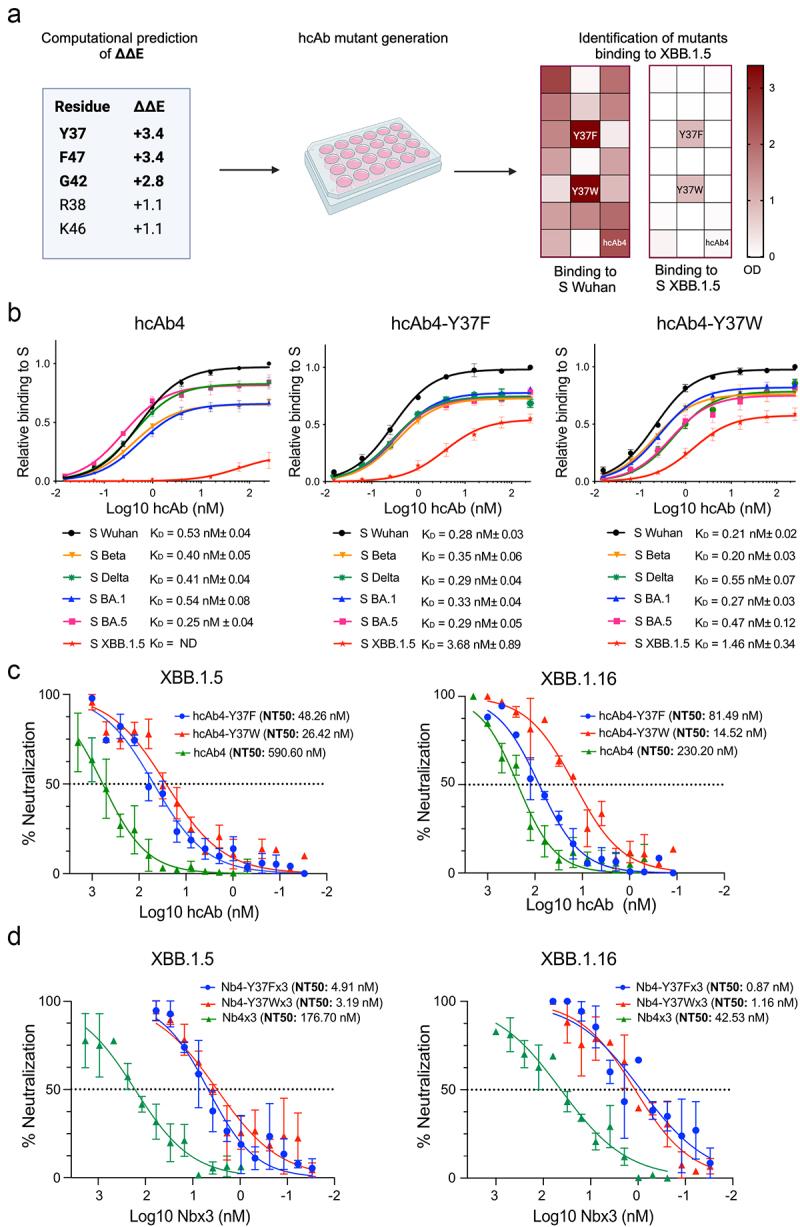
To generate antibodies (Abs) against SARS-CoV-2 emerging variants, we integrated multiple tools and engineered molecules with excellent neutralizing breadth and potency. Initially, the screening of an immune library identified a nanobody (Nb), termed Nb4, specific to the receptor-binding domain (RBD) of the Omicron BA.1 variant. A Nb4-derived heavy chain antibody (hcAb4) recognized the spike (S) of the Wuhan, Beta, Delta, Omicron BA.1, and BA.5 SARS-CoV-2 variants. A high-resolution crystal structure of the Nb4 variable (VHH) domain in complex with the SARS-CoV-2 RBD (Wuhan) defined the Nb4 binding mode and interface. The Nb4 VHH domain grasped the RBD and covered most of its outer face, including the core and the receptor-binding motif (RBM), which was consistent with hcAb4 blocking RBD binding to the SARS-CoV-2 receptor. In mouse models, a humanized hcAb4 showed therapeutic potential and prevented the replication of SARS-CoV-2 BA.1 virus in the lungs of the animals. , hcAb4 neutralized Wuhan, Beta, Delta, Omicron BA.1, and BA.5 viral variants, as well as the BQ.1.1 subvariant, but showed poor neutralization against the Omicron XBB.1.5. Structure-based computation of the RBD-Nb4 interface identified three Nb4 residues with a reduced contribution to the interaction with the XBB.1.5 RBD. Site-saturation mutagenesis of these residues resulted in two hcAb4 mutants with enhanced XBB.1.5 S binding and virus neutralization, further improved by mutant Nb4 trimers. This research highlights an approach that combines library screening, Nb engineering, and structure-based computational predictions for the generation of SARS-CoV-2 Omicron-specific Abs and their adaptation to emerging variants.
为了产生针对严重急性呼吸综合征冠状病毒2(SARS-CoV-2)新出现变体的抗体(Abs),我们整合了多种工具并设计了具有出色中和广度和效力的分子。最初,对一个免疫文库的筛选鉴定出一种纳米抗体(Nb),称为Nb4,它对奥密克戎BA.1变体的受体结合域(RBD)具有特异性。一种源自Nb4的重链抗体(hcAb4)识别武汉、贝塔、德尔塔、奥密克戎BA.1和BA.5 SARS-CoV-2变体的刺突(S)蛋白。Nb4可变(VHH)结构域与SARS-CoV-2 RBD(武汉株)复合物的高分辨率晶体结构确定了Nb4的结合模式和界面。Nb4 VHH结构域抓住RBD并覆盖其大部分外表面,包括核心和受体结合基序(RBM),这与hcAb4阻断RBD与SARS-CoV-2受体结合一致。在小鼠模型中,一种人源化hcAb4显示出治疗潜力,并阻止了SARS-CoV-2 BA.1病毒在动物肺部的复制。hcAb4中和了武汉、贝塔、德尔塔、奥密克戎BA.1和BA.5病毒变体以及BQ.1.1亚变体,但对奥密克戎XBB.1.5的中和效果较差。基于结构的RBD-Nb4界面计算确定了三个对与XBB.1.5 RBD相互作用贡献降低的Nb4残基。对这些残基进行位点饱和诱变产生了两个与XBB.1.5 S结合增强且病毒中和能力增强的hcAb4突变体,突变体Nb4三聚体进一步改善了这种能力。这项研究突出了一种结合文库筛选、Nb工程和基于结构的计算预测的方法,用于生成针对SARS-CoV-2奥密克戎变体的抗体及其对新出现变体的适应性。


 Zotero 插件