
注意年龄差距:扩大小鼠mRNA疫苗测试的年龄范围
Mind the Age Gap: Expanding the Age Window for mRNA Vaccine Testing in Mice.
作者信息
Hussain Muattaz, Ferguson-Ugorenko Agata, Macfarlane Rebecca, Orr Natalie, Clarke Samuel, Wilkinson Michael J A, Horan Linda, Perrie Yvonne
机构信息
Strathclyde Institute of Pharmacy and Biomedical Sciences, 161 Cathedral St., University of Strathclyde, Glasgow G4 0RE, UK.
Cytiva, 1055 Vernon Drive, Vancouver, BC V6A 3P4, Canada.
出版信息
Vaccines (Basel). 2025 Mar 30;13(4):370. doi: 10.3390/vaccines13040370.
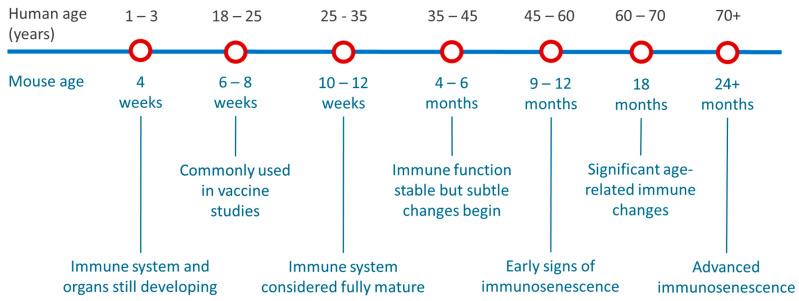
BACKGROUND/OBJECTIVES: Murine models play a key role in guiding formulation and immunogenicity studies across various vaccine platforms, including mRNA-based vaccines. Typically, a narrow age range (6 to 8 weeks) is used in these studies. Here, we investigated whether widening this age range could provide greater flexibility in experimental design without impacting pre-clinical outcomes.
METHODS
To achieve this, we evaluated two commonly used lipid nanoparticle (LNP) formulations (based on SM102 and ALC-0315 ionizable lipids) containing either firefly luciferase or ovalbumin mRNA in female BALB/c mice aged 4, 8, and 16 weeks. LNPs were prepared and purified via microfluidics, and their size, polydispersity, zeta potential, and encapsulation efficiency were measured. Mice were injected intramuscularly, and the in vivo bioluminescence and antibody titers were measured to evaluate mRNA expression profiles and immunogenicity across the three age groups.
RESULTS
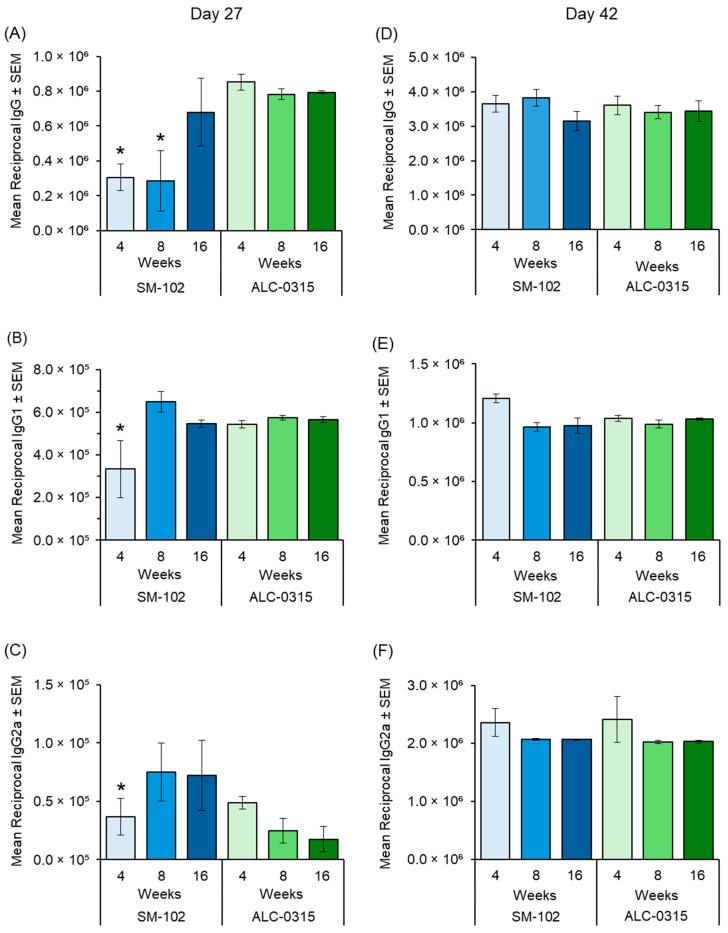
Our findings show that the 4-week-old mice exhibited higher protein expression following mRNA administration compared to the older groups; however, no significant differences were observed between the 8- and 16-week-old mice. Despite the initial higher protein expression, the antibody responses after the prime dose were lower in the 4-week-old mice compared to the other two groups. However, following the booster dose, antibody levels were comparable across all three age groups.
CONCLUSIONS
By identifying a broader age range window, we provide greater flexibility in study design, enhance data comparability across studies, and promote more efficient use of animal resources, all while maintaining reliable and representative results in these murine models.
背景/目的:小鼠模型在指导包括基于mRNA的疫苗在内的各种疫苗平台的配方和免疫原性研究中发挥着关键作用。通常,这些研究使用的年龄范围较窄(6至8周)。在此,我们研究了扩大这个年龄范围是否能在不影响临床前结果的情况下为实验设计提供更大的灵活性。
方法
为实现这一目标,我们在4周龄、8周龄和16周龄的雌性BALB/c小鼠中评估了两种常用的脂质纳米颗粒(LNP)配方(基于SM102和ALC-0315可电离脂质),其分别包含萤火虫荧光素酶或卵清蛋白mRNA。通过微流控技术制备并纯化LNP,并测量其大小、多分散性、zeta电位和包封效率。小鼠通过肌肉注射给药,并测量体内生物发光和抗体滴度,以评估三个年龄组的mRNA表达谱和免疫原性。
结果
我们的研究结果表明,与年龄较大的组相比,4周龄小鼠在给予mRNA后表现出更高的蛋白质表达;然而,在8周龄和16周龄小鼠之间未观察到显著差异。尽管最初蛋白质表达较高,但4周龄小鼠在初次给药后的抗体反应低于其他两组。然而,在加强剂量后,所有三个年龄组的抗体水平相当。
结论
通过确定更宽的年龄范围窗口,我们在研究设计中提供了更大的灵活性,提高了不同研究之间的数据可比性,并促进了动物资源的更有效利用,同时在这些小鼠模型中保持了可靠且具有代表性的结果。


 Zotero 插件